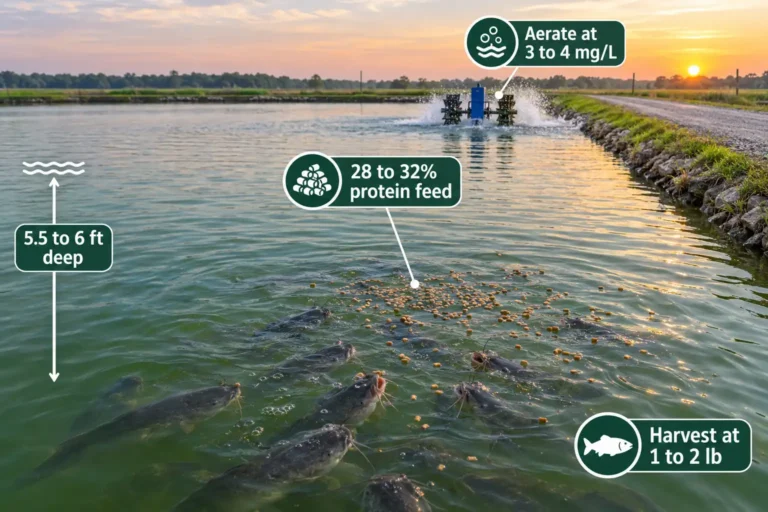
Channel Catfish vs Blue Catfish: Growth, Harvest, and Hybrid Facts
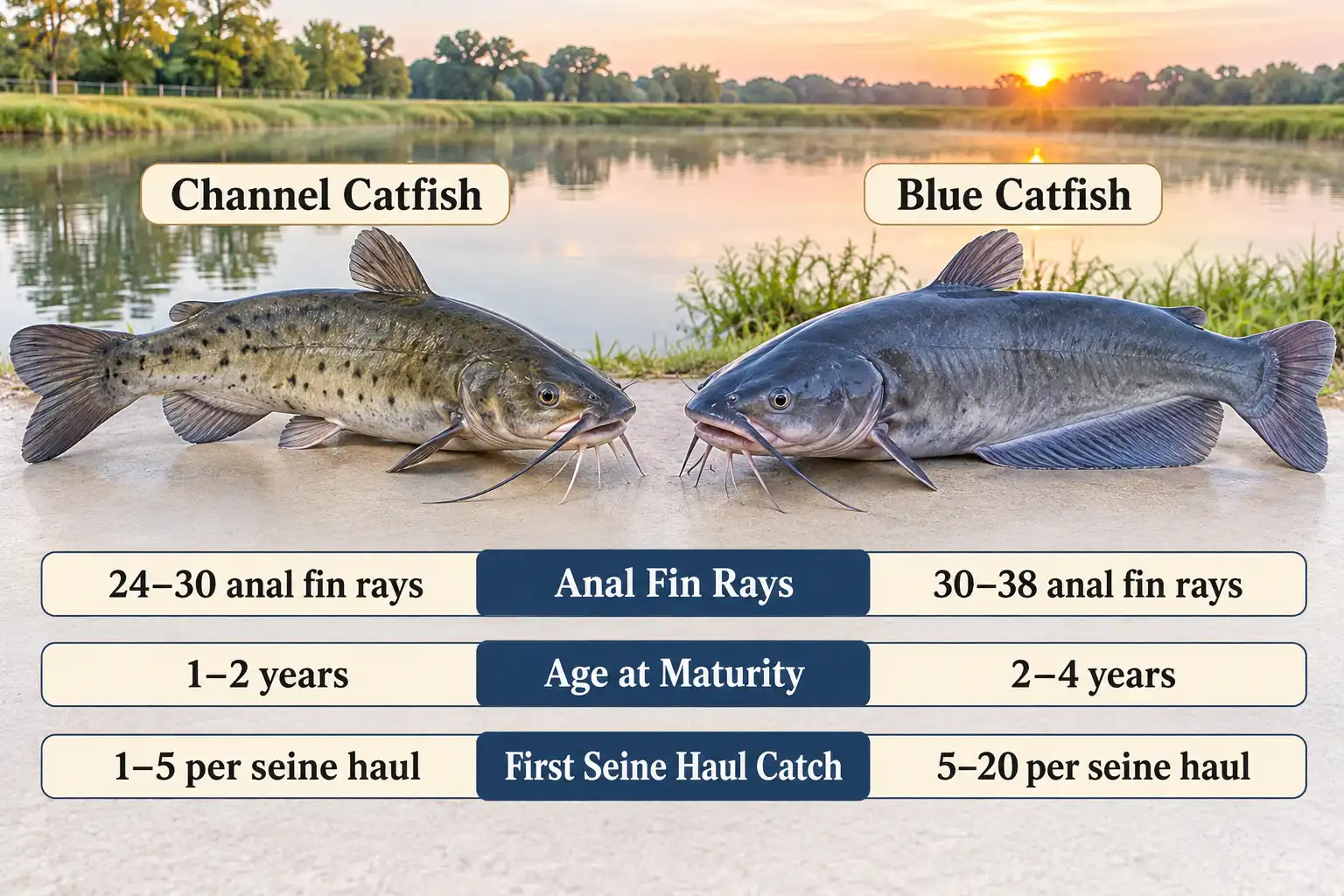
Channel catfish built the US catfish farming industry, and blue catfish matter mainly as the sire of the hybrid that now fills many Southern ponds. Set side by side, channel catfish vs blue catfish differ on growth, survival, harvest ease, and processing yield.
Channel catfish vs blue catfish comes down to trade-offs. Channel catfish spawn readily and mature in 2 to 3 years. Blue catfish seine more easily and resist some diseases but need about 5 years to mature. Hybrids blend both.
Channel Catfish vs Blue Catfish at a Glance
Channel catfish and blue catfish share the genus Ictalurus, but they behave differently in a farm pond. This table pulls the main extension and pond trial figures into one place, with the source for each row.
| Trait | Channel catfish | Blue catfish | Source |
|---|---|---|---|
| Scientific name | Ictalurus punctatus | Ictalurus furcatus | SRAC 190 |
| Anal fin rays | 24 to 26 (SRAC); 24 to 30 (MSU) | 30 to 36 | SRAC 190, Mississippi State |
| Swim bladder | One heart-shaped chamber | Two lobes | SRAC 190 |
| Age at sexual maturity | At least 3 years (SRAC); 2 to 3 years (ARS) | At least 5 years | SRAC 190, USDA ARS |
| First seine haul catch, food-size fish | 31% (HS-5 strain) | 94% (D&B strain) | Auburn University |
| Net production, high-oxygen ponds | About 5,940 lb per acre | About 5,940 lb per acre | USDA ARS |
| Net production, low-oxygen ponds | About 4,930 lb per acre | About 6,140 lb per acre | USDA ARS |
| Food-size weight, mixed-group trial | 1.26 lb (NWAC103 strain) | 0.87 lb | Auburn University |
| Native range | Gulf States and Mississippi Valley | Lower and middle Mississippi basin, Rio Grande | SRAC 180, USGS |
The production rows come from separate trials. So compare across each row, not down a column. The sections below explain each figure and where the sources disagree.
How to Tell Channel and Blue Catfish Apart
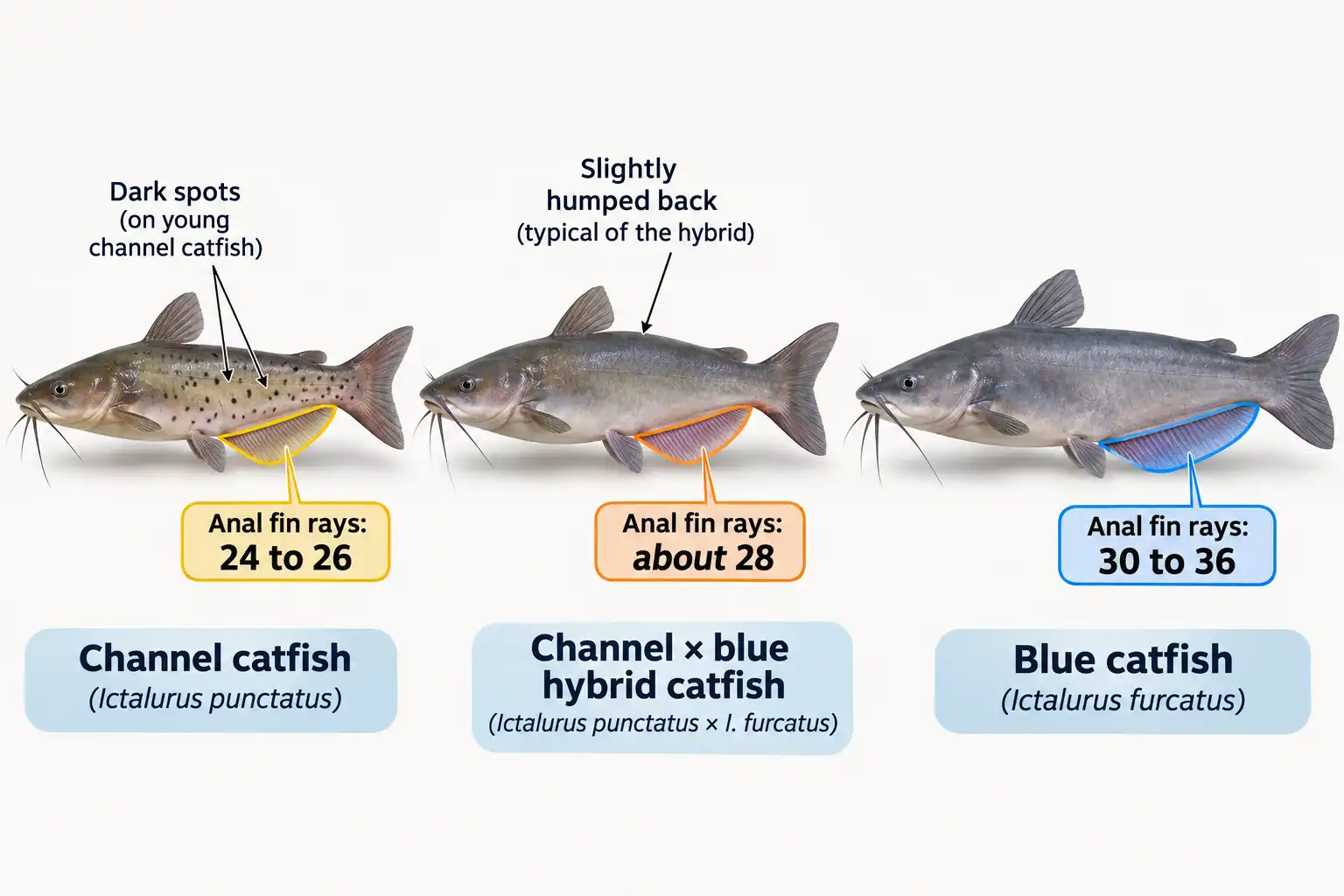
Count the anal fin rays first. SRAC Publication 190 puts channel catfish at 24 to 26 rays and blue catfish at 30 to 36. The channel × blue hybrid usually has 28. However, Mississippi State University Extension gives channel catfish a wider range of 24 to 30 rays on a rounded fin. As a result, a count in the high 20s doesn’t settle the question alone.
Spots help with young fish. Mississippi State University Extension notes that channel catfish carry irregular dark spots on their sides. Those spots often fade once a channel catfish passes about 1 pound.
Body shape is the third clue. SRAC Publication 190 describes the hybrid as humped like its blue catfish sire, with a small head and sharp spines. At processing, the swim bladder also differs: one heart-shaped chamber in channel catfish and two lobes in blue catfish.
Identification matters on a working farm. You may need to check a delivery of hybrid fingerlings or sort a mixed pond. Some states also regulate blue catfish, so confirm the species before you stock.
Which Grows Faster in Ponds?
Improved channel catfish strains usually outgrow pure blue catfish, and the hybrid tends to beat both. Still, strain and pond conditions shape the gap.
Auburn University reared four groups together at commercial densities in a 2008 study. At the food-fish stage, average weights were:
- C×B hybrid from NWAC103 channel catfish dams: 1.41 pounds
- NWAC103 channel catfish: 1.26 pounds
- Kansas Select 21 channel catfish: 1.13 pounds
- Blue catfish: 0.87 pound
Production put the hybrid first at about 7,700 pounds per acre and blue catfish last at about 4,090. Kansas Select 21 channel catfish netted about 5,575 pounds per acre. NWAC103 channel catfish netted about 4,640, partly because fewer survived.
USDA Agricultural Research Service (ARS) trials at Stoneville, Mississippi, found no gap at all. Each pond covered about 1 acre, and dissolved oxygen stayed above 4.3 mg/L. There, an unselected commercial channel catfish strain and D&B blue catfish each gained about 1.46 pounds per fish. Both netted about 5,940 pounds per acre.
The results answer different questions. Auburn’s mixed ponds faced disease outbreaks, while each ARS pond held one species in high-oxygen water. Strain matters too, since SRAC Publication 190 notes that some pure strains outgrew hybrids in certain experiments.
Scaled to a 5-acre pond, Auburn’s yields come to about 38,500 pounds of hybrids. The same pond would give about 23,200 pounds of NWAC103 channel catfish or 20,400 pounds of blue catfish. Treat those as trial results, not a forecast.
Which Survives Disease Better?
Fish health note: These figures compare species. They don’t diagnose sick fish. If catfish go off feed or start dying, check dissolved oxygen first. Then call your extension aquaculture specialist or a fish health diagnostic lab. Report heavy, unexplained losses to your state veterinarian or state aquatic animal health official.
Blue catfish and the hybrid both resist several diseases better than channel catfish. USDA ARS reports that blue catfish resist enteric septicemia of catfish (ESC) better than channel catfish. The same holds for proliferative gill disease and channel catfish virus. ARS also rates blue catfish as more resistant to environmental nitrite, the cause of brown blood disease.
Similarly, SRAC Publication 190 rates the hybrid above channel catfish against columnaris, ESC, and Aeromonas. Ich and channel catfish virus round out its list.
The Auburn growth trial above also ran through natural ESC outbreaks. Survival looked like this:
| Group | Fingerling survival | Food-fish survival |
|---|---|---|
| C×B hybrid (NWAC103 dams) | 100% | 88.7% |
| Blue catfish | 72.9% | 76.3% |
| Kansas Select 21 channel catfish | 43.5% | 82.7% |
| NWAC103 channel catfish | 25.7% | 60.0% |
Notice that Kansas Select 21 channel catfish outlived blue catfish at the food-fish stage. So strain choice can matter as much as species.
SRAC Publication 190 also summarizes 30 years of Auburn research. Hybrid fingerlings averaged 80 to 85 percent survival, and hybrid food fish 90 percent. By contrast, channel catfish fingerlings averaged 50 to 60 percent and food-size channel catfish about 70 percent.
Resistance is not immunity, though. Vaccination, biosecurity, and feeding management still apply to every group.
Which Handles Low Oxygen Better?
Blue catfish held up better in USDA ARS low-oxygen ponds. From June through September, average daily minimum oxygen ran 2.45 mg/L in the blue catfish ponds. The channel catfish ponds averaged 2.62 mg/L. Even so, blue catfish netted about 6,140 pounds per acre, against about 4,930 for channel catfish.
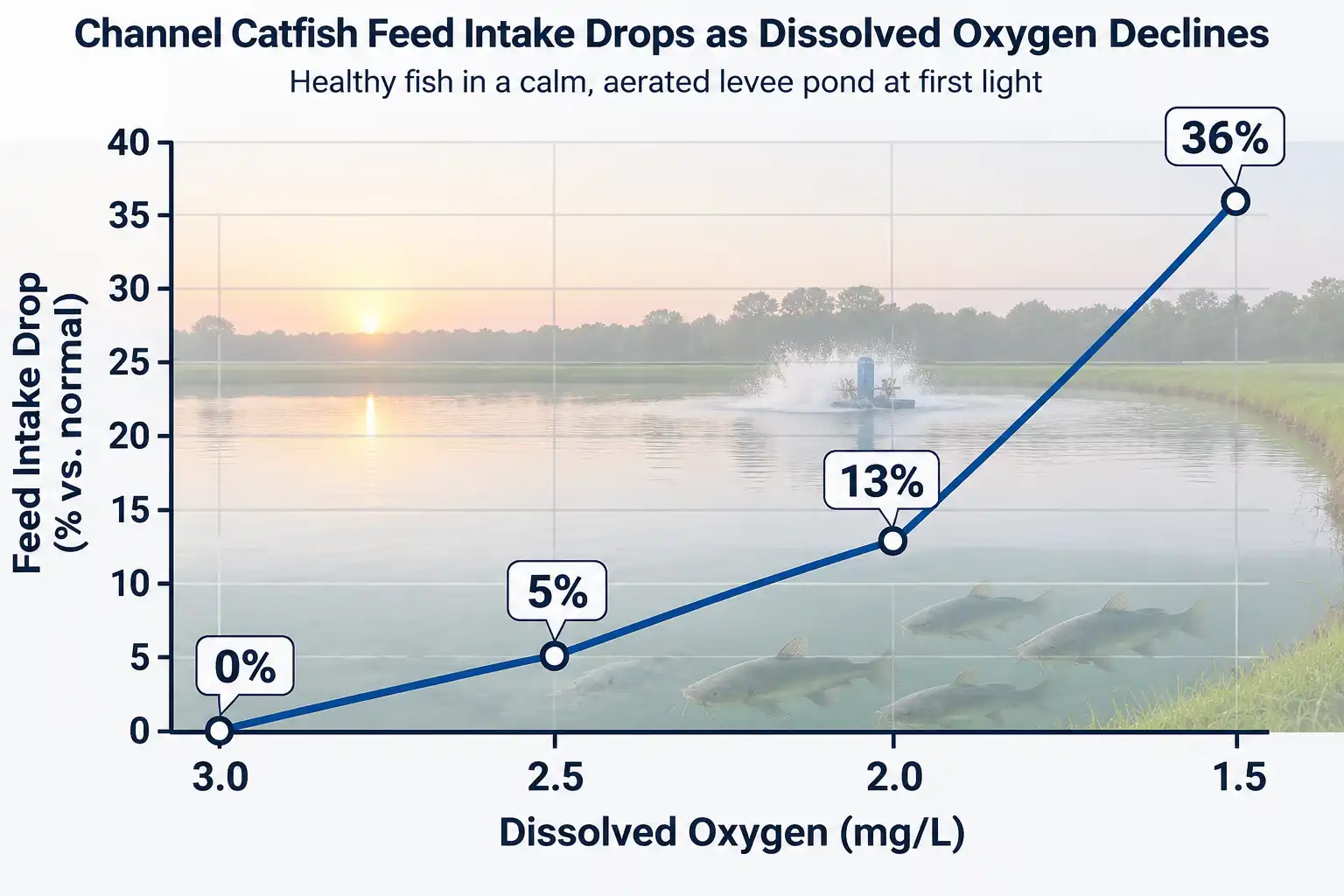
Feed intake explains much of the gap. ARS found that channel catfish ate 5 percent less at 2.5 mg/L and 13 percent less at 2.0 mg/L. At 1.5 mg/L, intake fell 36 percent. Above about 3.0 mg/L, oxygen had no significant effect on feed intake or growth in either species.
An older figure sets a stricter bar. SRAC Publication 180, from 1988, puts the lethal level for channel catfish near 1 ppm. It also notes reduced growth below 4 ppm. The two figures answer different questions. SRAC’s 4 ppm is a general growth guide. ARS’s 3 mg/L comes from measured feed intake in later pond trials.
Neither species replaces aeration. Watching oxygen levels before dawn and running aerators on time protects any catfish crop.
Which Is Easier to Seine?
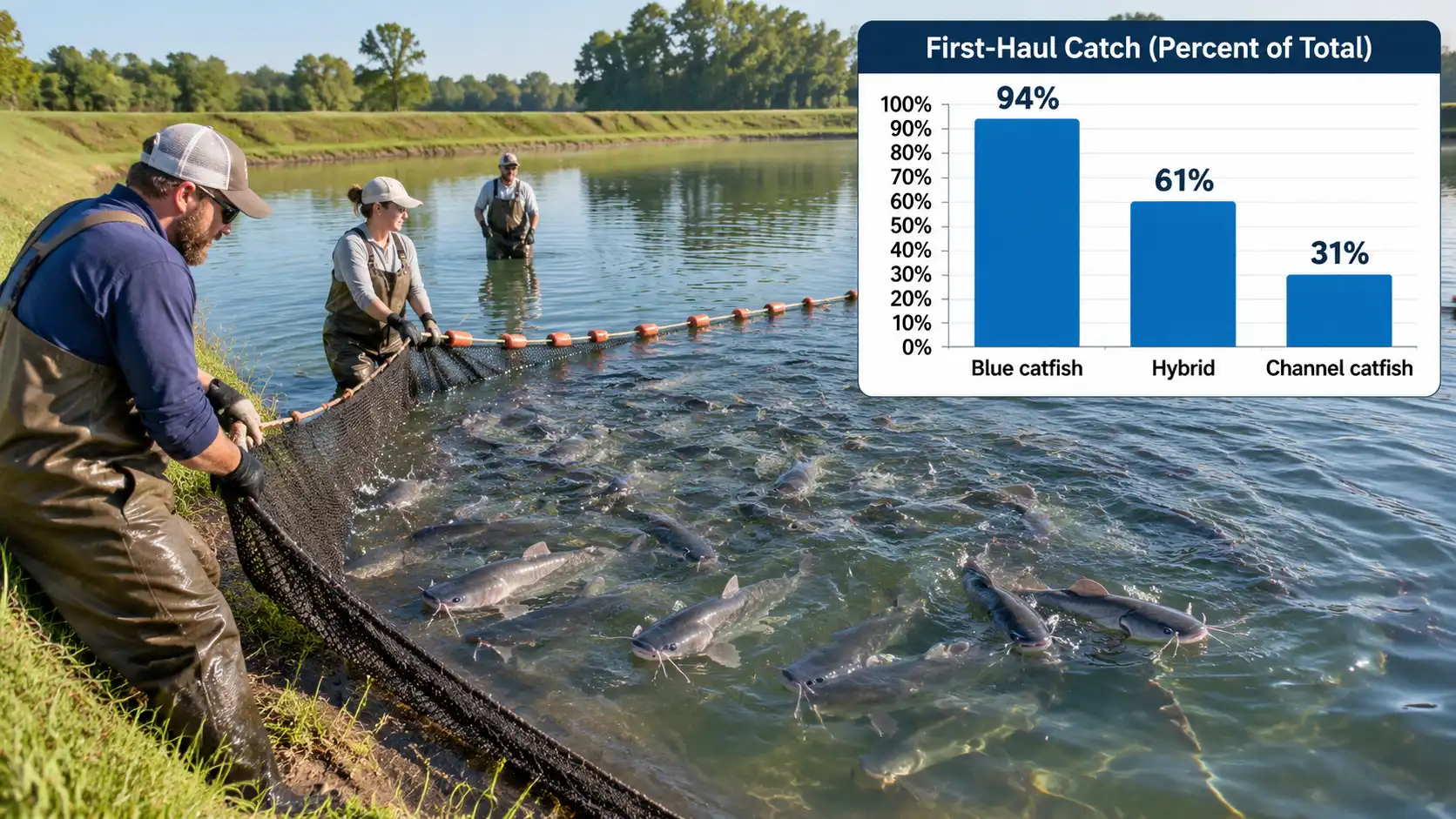
Blue catfish are far easier to seine than channel catfish. Auburn University ran a 277-day pond trial at about 5,060 fish per acre. Its first seine haul caught 94 percent of D&B blue catfish. The same haul caught 61 percent of HS-5 hybrids and only 31 percent of HS-5 channel catfish.
SRAC Publication 190 tells the same story for hybrids. It rates them two to three times easier to seine than channel catfish. In practice, two or three hauls take nearly all hybrids, while channel catfish need five or more. USDA ARS adds that blue catfish often come out in one haul. They likely hold in midwater rather than near the bottom.
Take a 10-acre pond stocked at your rate of 5,000 fish per acre, or 50,000 fish. At Auburn’s first-haul rates, one pass would catch about 47,000 blue catfish, 30,500 hybrids, or 15,500 channel catfish.
Size uniformity follows a similar pattern. Auburn found D&B blue catfish more uniform than NWAC103 channel catfish. SRAC Publication 190 places the hybrid between them.
Hybrids bring one harvest problem of their own. Their small heads and sharp spines can wedge in traditional graders. SRAC Publication 190 points to 1-inch mesh seines and side-panel graders instead. The basics of seining a levee pond apply to all three.
How Feed Conversion Compares
Pure channel catfish and blue catfish convert feed at similar rates, while the hybrid converts better. Auburn’s 277-day trial recorded a mean feed conversion ratio (FCR) of 1.62. The channel, blue, and hybrid groups showed no significant difference. Meanwhile, USDA ARS recorded an FCR of 2.26 for both channel and blue catfish in its high-oxygen ponds.
The two trials disagree on the level but agree on the ranking: the pure species matched each other. Pond size, season length, strains, and feeding methods all differed between them. So use the range rather than an average.
Carried through to a crop, adding 5,000 pounds of channel or blue catfish weight takes:
- About 8,100 pounds of feed, or 162 fifty-pound bags, at Auburn’s FCR of 1.62
- About 11,300 pounds of feed, or 226 fifty-pound bags, at the ARS FCR of 2.26
For hybrids, SRAC Publication 190 reports feed conversion 10 to 15 percent better than channel catfish in experiments. On farms, the gain runs 10 to 20 percent. Now apply that to your own records. If your channel catfish ponds run an FCR of 2.0, hybrids would land near 1.6 to 1.8. On 5,000 pounds of gain, feed drops from 10,000 pounds to 8,000 to 9,000. That is 20 to 40 fewer bags.
Processing Yield
Hybrids give the most meat per pound of live fish, mainly because their heads are smaller. In Auburn’s 277-day seining trial, heads made up 17.0 and 16.5 percent of body weight in the two hybrid groups. Their channel catfish parents carried heads of 20.8 and 19.1 percent.
Dress-out followed. Headed and gutted with skin on, the hybrids dressed out at 72.1 and 71.8 percent. Their channel catfish parents reached 67.4 and 69.6 percent. Skin-on fillet yield, however, averaged about 50.6 percent with no significant difference across all five groups, D&B blue catfish included.
USDA ARS adds that blue catfish give a greater headed, gutted, and skinned yield than channel catfish. Blue catfish shank fillets run slightly smaller, though, and nuggets larger. ARS gives no percentages for those differences.
Take a load of 10,000 pounds of live fish. At Auburn’s rates, HS-5 hybrids dress out to about 7,210 pounds and HS-5 channel catfish to about 6,740. That is roughly 470 more pounds of product from the same live weight.
All three belong to the order Siluriformes. So channel, blue, and hybrid catfish all fall under USDA Food Safety and Inspection Service rules. Those rules have been fully in force since 2017.
Why Few Farms Raise Pure Blue Catfish
Time is the biggest hurdle. SRAC Publication 190 says blue catfish usually mature at 5 years or older. Channel catfish mature at 3 years or older. USDA ARS gives about 5 years for blue catfish and 2 to 3 years for channel catfish. That means two or more extra years of feeding broodstock before the first spawn.
Handling is the second hurdle. ARS notes that blue catfish tolerate handling poorly, especially in warm water, and carry sharper pectoral spines. Growth is the third: in Auburn’s mixed-group trial, blue catfish were the smallest at harvest.
So most blue catfish on US farms serve as sires for hybrid production. ARS notes that farms need blue catfish mainly as breeders, and producers often hold surplus fish.
Published research on pure blue catfish as a food fish is also thin. The head-to-head pond trials cited here date from 2008 to 2012. Each tested only one or two blue catfish strains, such as D&B or a Rio Grande × D&B cross. Newer strains haven’t been compared in the same way.
So ask any supplier what independent trial data backs its growth claims. Treat supplier figures as the supplier’s own.
Where the Hybrid Fits
The C×B hybrid is a cross between a female channel catfish and a male blue catfish. Mississippi State University Extension calls it the most common catfish hybrid. It is easier to produce than the reverse cross and performs better. Mississippi State also estimates that almost 50 percent of US catfish production comes from hybrids. The page gives no year for that estimate.
That share sits inside a shrinking industry footprint. USDA NASS reported 2025 US catfish sales of $394 million, up 1 percent from 2024. Water surface acres in catfish production fell 8 percent to 48,115 acres as of January 1, 2026. Mississippi, Alabama, Arkansas, and Texas accounted for 96 percent of sales.
Economics favor the hybrid in published work, with limits. A 2012 Mississippi State research report cites economic analyses showing hybrid fingerling and food fish production generally more profitable than channel catfish. That result held at moderate feed prices, even though hybrid fry and fingerlings cost more. Feed and fingerling prices vary by farm and by year. So run the numbers with your own costs.
How Hybrid Fingerlings Are Produced
USDA ARS notes that channel and blue catfish rarely mate on their own. So hybrid fry come from hatcheries. SRAC Publication 190 reports that pen spawning usually succeeds with 0 to 20 percent of channel catfish females. Artificial fertilization, by contrast, runs 67 to 100 percent successful.
The hatchery process has three stages. First, channel catfish females receive hormone treatment to induce ovulation. Next, hatchery staff strip the eggs by hand. Finally, they fertilize the eggs with sperm from blue catfish males, which must be sacrificed to collect it. One blue catfish male can fertilize eggs from about 5 to 10 females, per SRAC Publication 190.
Spawning hormones are regulated products, and some require a prescription. This is trained hatchery work, so most growers start by buying hybrid fingerlings from an established hatchery.
Don’t plan to breed your own hybrids from hybrid stock. SRAC Publication 190 notes that some first-generation hybrids are nearly sterile. Second-generation and backcross fish also perform worse than first-generation hybrids. According to the same publication, hybrid fry output grew from about 1 million to about 100 million by 2011.
Temperature and Water Needs
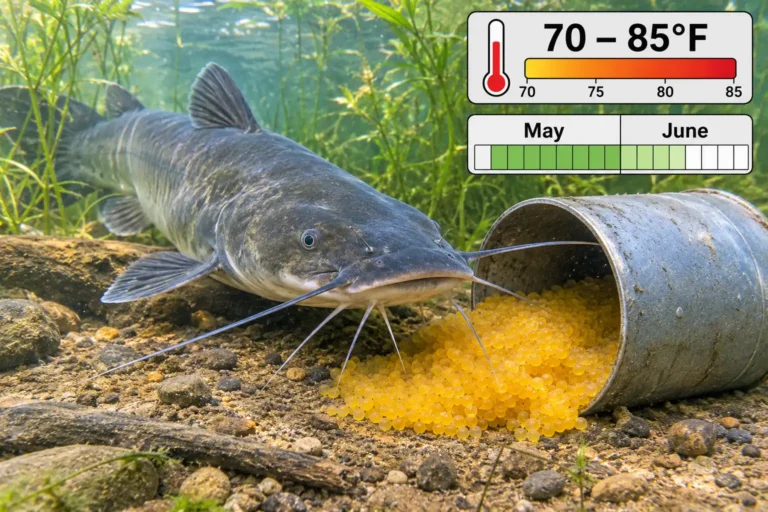
Channel catfish data is solid. Mississippi State University Extension puts the best growth for channel catfish at 75 to 85°F. Growth slows below 65°F, and feeding nearly stops below about 50°F. Channel catfish survive indefinitely up to about 95°F, and only briefly above 100°F.
Salinity matters for coastal sites. Adult channel catfish tolerate about 0 to 11 ppt and prefer less than 4 ppt, according to Mississippi State. Channel catfish eggs hatch only at 8 ppt or below.
Blue catfish pond data is thin. No current extension fact sheet gives a growth temperature table for blue catfish in pond culture. ARS reports that blue catfish handle poorly in warm water. As a result, plan to seine, grade, and haul blue catfish broodstock in cooler weather.
Hybrids share the warmwater pond conditions of channel catfish. SRAC Publication 190 adds that hybrids start feeding earlier in spring, which helps explain part of their growth edge. The full catfish pond production cycle covers feeding by season.
Rules: Blue Catfish Outside Its Native Range
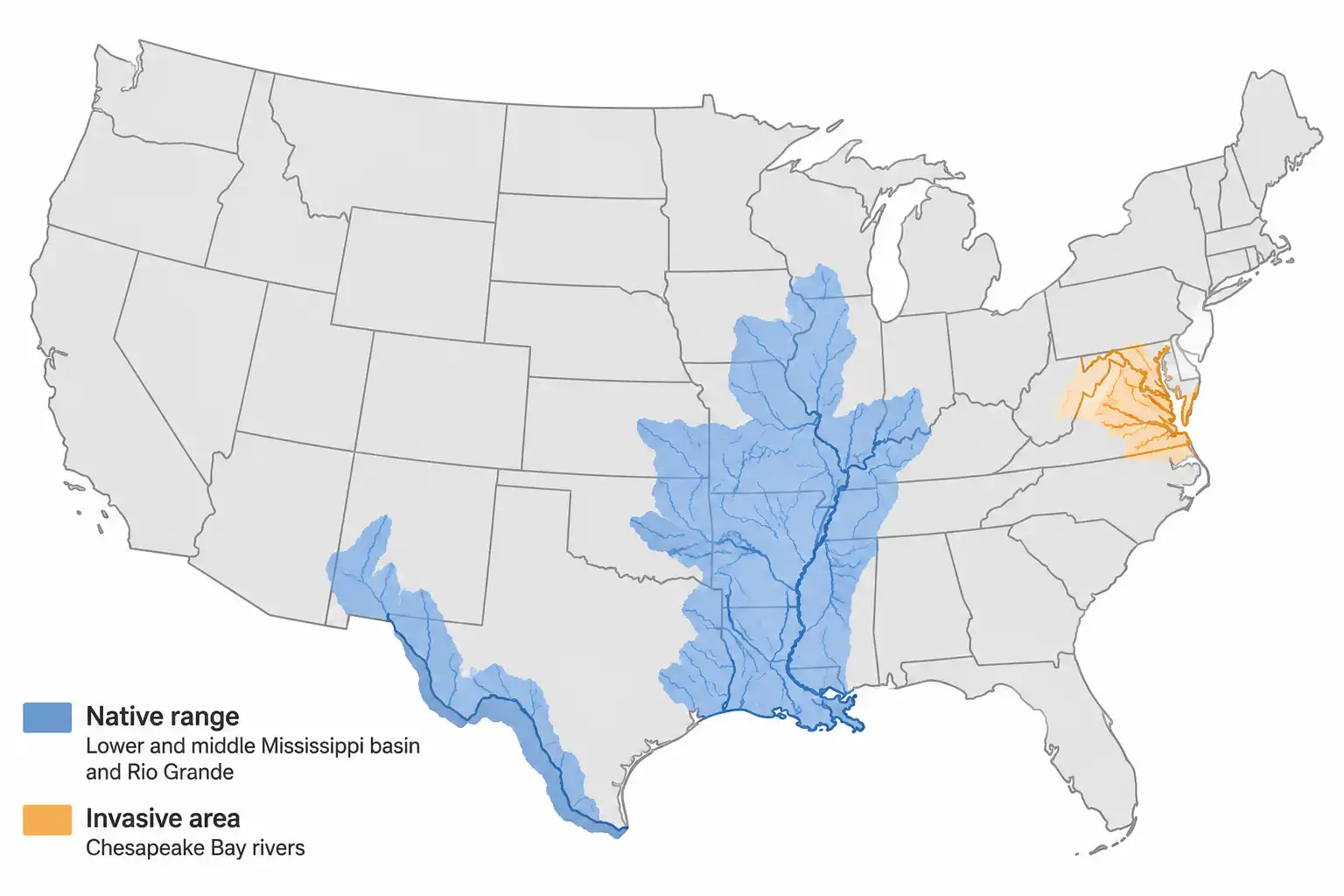
Check your state’s rules before you buy blue or hybrid catfish. Blue catfish have a limited native range. The US Geological Survey places it in the lower and middle Mississippi basin and the Rio Grande.
Outside that range, blue catfish can cause serious harm. USGS Fact Sheet 2024-3033, published in August 2024, describes invasive blue catfish spreading through the Chesapeake Bay’s major rivers. It warns that they could limit the gains from Bay restoration work.
Before stocking, contact your state wildlife or agriculture agency, or your state aquaculture coordinator. Ask three questions:
- Is blue catfish or the C×B hybrid restricted in your state?
- Do you need an aquaculture license or an import permit?
- Does the source hatchery need a fish health certificate?
Moving live fish across state lines often requires a health certificate or an import permit from the receiving state. Never release farmed catfish into public waters. It is often illegal, and escaped farm fish can spread disease or start new wild populations.
Which Should You Stock?
Match the species to your goal, your pond, and your state’s rules.
- Raising your own fry on a small farm: Choose channel catfish. They spawn readily in ponds and reach breeding age in 2 to 3 years.
- Commercial food fish from purchased fingerlings: Consider the C×B hybrid. Published trials show faster growth, better survival, easier seining, and higher dress-out than channel catfish, at a higher fingerling price.
- Producing hybrid fry: Keep blue catfish as sires, and plan on about 5 years to maturity.
- Ponds that run low on oxygen: Blue catfish and hybrids held up better in trials, but fix aeration first.
- States that restrict blue catfish: Stay with channel catfish unless the state approves the alternative.
Pure blue catfish as a food-fish crop makes sense in few situations. Slow maturity, poor handling tolerance in warm water, and thin research all weigh against it.
FAQs About Channel Catfish vs Blue Catfish
Can channel and blue catfish share a pond?
Yes, channel and blue catfish can share a pond, and Auburn University trials raised them together with hybrids. The two species rarely mate on their own, so hybrids come from hatcheries rather than mixed ponds.
Do blue catfish grow faster than channel catfish on farms?
Blue catfish usually don’t outgrow channel catfish in one growing season. In Auburn’s mixed-group trial, blue catfish averaged 0.87 pound at harvest, below both channel catfish strains, though USDA ARS found equal growth in well-oxygenated ponds.
Why do so many farms switch to hybrid catfish?
Hybrids beat channel catfish on feed conversion, survival, seining, and dress-out, per SRAC Publication 190. A Mississippi State report cites analyses showing hybrids generally more profitable at moderate feed prices, despite higher fingerling costs.
How long before blue catfish can spawn?
Blue catfish usually need about 5 years to mature, according to SRAC Publication 190 and USDA ARS. Channel catfish mature in 2 to 3 years, so blue broodstock cost more to carry before the first spawn.
Are blue catfish legal to farm in every state?
No, the rules vary by state, and USGS reports blue catfish as invasive in Chesapeake Bay rivers. Check with your state wildlife or agriculture agency before you buy blue or hybrid catfish fingerlings or broodstock.
Can hybrid catfish be used as broodstock?
Hybrid catfish don’t make reliable broodstock. SRAC Publication 190 notes that some first-generation hybrids are nearly sterile, and their offspring perform worse, so farms buy new hybrid fingerlings for each crop.
Before You Stock
For most new farms, the real choice is channel catfish or the C×B hybrid. Pure blue catfish rarely fit as a food-fish crop. Channel catfish suit growers who want to spawn their own fish. Hybrids suit commercial ponds with good aeration and a reliable fingerling supplier. Either way, confirm your state’s species rules and ask your supplier for strain-specific trial data. Then talk with your extension aquaculture specialist before you order fish.