How Long Do Catfish Live? Lifespan by Species, Wild and Farmed
How long do catfish live? It depends on the species and on whether the fish is wild, farmed, or kept for spawning. Wild catfish count their lives in years, often decades. Farmed catfish count theirs in months.
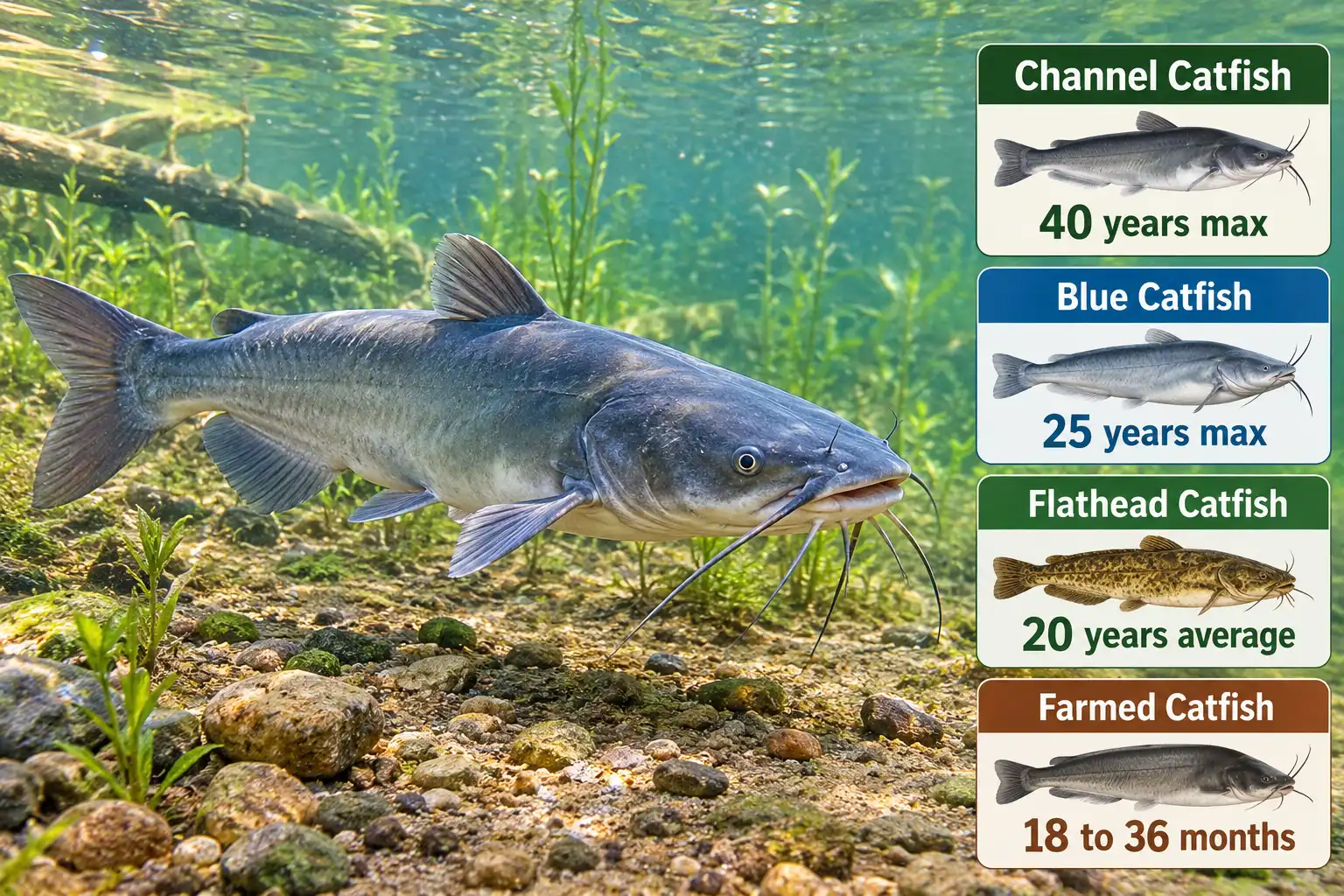
Blue and flathead catfish live about 10 to 20 years on average in the wild, per Virginia DWR. Channel catfish can reach 40 years, per SRAC. Farmed channel catfish are harvested at 18 to 36 months, per Mississippi State.
Catfish Lifespan by Species
Catfish lifespan runs from a few years to four decades, and the setting matters as much as the species. Each row below names the source and the setting it describes.
| Catfish and setting | Published lifespan figure | Source |
|---|---|---|
| Channel catfish, wild (any water) | Oldest recorded: 40 years | SRAC Publication 180 (1988) |
| Channel catfish, wild, Virginia | Up to 30 years | Virginia DWR |
| Channel catfish, wild, Washington | Some live 15 to 20 years | WDFW |
| Blue catfish, wild | Average 9 to 10 years; maximum 25 | Virginia DWR |
| Flathead catfish, wild, Virginia | Average 20 years | Virginia DWR |
| Channel catfish, farmed food fish | 18 to 36 months from egg to harvest | Mississippi State University Extension |
| Channel catfish broodfish | Prime spawners at 4 to 6 years | SRAC Publication 1802 (2004) |
| Panda corydoras, aquarium | Up to 10 years | UF College of Veterinary Medicine |
| Walking catfish, wild | No age data in the federal screening | USFWS (revised 2024) |
Two patterns stand out. First, maximum ages come from rare old fish, so most wild catfish die well short of them. Second, the market and the hatchery schedule set a farmed catfish’s lifespan, not biology.
Read next: How Big Do Catfish Get? Sizes by Species, Records, and Farm Harvest
How Long Do Channel Catfish Live?
Wild channel catfish can live 15 to 30 years, and the oldest on record reached 40. WDFW reports that some channel catfish in Washington live 15 to 20 years. Virginia DWR says channel catfish can live up to 30 years in Virginia waters. Meanwhile, SRAC Publication 180, published in 1988, puts the maximum age ever recorded at 40 years.
These figures don’t conflict. Each answers a different question. WDFW describes a typical old fish, Virginia DWR a state maximum, and SRAC the oldest ever recorded.
Age and size also part ways in the wild. SRAC Publication 180 notes that in many natural waters, channel catfish take 2 to 4 years to reach 1 pound. In one Lake of the Ozarks study, channel catfish did not reach 13 inches until age 8. So a modest wild channel catfish can be much older than it looks.
Water temperature drives much of that pace. Channel catfish grow best at about 85°F, per SRAC Publication 180. A channel catfish’s metabolic rate doubles or halves with each 18°F change. As a result, channel catfish in cooler waters grow more slowly and tend to be older at any given size.
How Long Do Blue Catfish Live?
Blue catfish average 9 to 10 years and can reach 25, per Virginia DWR’s blue catfish profile. The same agency lists the world record as a 143-pound blue catfish from Buggs Island Lake, caught in 2011.
In the East, that long life creates a management problem. Virginia DWR introduced blue catfish to the James and Rappahannock rivers in 1974. By 2023 they had reached every Virginia tributary of the Chesapeake Bay. The agency now lists them as invasive. Virginia DWR also notes that larger blue catfish eat mostly other fish.
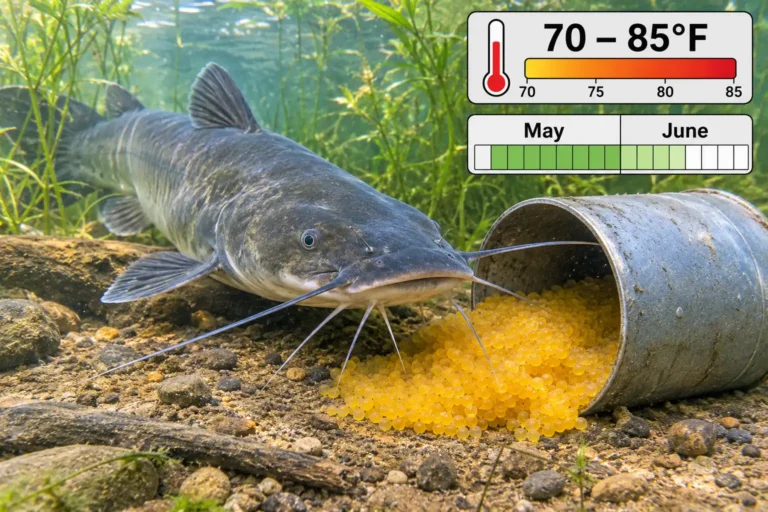
Blue catfish spawn once a year, in late spring and early summer, when water reaches 70 to 75°F. Blue catfish females produce 2,000 to 4,000 eggs per pound of body weight, per Virginia DWR. Males guard the nest and young.
How Long Do Flathead Catfish Live?
Flathead catfish live to an average of 20 years in Virginia, per Virginia DWR. Flatheads can top 50 inches and 60 pounds, and they spawn from May to July. Like blue catfish, flatheads count as invasive in many waters where people introduced them. That makes their long lives a concern for fisheries managers.
How Long Do Farmed Catfish Live?
Most farmed channel catfish live 18 to 36 months. That is how long they take to grow from egg to food size. Mississippi State University Extension sets out the stages:
- Channel catfish eggs hatch in 5 to 8 days, depending on water temperature.
- Fry stay in the hatchery about 4 to 10 days, then move to nursery ponds.
- Fingerlings grow to 3 to 8 inches over 5 to 10 months.
- Some farms grow stockers of 0.1 to 0.25 pound before growout.
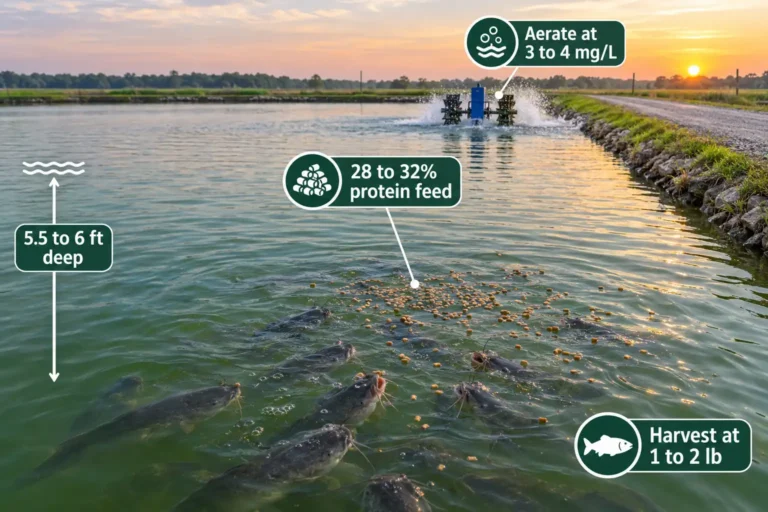
- Food-size fish reach 1 to 2 pounds and go to harvest.
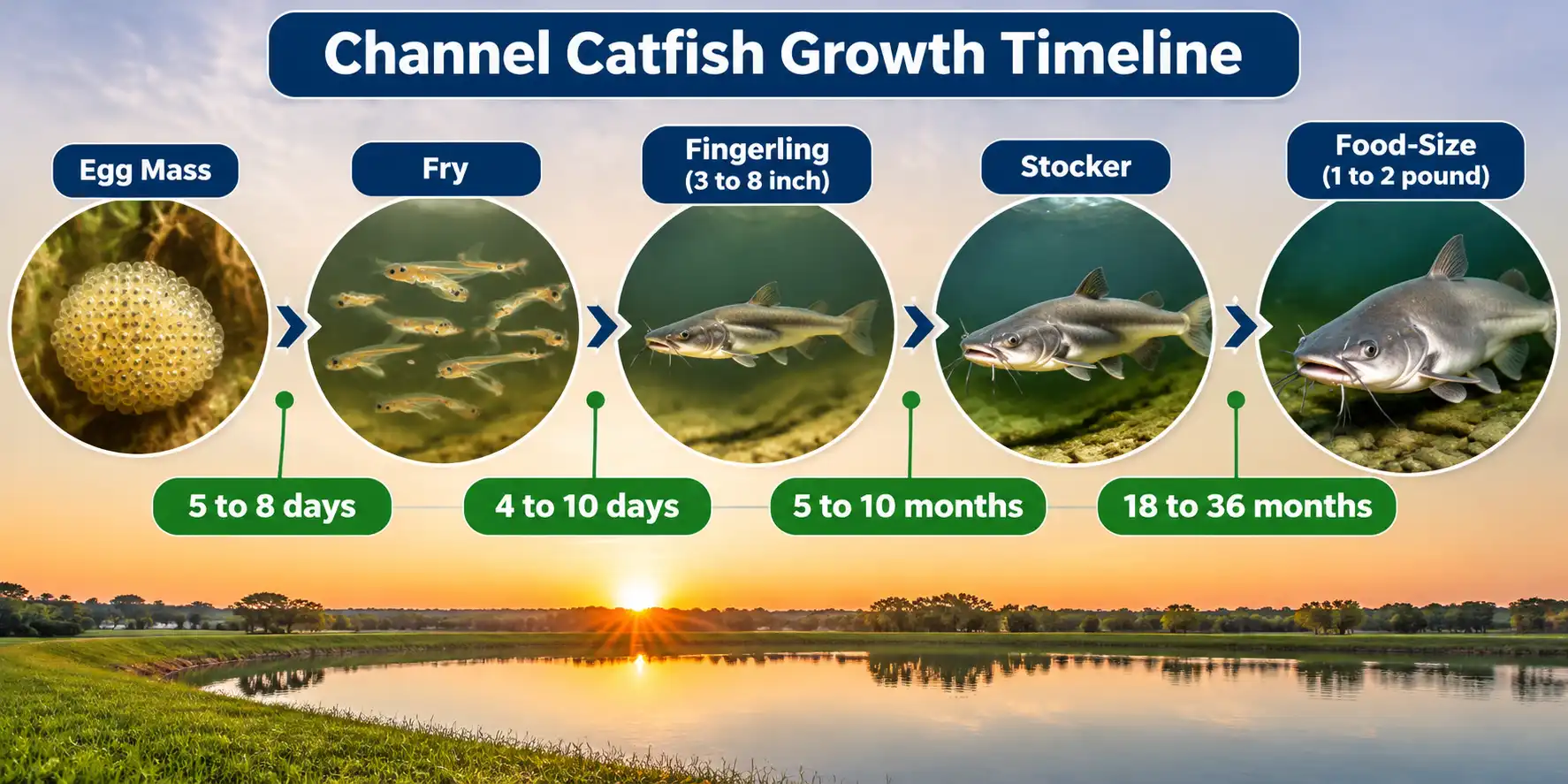
An older figure runs shorter. SRAC Publication 180 (1988) says farms harvested most channel catfish before age 2. Back then, farmed channel catfish reached about 1¼ pounds near 18 months. The current Mississippi State range is wider. Farms now combine fingerling, stocker, and growout phases in many ways, and Mississippi State says no single typical scheme exists.
Hybrid catfish (channel catfish female x blue catfish male) now lead stocking in intensive ponds, per Mississippi State. For stocking, feeding, and harvest timing, see the pond growout and harvest schedule.
When Farmed Catfish Die Early
On a farm, catfish rarely die of old age. Sudden losses point elsewhere, and dissolved oxygen is the first check. SRAC Publication 180 puts the lethal oxygen level for channel catfish at about 1.0 mg/L (1 ppm). Their growth slows below 4 mg/L. So start with oxygen levels before dawn, when they run lowest.
Low oxygen, disease, and toxins can look alike from the bank. A fish health lab or your extension aquaculture specialist confirms the cause. Report heavy, unexplained losses to your state veterinarian or aquatic animal health official. Until you know the cause, don’t move or sell fish from that pond.
How Long Do Catfish Broodfish Stay in Production?
Channel catfish broodfish usually work from about age 3 to age 6, and then farms replace them. SRAC Publication 1802 (revised 2004) sets a floor of 3 years and 3 pounds for reliable channel catfish spawning. Prime channel catfish spawners are 4 to 6 years old and 4 to 8 pounds. Fish over 10 pounds lay fewer eggs per pound and are harder to handle, so the publication advises culling them.

Losses shorten that working life too. SRAC Publication 1803 (2005) cites a producer survey on losses. About 14 percent of channel catfish broodfish die each year from fighting, disease, and spawning stress. So the publication advises adding broodfish every 2 to 3 years. It also says retirement should follow each group’s spawning success rather than a fixed age. For selection and holding ponds, see choosing and keeping broodfish.
Carry It Through to Your Hatchery
SRAC Publication 1803 recommends 1,350 to 2,000 pounds of female channel catfish broodfish per 1 million fry. That figure assumes a 50 percent spawn, a 70 percent hatch, and 70 percent survival to swim-up. Say you plan for 3 million fry, which is your own target:
- Female broodfish needed: 3 x 1,350 to 2,000 = 4,050 to 6,000 pounds
- First-year loss at 14 percent of a 5,000-pound inventory, inside that range: about 700 pounds
- That loss equals roughly 90 to 175 prime females at 4 to 8 pounds each
- After three years with no additions: 5,000 x 0.86 x 0.86 x 0.86 = about 3,180 pounds left
That drop is why the 2 to 3 year restocking advice matters.
How Long Can Catfish Survive Out of Water?
It depends on whether the catfish can breathe air. Channel, blue, and flathead catfish breathe through their gills. No extension or agency source we checked gives them a safe out-of-water time. The walking catfish is the exception. The USFWS ecological risk screening for walking catfish calls it a facultative air-breather. It can live out of water for quite some time. Even so, USFWS gives no set number of hours.
Figures online run from a few minutes to many hours. None that we found traces back to a controlled study, so treat them as guesses.
What the research does support is how much channel catfish depend on oxygen in water. Channel catfish die at about 1.0 mg/L of dissolved oxygen in water, per SRAC Publication 180. Out of water, gills can’t pull oxygen at all. So for channel, blue, and flathead catfish, treat every minute out of water as harmful.
Handling Catfish Out of Water
- Keep catfish in water during grading, weighing, and loading.
- Move live fish in tanks with aeration or bottled oxygen.
- Return a fish to water at once if it lands on a bank or deck.
- Keep handling short on hot days, when stress builds fastest.
For tank setup and loading, see the guide to hauling live fish in oxygenated tanks.
Catfish Walking: How the Walking Catfish Moves on Land
The walking catfish (Clarias batrachus) wriggles across wet ground on its pectoral fins, per the USFWS screening revised in 2024. It breathes air through auxiliary breathing organs. In Florida, overland moves sped up its spread, typically on rainy nights.
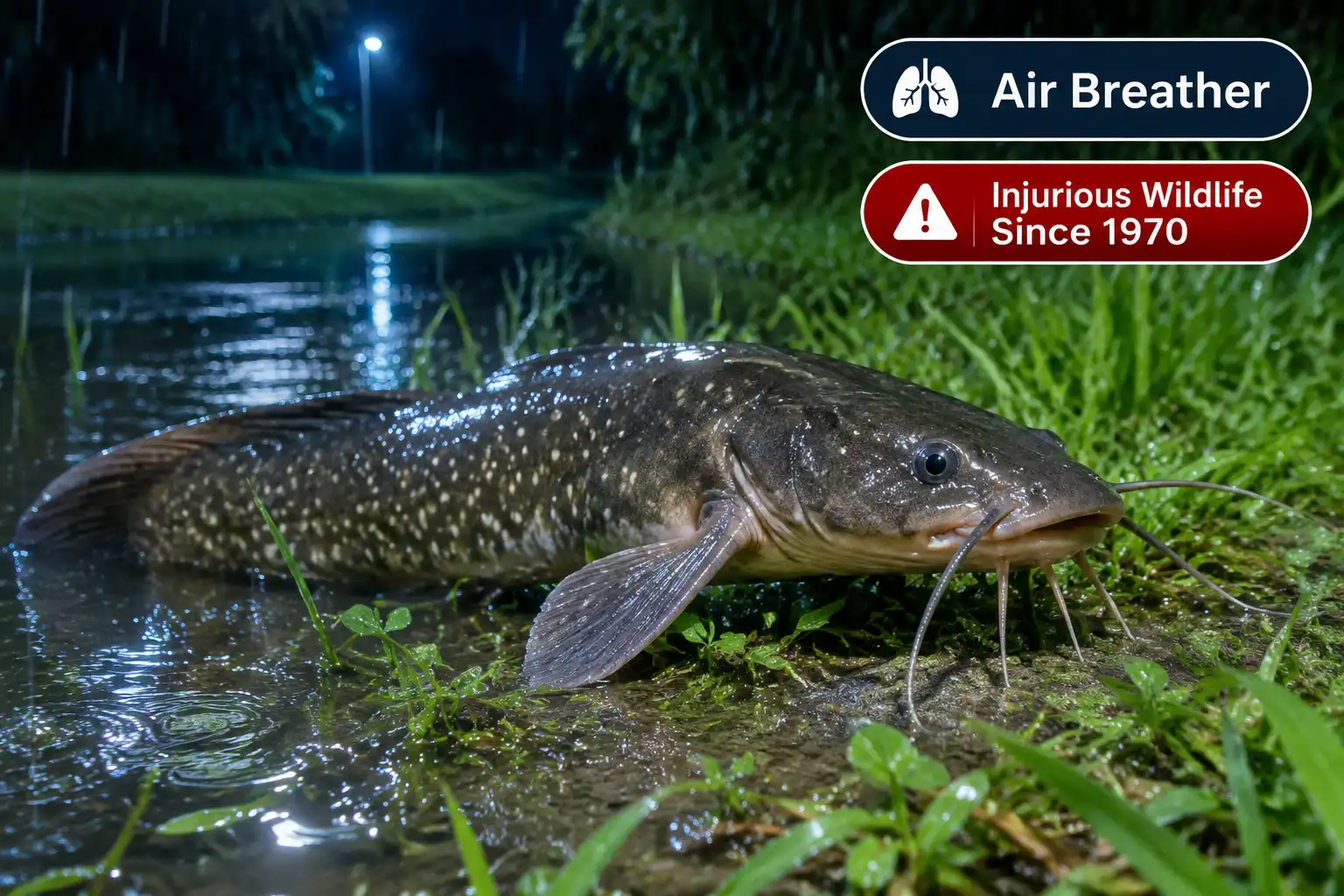
The fish is native to Southeast Asia. USFWS reports it as established in Florida, while introductions failed in California, Connecticut, Georgia, Massachusetts, and Nevada. Cold limits it, too. Studies cited by USFWS put the walking catfish’s lower lethal temperature at about 49 to 55°F. The exact limit depends on the water the fish came from.
Lifespan data is thin. The USFWS screening lists no maximum age, and we found no US agency source that gives one.
Walking Catfish Rules Come First
USFWS listed every species in the family Clariidae as injurious wildlife in 1970, under the Lacey Act. That listing bars bringing them into the United States without a limited federal permit. State rules can ban keeping them at all. So don’t buy, move, or stock any Clarias catfish. Never release one, or any farmed fish, into public waters. Check your state wildlife agency’s prohibited species list before you buy any catfish.
How Long Do Cory Catfish Live?
Panda corydoras (Corydoras panda) can live up to 10 years, but published lifespan research on cory catfish is thin. That figure comes from the Aquatic Animal Health Club at the University of Florida College of Veterinary Medicine. The club profiles the fish in a teaching tank, not a controlled study.
Cory catfish are small South American catfish kept in home aquariums. The UF profile notes that panda corydoras come from the Ucayali River system and prefer tannin-stained blackwater. They scavenge the tank bottom, mostly at night.
Hobby care guides give a wide spread of lifespan figures, and most rest on owner records. Lifespan also differs among the many Corydoras species, so one number won’t fit them all. Corydoras aren’t a food or stocking species, so farm production data doesn’t cover them.
Washington Catfish: Where They Live and How Long
Some Washington channel catfish live 15 to 20 years and pass 30 pounds, per WDFW’s channel catfish page. They reproduce naturally in the lower Columbia, Snake, Walla Walla, and lower Yakima rivers and lower tributary reaches. The Yakima and Snake hold the highest densities.

Lowland lakes work differently. WDFW says channel catfish aren’t known to spawn there, so lake fisheries depend on regular stocking. That makes lifespan the clock on every stocked lake. Once the stocked fish die off, the fishery fades unless WDFW stocks again.
Washington’s record channel catfish weighed 37.70 pounds, per WDFW. It came from Lake Terrell in Whatcom County on August 20, 2019.
Washington Rules Before You Stock
Under WDFW’s stocking and transport permit rules, planting fish in any pond or lake takes a Fish Stocking Permit. That includes a private pond on your own land. Bringing fish into the state takes a Fish Transport Permit, which mostly applies to commercial aquaculture, researchers, and retailers. Anyone farming fish must also register as an aquatic farm with WDFW before culture starts, under WAC 220-370-060.
How Big Do Channel Catfish Get?
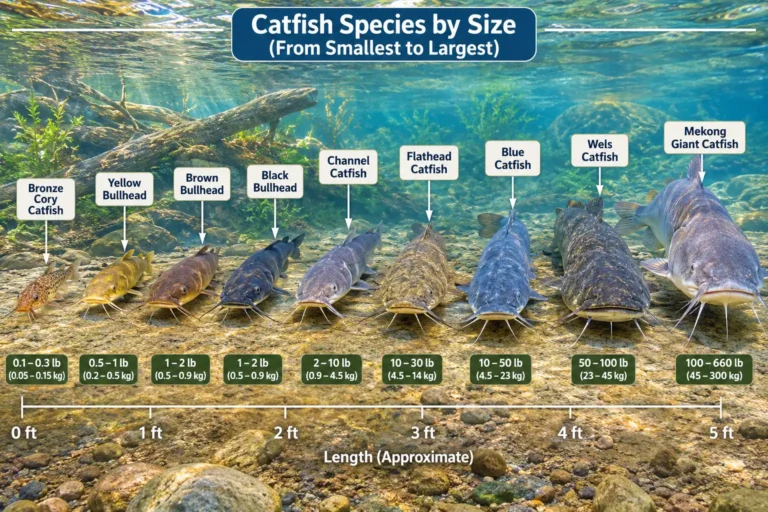
Most wild channel catfish caught by anglers probably weigh under 2 to 3 pounds, per SRAC Publication 180. Still, the world record is 58 pounds, from Santee Cooper Reservoir in South Carolina in 1964. Virginia DWR says mature channel catfish there average about 20 inches, and large ones pass 30 inches. On farms, food-size channel catfish weigh 1 to 2 pounds at harvest, per Mississippi State.
Size says little about age, though. Because wild growth is so slow, a modest channel catfish can be many years old. For size figures across species and ages, see catfish size by species and age.
Catfish Facts Tied to How They Live and Breed
Each fact below shapes how catfish grow, spawn, or survive. So each one matters on a farm or in a fishery.
- Taste across the body. Channel catfish have taste buds over their entire outer surface, per SRAC Publication 180. The buds cluster most on the barbels and gill arches. In muddy water, taste is how they find food.
- Eggs by the pound. SRAC Publication 180 says a female channel catfish lays 3,000 to 4,000 eggs per pound of body weight. She spawns once a year.
- A narrow spawning window. Channel catfish spawn at 75 to 85°F, best near 80°F, per SRAC Publication 180. At 78°F, their eggs hatch in about 8 days.
- Hybrids outgrow both parents. SRAC Publication 1802 notes that hybrid catfish grow faster than either parent. They also resist disease better.
- One air breather. USFWS describes the walking catfish as a facultative air-breather, and that ability helps it survive in low-oxygen water.
FAQs About Catfish Lifespan
How long do channel catfish live in a farm pond?
A farmed channel catfish usually lives 18 to 36 months before harvest at 1 to 2 pounds, per Mississippi State. Left unharvested in a pond, it can live for many years, as wild channel catfish do.
What is the oldest catfish ever recorded?
The oldest channel catfish on record reached 40 years, per SRAC Publication 180. For comparison, Virginia DWR lists a 25-year maximum for blue catfish, so a 40-year channel catfish is rare.
Do farmed catfish die of old age?
Rarely, because most farmed channel catfish go to harvest before they reach age 3. If catfish die suddenly in a pond, check dissolved oxygen first, then have a fish health lab confirm the cause.
Do blue catfish or channel catfish live longer?
Channel catfish can live longer: up to 30 years in Virginia waters, per Virginia DWR. Blue catfish there average 9 to 10 years and top out near 25, even though they grow much larger.
Can walking catfish survive in cold states?
Probably not outdoors for long, since studies cited by USFWS put their lower lethal temperature at about 49 to 55°F. USFWS reports them established in Florida, while introductions in five other states failed.
Do channel catfish reproduce in Washington lakes?
Not in lowland lakes, where WDFW says channel catfish aren’t known to spawn, so those fisheries rely on stocking. Reproducing populations live in the lower Columbia, Snake, Walla Walla, and lower Yakima rivers.
What the Research Supports
Wild lifespans are well documented for channel, blue, and flathead catfish. The figures differ because each source answers a different question. Some describe a state’s typical fish, others the oldest one ever aged. On farms, harvest dates and broodfish schedules set lifespan, not biology. Data on walking catfish and cory catfish is thin, so treat any single number with care.
Before you buy or stock any catfish, check your state’s prohibited species list and permit rules. Then match the species to your water and market with the guide to farmed catfish species and strains.