When Do Catfish Spawn? Season, Nest, and Egg Hatch Timeline

Catfish spawn on water temperature, not on a calendar date. So when do catfish spawn? The answer shifts by species, region, and year. It also sets the brood pond schedule, the hatchery workload, and how pond catfish bite in spring.
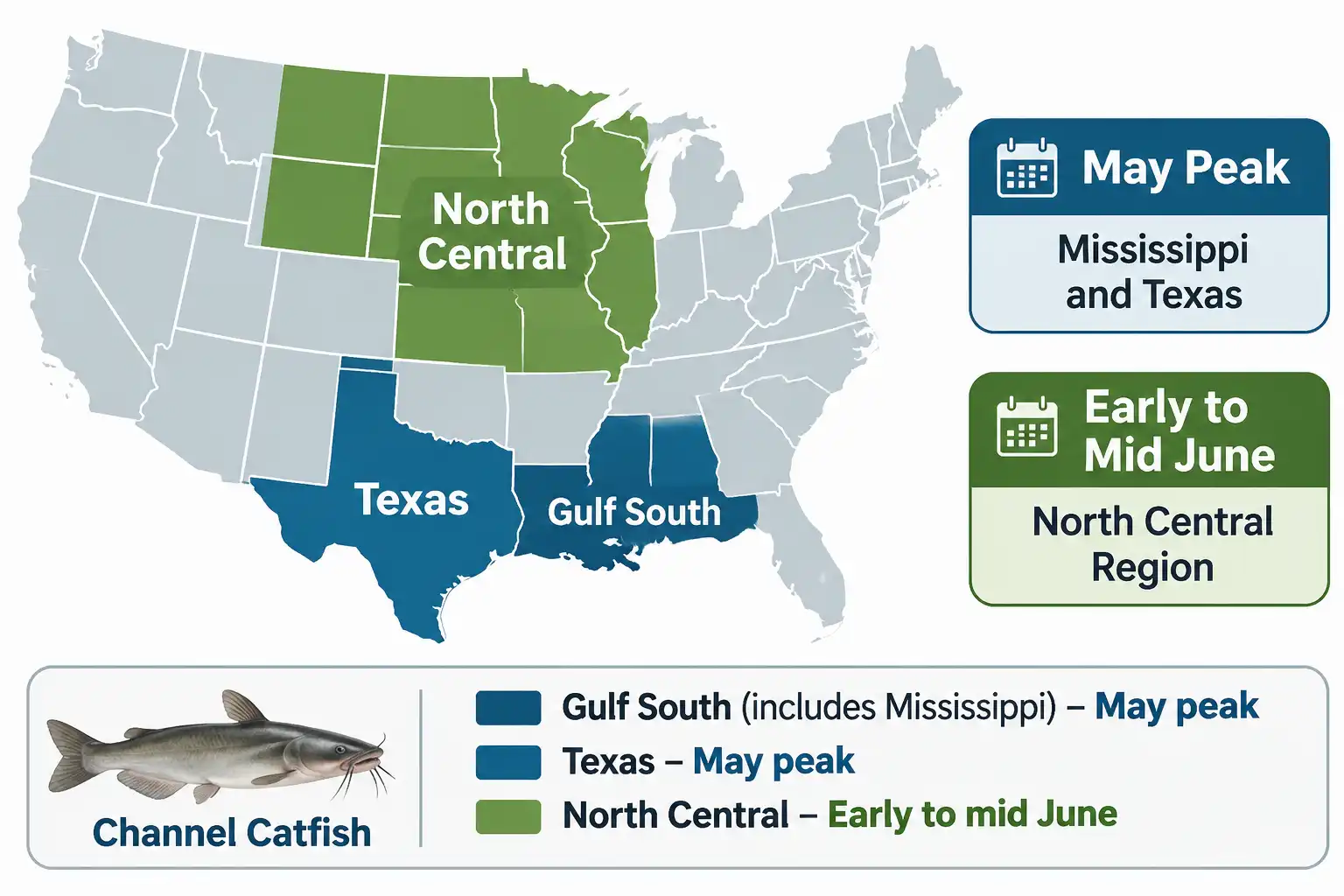
Channel catfish spawn in spring and early summer, once pond water holds above 70 to 75°F, with about 80°F best, per SRAC. Mississippi spawning usually peaks in May. In the North Central states, it starts in early to mid June.
When Is Spawning Season for Catfish?
Spawning season for channel catfish starts in spring, once pond water warms past 70°F. Mississippi State University Extension says channel catfish spawning begins when water rises above 70°F. Then channel catfish spawning activity picks up once the water stays near 75°F.
Still, other sources give a wider band. SRAC Publication 1804 puts channel catfish spawning at 70 to 84°F. SRAC Publication 180 gives 75 to 85°F, with about 80°F as the optimum.
These figures answer two different questions. The 70°F mark tells you when the first channel catfish start. The 75 to 85°F band is where most channel catfish spawning happens.
The calendar varies far more than the thermometer. SRAC Publication 180 notes that wild channel catfish may spawn from late February to August, depending on location. It adds that the length and timing of the season shift from year to year with the weather. So an early warm spell moves spawning forward, and a cool spring holds it back.
That is why farms track water temperature instead of dates. Spawning is also the first step in raising channel catfish in ponds. So the rest of the year’s schedule hangs on it.
Read next: How Long Do Catfish Live? Lifespan by Species, Wild and Farmed
Catfish Spawning Temperature by Species
Channel, blue, and flathead catfish all spawn in warm water. But the published figures differ by species, and channel x blue hybrids don’t spawn on their own at all.
| Species | Spawning water temperature | Usual season | Age at reliable spawning | Source |
|---|---|---|---|---|
| Channel catfish | 70 to 85°F, best near 80°F | Spring to early summer | At least 3 years | SRAC 180 and 1804, Mississippi State |
| Blue catfish | No separate figure; behavior similar to channel catfish | Similar to channel catfish | At least 5 years, or about 24 inches long | TPWD, SRAC 190 |
| Flathead catfish | 75 to 80°F | Late May through August | Third to sixth year | TPWD |
| Channel x blue hybrid | Hatchery vats near 82°F, with results from 72 to 86°F | Set by the hatchery | Made by artificial fertilization, not pond spawning | SRAC 190 |
Independent spawning data for blue catfish is thin. The Texas Parks and Wildlife Department (TPWD) says only that blue catfish spawning behavior appears similar to channel catfish. So treat channel catfish figures as a rough guide for blues, not a confirmed range.
Flathead catfish, by contrast, start later and a little warmer. TPWD’s flathead catfish profile puts their season from late May through August. The sections below focus on channel catfish and channel x blue hybrids.

Spawning Season by Region
Spawning moves north with the warm water. In the Deep South, channel catfish spawning peaks in late spring. Farther north, it starts in June.
| Area | Typical channel catfish spawning window | Source |
|---|---|---|
| Mississippi farm ponds | Spring, with the usual peak in May | SRAC 180 |
| Texas reservoirs (Lake Fork) | Usually May | TPWD |
| North Central states | Early to mid June, at 75 to 85°F | NCRAC 444 |
| Wild fish across the US range | Late February to August | SRAC 180 |
The northern season is shorter, too. NCRAC Publication 444 (1993) counts 185 to 205 days a year with air at 65°F or higher in southern Arkansas. By contrast, the North Central region gets 120 to 140 such days. As a result, the same publication estimates channel catfish take 3 to 6 months longer to reach market size there.
A 2007 SRAC research report found that channel catfish need at least 70°F (21°C) to start the reproductive process. Its authors suggest tracking degree-days above 70°F to predict when channel catfish spawning will begin. In practice, that means logging morning water temperature at spawning depth from early spring on.
How Long Do Catfish Spawn?
A channel catfish spawning season lasts several weeks. Yet a single spawn takes only several hours, and each nest lasts about two weeks.
| Time frame | How long, for channel catfish | Source |
|---|---|---|
| Spawning season in a brood pond | Several weeks | SRAC 1803 |
| One spawn, male and female in the nest | Several hours | Mississippi State |
| Eggs in the nest until hatch | About a week, or 5 to 10 days by temperature | TPWD, SRAC 180 |
| Fry in the nest under the male | About another week | TPWD |
So one channel catfish nest runs about two weeks, from spawn to fry leaving. Also, channel catfish females spawn only once a year, per SRAC Publication 180. Males can do more. In hatcheries, channel catfish males may spawn 3 or 4 times. One male spawned with nine females in a single season.
Spawning is also spread out across the pond. At peak, SRAC Publication 1803 expects no more than 20 percent of channel catfish females to spawn in 48 hours. That is why a brood pond keeps producing egg masses for weeks, not days.
What Happens During a Catfish Spawn
A male channel catfish claims a dark cavity, a female lays her eggs there, and the male guards them. SRAC Publication 180 says channel catfish spawn only in secluded, semi-dark spots. In the wild, that means hollow logs, undercut banks, and rock piles. In a farm pond, it means a can or barrel set out for them.
First, the male picks the site and fans out the mud. Then a female joins him and lays a gelatinous egg mass on the nest floor. TPWD’s channel catfish profile describes the mass as golden-yellow. Mississippi State University Extension notes that the spawn takes several hours, as layers of sticky eggs build up.
After that, the male drives the female away. He fans the eggs to keep them aerated and clean, and he guards the nest until the fry leave. TPWD adds that a disturbed male may eat some of the eggs.
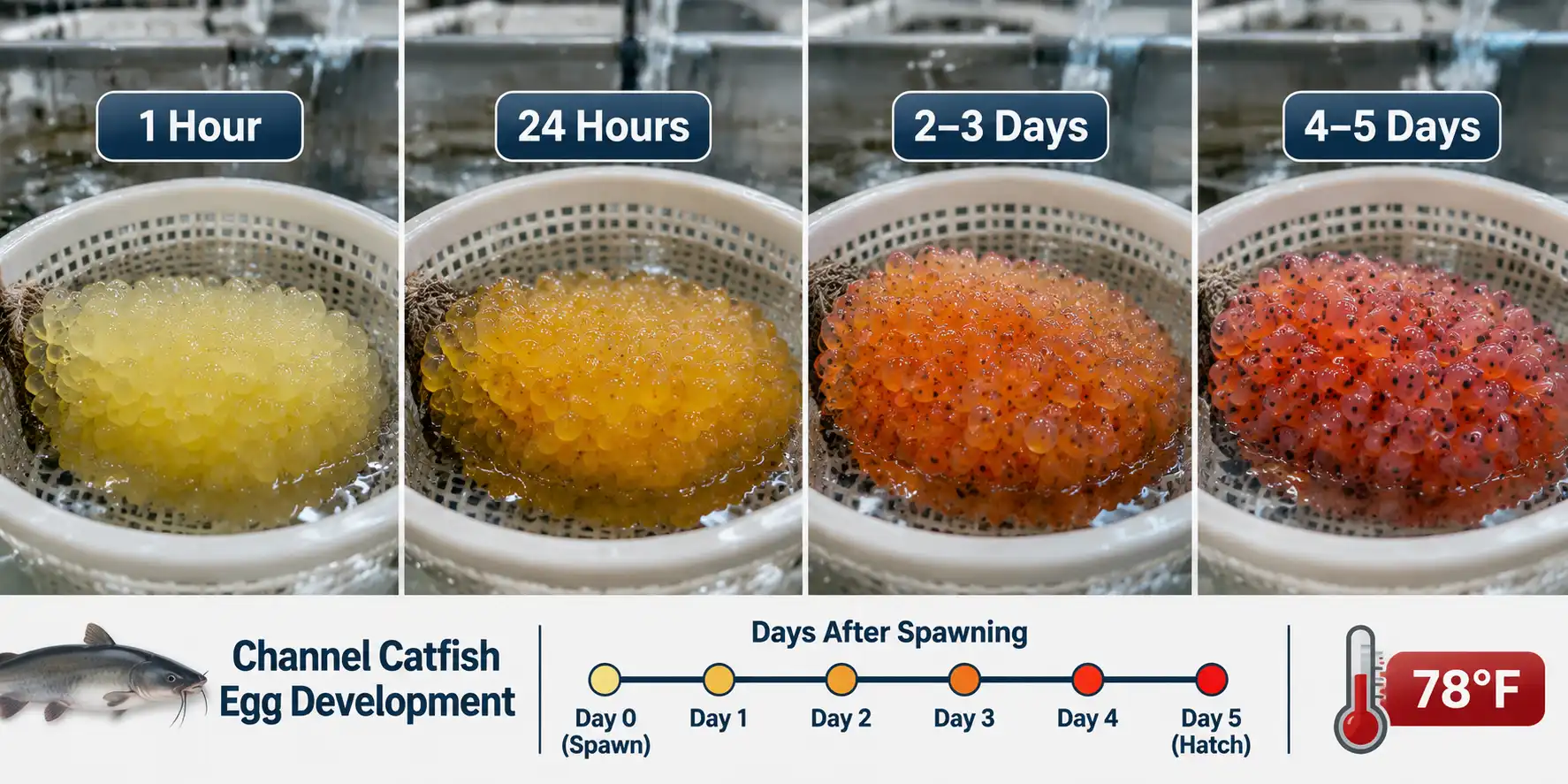
Meanwhile, egg color shows age. SRAC Publication 1804 tracks channel catfish eggs held at 78°F. They are pale yellow at 1 hour and yellow with distinct fry at 2 to 3 days. By 4 to 5 days, they turn orange-red, with eyes showing.
How Long Catfish Eggs Take to Hatch
Channel catfish eggs hatch in about 8 days at 78°F, per SRAC Publication 180. Warmer water speeds that up. So subtract one channel catfish incubation day for each 2°F above 78°F, and add one for each 2°F below.
| Water temperature | Channel catfish days to hatch (SRAC 180 rule) |
|---|---|
| 74°F | About 10 |
| 76°F | About 9 |
| 78°F | About 8 |
| 80°F | About 7 |
| 82°F | About 6 |
To run it for your own water, take your nest or hatchery temperature. Then find the gap from 78°F and divide by 2 for the days to add or subtract.
Other figures look shorter, but they count from a different start. Mississippi State University Extension gives 5 to 8 days of incubation for channel catfish eggs. SRAC Publication 1803 says hatching usually takes 5 to 6 days once eggs reach the hatchery. Farms collect eggs every two or three days. So many egg masses have already spent part of their time in the can.
Beyond timing, temperature also shapes survival. SRAC Publication 1804 puts the best incubation range for channel catfish eggs at 78 to 82°F. Above 82°F, channel catfish eggs face more bacterial infections. At 78°F and below, fungus hits channel catfish eggs more often. Channel catfish hatching success drops below 65°F and above 85°F, per SRAC Publication 180. For trough setup and daily checks, see hatching troughs and egg care.
Setting Up a Brood Pond Before Spawning Season
Move channel catfish broodfish into a clean, well-prepared pond before the water reaches spawning temperature. SRAC Publication 1803 says broodfish should go each spring to ponds with excellent water quality, ideally new or rebuilt ones. NCRAC Publication 444 advises moving them at least 6 to 8 weeks before spawning starts.
Next come age and size. Mississippi State University Extension says channel catfish must be at least 3 years old to spawn reliably. It rates channel catfish 4 to 6 years old and 4 to 8 pounds as prime spawners. But the guides differ at the top end. SRAC Publication 1803 says channel catfish over 10 pounds may spawn well but give fewer eggs per pound. NCRAC Publication 444, meanwhile, suggests channel catfish broodfish of no more than 6 to 8 pounds.
Both regional centers cap total channel catfish broodfish weight at 1,200 pounds per surface acre, males and females together. Sex ratios vary more. SRAC Publication 1803 uses 1:1 or 2:3 channel catfish males to females. By contrast, NCRAC Publication 444 saw no significant difference in channel catfish fingerling output from 1:1 to 1:3.
Once spawning starts, handle broodfish as little as you can. SRAC Publication 1803 advises extra care if they must move during the spawning period. For selection and winter care, see choosing and conditioning broodfish.
Spawning Containers: Size, Depth, and Spacing
Channel catfish need a cavity, so brood ponds get spawning containers. SRAC Publication 1803 lists ammunition cans, aluminum milk cans, and plastic buckets or barrels, set out this way:
- Opening: 5 to 7 inches across
- Volume: at least 10 gallons, with 15 to 20 gallons best
- Depth: 2 to 3 feet of water around the pond edge, since spawning drops off below 3 feet
- Spacing: 6 to 7 feet apart
- Number: one container for every three to four females, when eggs come out two to three times a week
NCRAC Publication 444 suggests more cans: two to three for every four channel catfish pairs, in 2 to 4 feet of water. It also has openings face the pond center, with a float on each can. The two guides serve different audiences. SRAC Publication 1803 targets commercial hatchery managers. NCRAC Publication 444 covers pond culture in the North Central region.
Check cans every 2 or 3 days, as Mississippi State University Extension describes. And make sure the can holds no fish before you reach in, because the male guards the nest.

How Many Eggs a 1-Acre Brood Pond Can Produce
A 1-acre channel catfish brood pond with 20 pairs can yield about 54,000 to 96,000 sac fry at typical spawning rates. Here is the working. The 4-pound female weight is a sample, so swap in your own fish.
| Step | Input and source | Result |
|---|---|---|
| Females stocked | 20 pairs per surface acre (NCRAC 444) | 20 channel catfish females |
| Female weight | 4 pounds each (your number) | 80 pounds of females |
| Eggs if all spawn | 3,000 to 4,000 eggs per pound for 4- to 8-pound females (Mississippi State) | 240,000 to 320,000 eggs |
| Spawning success | 30 to 40 percent industry-wide (SRAC 1803) | 72,000 to 128,000 eggs |
| Hatch | About 75 percent egg survival to hatch (NCRAC 444) | About 54,000 to 96,000 sac fry |
| Containers | One per 3 to 4 females (SRAC 1803), or 2 to 3 per 4 pairs (NCRAC 444) | 5 to 7 cans, or 10 to 15 cans |
| Weight check | 1,200-pound cap per surface acre (SRAC 1803, NCRAC 444) | About 160 pounds if males also average 4 pounds |
The spawning rate drives the result most. Mississippi State University Extension reports channel catfish spawning success from 30 to 80 percent a year. So a well-conditioned group can beat the low case by a wide margin. Still, plan on the low end. SRAC Publication 1803 notes that most farms keep two to three times the minimum broodfish weight for that reason.
Hybrid Catfish Spawning Works Differently
Channel x blue hybrid catfish don’t come from pond spawning. SRAC Publication 190 (2012) defines the hybrid as a channel catfish female crossed with a blue catfish male. It says open-pond spawning of the two species is not a consistent way to make hybrids. Usually, no spawns occur.
Instead, hatcheries use artificial fertilization. They give female channel catfish hormones to trigger ovulation and strip the eggs by hand. Then they fertilize the eggs with sperm from blue catfish males, which the hatchery euthanizes to collect the testes. One blue catfish male can fertilize five to ten females, per SRAC Publication 190.
Because the hatchery controls water temperature, it also sets when the hybrid season starts. SRAC Publication 190 rates channel catfish females 4 to 5 years old as the most reliable early in the season. It wants blue catfish males at least 5 years old. And it notes that hot weather late in the season over-ripens the channel catfish females.
Even so, hybrid output has grown fast. SRAC Publication 190 reports about 100 million channel x blue hybrid fry by 2011. Ten years earlier, the figure was about 1 million. Every crop has to be made fresh, though. The same publication advises against breeding fry from hybrid parents. Fertility varies by strain, and the offspring perform worse.
Spawning Hormones and the Rules That Apply
Hormone-induced spawning needs a veterinarian and the right FDA status. FDA lists chorionic gonadotropin (Chorulon) as an approved spawning aid for brood finfish. It is a prescription product. Meanwhile, SRAC Publication 190 notes that, as of 2012, no hormone was FDA approved for catfish spawning. So hybrid hatcheries used hormones such as LHRHa and pituitary extract under FDA’s Investigational New Animal Drug (INAD) program.
Approvals change, so check FDA’s list of approved aquaculture drugs before planning a hormone program. Then work out species, use, and label limits with an aquatic animal veterinarian. The guide to how fish drug approvals work covers prescriptions and extra-label limits in more depth.
Hormone spawning is hands-on hatchery work. Hatchery staff learn it through training at a working hatchery or an extension workshop, not from a fact sheet.
Spring Catfishing and the Spawn in Farm Ponds
Spring catfishing in a stocked pond follows the same thermometer as spawning. Mississippi State University Extension notes that farmed catfish don’t take extruded feed consistently below 70°F. At 50°F and below, farmed catfish more or less stop eating. So channel catfish appetite climbs as spring water warms toward 70°F, which is also when spawning begins.
During the spawn, the catch changes. TPWD reports that channel catfish in Lake Fork tend to move shallower and usually spawn in May. Bigger channel catfish get harder to catch during the spawn, while plenty of eating-size fish still bite.
Don’t count on the spawn to restock a pond, though. Mississippi State University Extension says channel catfish usually don’t reproduce well in ponds with largemouth bass. Instead, restock with channel catfish at least 8 inches long, so the bass don’t eat them.
Catfish-only ponds can have the opposite problem. In catfish-only ponds smaller than 1 acre, Mississippi State suggests 25 largemouth bass per acre to control unwanted spawning. The bass eat channel catfish fingerlings smaller than 6 inches.
On public lakes and rivers, your state wildlife agency sets the catfishing rules, so check them before a spring trip. And never move fish from a farm pond into public water. It is often illegal, and it can spread disease.
Why a Catfish Spawning Season Comes Up Short
Egg, fry, and broodfish losses can come from water quality, temperature, or disease. From the pond bank, they look alike. So check dissolved oxygen first, using the timing in oxygen levels before dawn. Then call your extension aquaculture specialist or a fish health diagnostic lab to confirm the cause. Report heavy, unexplained broodfish losses to your state veterinarian or state aquatic animal health official.
These are the failure points the SRAC hatchery guides describe for channel catfish:
- No spawning, or spawning stops. SRAC Publication 1803 says to check the brood pond for water quality, weeds, and disease. If nothing shows, moving the broodfish often works.
- Low success year after year. SRAC Publication 1803 suggests replacing broodfish groups under 30 percent spawning success.
- Eggs die early. Per SRAC Publication 1804, channel catfish hatch rates drop up to 70 percent below 10 ppm calcium hardness in the first day. It recommends at least 20 ppm for channel catfish eggs.
- Eggs damaged on the way in. SRAC Publication 1804 says channel catfish eggs shouldn’t sit on the bank over 15 to 30 minutes. Trips over 30 minutes need insulated containers holding above 5 ppm dissolved oxygen for channel catfish eggs.
- Late-season losses. SRAC Publication 1804 links water above 82°F to more bacterial infections in channel catfish eggs. Hot weather also over-ripens females, per SRAC Publication 190.
- Hidden damage. Per SRAC Publication 1803, channel catfish eggs hurt by poor water quality can look normal for 48 hours or more.
Catfish Spawning by the Numbers in US Farming
USDA NASS counted 770,000 catfish broodfish on hand on July 1, 2026, in Alabama, Arkansas, and Mississippi. That is 1 percent below the 775,000 of a year earlier, per the July 2026 Catfish Production report. The same report counted 227 million catfish fingerlings and fry, down 7 percent.
For the second half of 2026, those states planned 2,145 water surface acres for catfish broodfish, up 4 percent. They also set aside 6,165 acres for catfish fingerlings, up 24 percent. Each of those fry and fingerlings traces back to a spring spawn in a brood pond or a hatchery.
FAQs About Catfish Spawn
What month do catfish spawn?
Channel catfish usually spawn in May in Mississippi and Texas, per SRAC and TPWD. In the North Central states, NCRAC puts the start in early to mid June, depending on water temperature.
Do catfish bite during the spawn?
Yes, though bigger channel catfish get harder to catch during the spawn, per the Texas Parks and Wildlife Department. Plenty of eating-size fish still bite, so spring catfishing stays worthwhile through the spawning weeks.
Do catfish spawn more than once a year?
Female channel catfish spawn only once a year, per SRAC Publication 180. Channel catfish males in hatcheries can spawn 3 or 4 times a season, and one male mated with nine females.
Will catfish reproduce in my pond?
Rarely, if the pond holds largemouth bass, since channel catfish usually don’t reproduce well with bass, per Mississippi State University Extension. Plan to restock with channel catfish at least 8 inches long.
How many eggs does a female channel catfish lay?
Female channel catfish lay about 3,000 to 4,000 eggs per pound of body weight, per Mississippi State University Extension. So a 5-pound channel catfish female lays roughly 15,000 to 20,000 eggs in her one spawn of the year.
What water temperature is too hot for catfish spawning?
Channel catfish spawn up to about 85°F, per SRAC Publication 180, and hatching success drops above that. In hatcheries, bacterial infections in channel catfish eggs become more likely once water passes 82°F, per SRAC Publication 1804.
Do hybrid catfish reproduce?
Some channel x blue hybrids can, depending on parent strains, but SRAC Publication 190 advises against breeding fry from them. Farms make each hybrid crop fresh by crossing channel catfish females with blue catfish males.
Before the Spawning Season Starts
Start logging morning water temperature at spawning depth in early spring. Mississippi State University Extension ties the first channel catfish spawns to water above 70°F, with activity building near 75°F. So have broodfish in clean ponds and cans in place before that point. Plan egg and fry numbers on a low spawning rate, not the best year on record. And if spawning stalls or eggs start dying, check oxygen first, then call your extension aquaculture specialist before treating anything.