How Big Do Catfish Get? Sizes by Species, Records, and Farm Harvest
How big do catfish get? The answer changes completely from one species to the next. Some aquarium catfish never pass a few inches. The largest river species weigh hundreds of pounds. Farm-raised catfish, by contrast, go to market long before they near that limit.
How big catfish get varies by species. Guinness World Records lists a 646-pound Mekong giant catfish. The IGFA blue catfish record is 143 pounds. Farmed channel catfish, however, reach harvest at 1 to 2 pounds, per Mississippi State Extension.
How Big Do Catfish Get by Species?
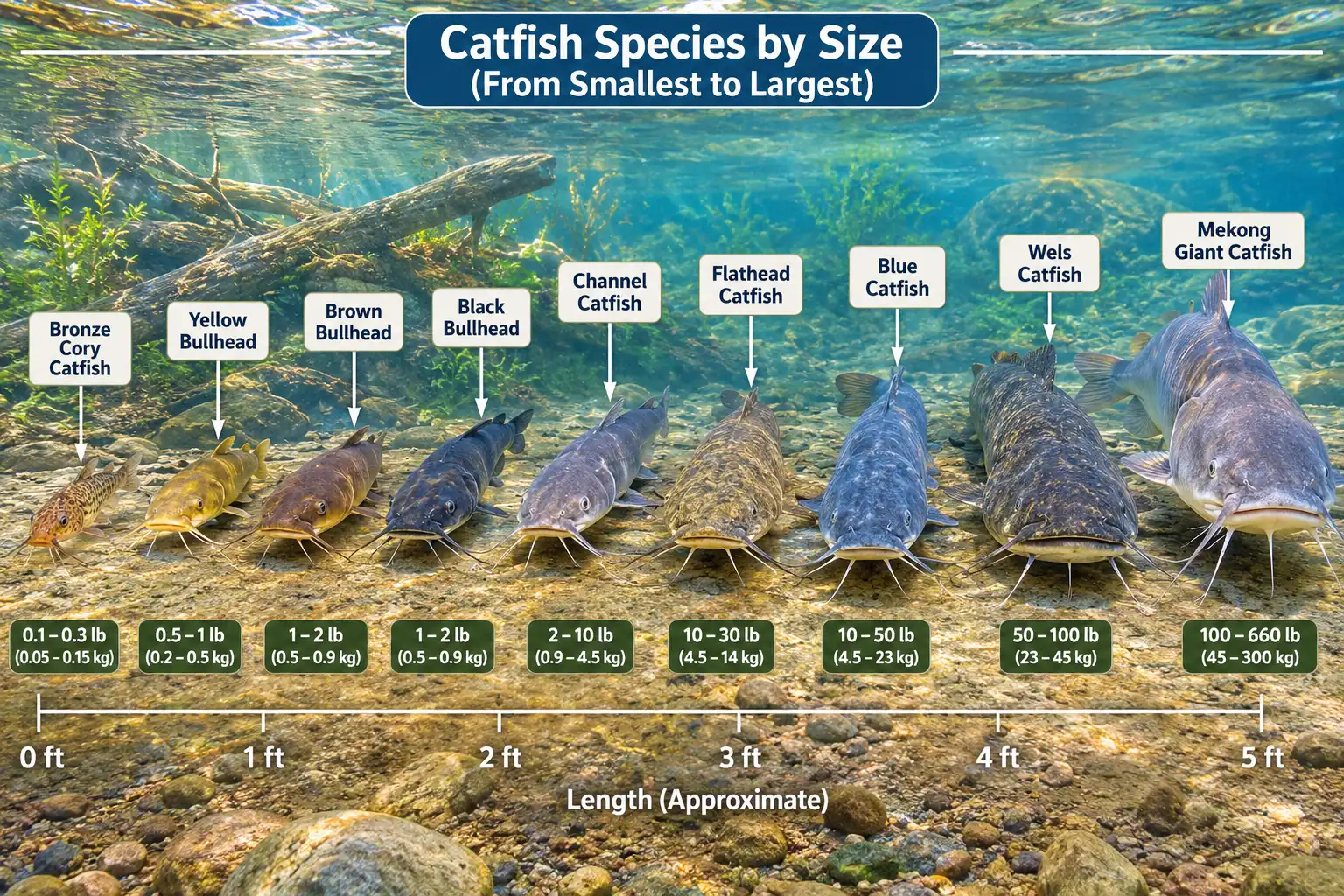
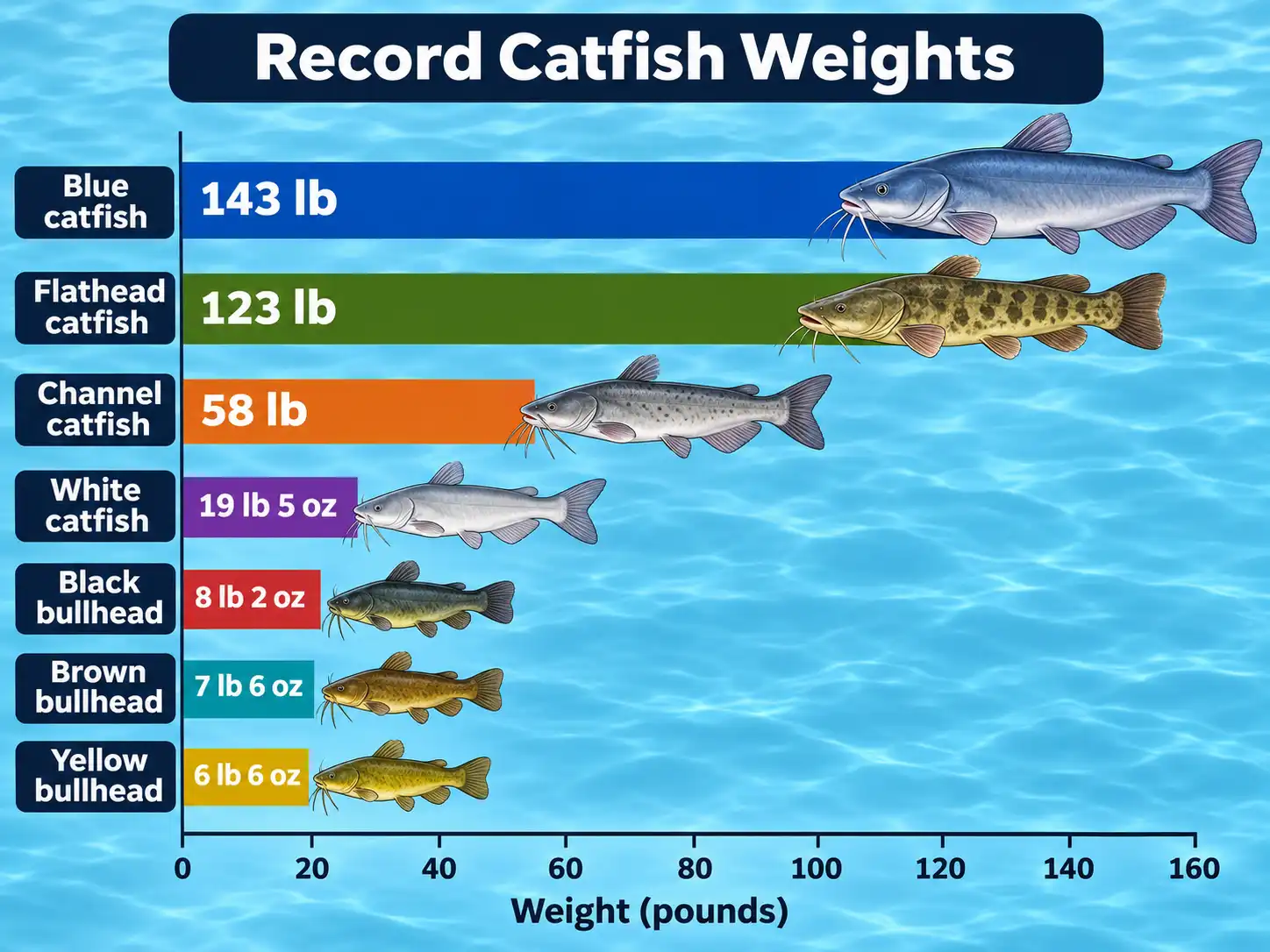
Record weights below run from 6 pounds 6 ounces for the yellow bullhead to 646 pounds for the Mekong giant catfish. Most figures below come from the all-tackle records of the International Game Fish Association (IGFA). The Mekong giant figure comes from Guinness World Records, and the cory catfish size comes from UF/IFAS Extension.
| Species | Biggest documented size | Where and when | Record keeper |
|---|---|---|---|
| Mekong giant catfish (Pangasianodon gigas) | 646 lb, 8 ft 11 in long | Mekong River, Thailand, 2005 | Guinness World Records |
| Wels catfish (Silurus glanis) | 297 lb 9 oz | River Po, Italy, 2010 | IGFA all-tackle |
| Blue catfish (Ictalurus furcatus) | 143 lb | Kerr Lake, Virginia, 2011 | IGFA all-tackle |
| Flathead catfish (Pylodictis olivaris) | 123 lb | Elk City Reservoir, Kansas, 1998 | IGFA all-tackle |
| Channel catfish (Ictalurus punctatus) | 58 lb | Santee-Cooper Reservoir, South Carolina, 1964 | IGFA all-tackle |
| White catfish (Ameiurus catus) | 19 lb 5 oz | Oakdale, California, 2005 | IGFA all-tackle |
| Black bullhead (Ameiurus melas) | 8 lb 2 oz | Massapequa Lake, New York, 2015 | IGFA all-tackle |
| Brown bullhead (Ameiurus nebulosus) | 7 lb 6 oz | Mahopac Lake, New York, 2009 | IGFA all-tackle |
| Yellow bullhead (Ameiurus natalis) | 6 lb 6 oz | Drexel, Missouri | IGFA all-tackle |
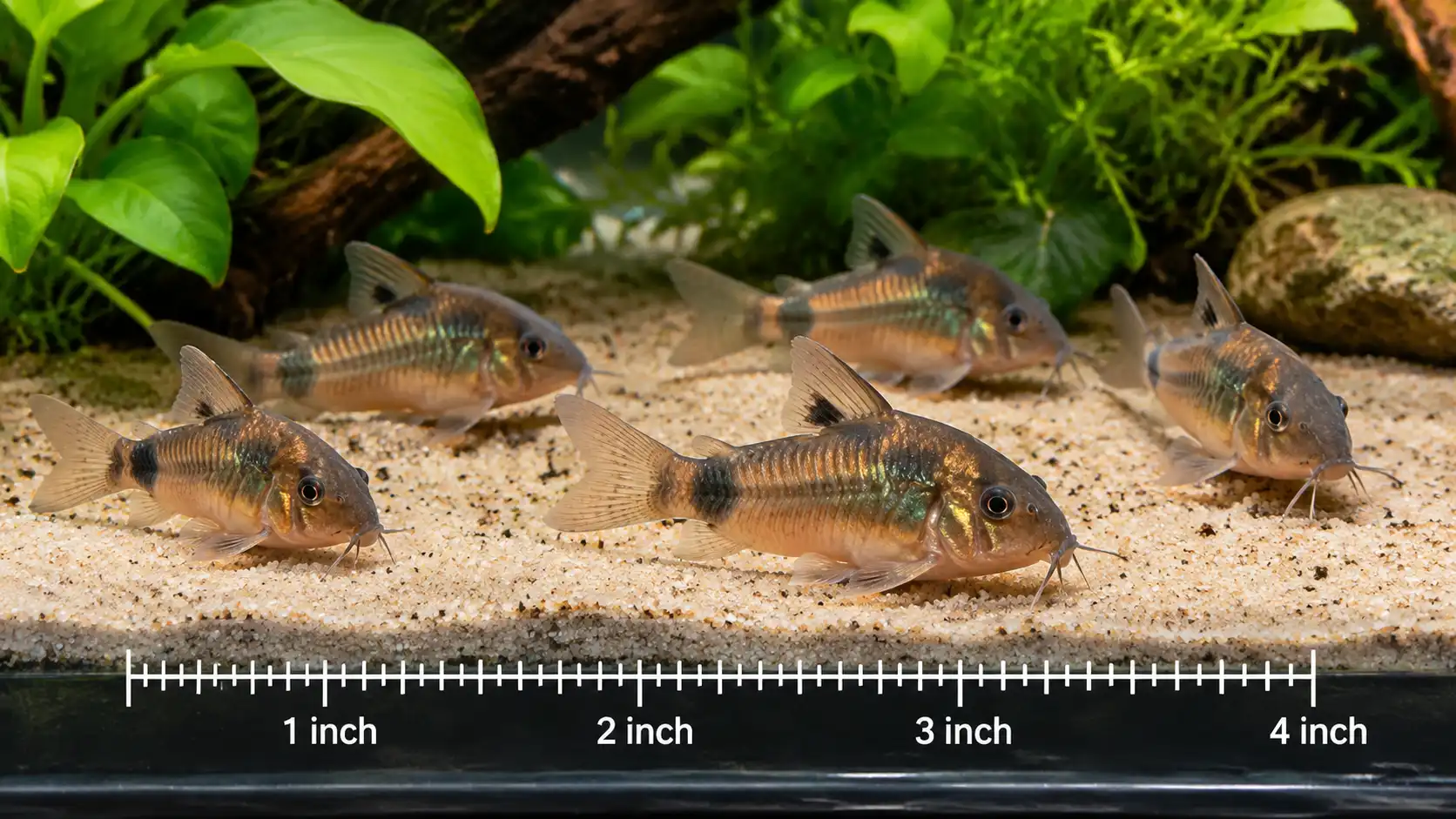
| Cory catfish (Corydoras species) | Most under 4 in long | Aquarium fish, farmed in Florida | UF/IFAS Extension |
Records mark the ceiling, not the typical fish. A commercial catfish pond, for example, rarely holds fish anywhere near these weights.
Types of Catfish and How Their Sizes Differ
“Catfish” covers a whole order of fish, Siluriformes, so the name spans many families with very different sizes. These six families cover every species in this guide:
- North American catfishes (Ictaluridae): blue, channel, flathead, and white catfish, plus the bullheads. This is the family US catfish farms raise.
- Shark catfishes (Pangasiidae): the Mekong giant catfish of Southeast Asia.
- Sheatfishes (Siluridae): the wels catfish, native to Europe and western Asia.
- Armored catfishes (Callichthyidae): the cory catfish. UF/IFAS Extension counts about 224 species in eight genera, and most stay under 4 inches.
- Suckermouth armored catfishes (Loricariidae): the plecos. UF/IFAS puts this family at more than 1,000 species.
- Airbreathing catfishes (Clariidae): the walking catfish and its relatives, which federal rules restrict.
On US farms, the first family is the one that pays. US catfish growers had $394 million in sales in 2025, per USDA NASS’s February 2026 Catfish Production report.
What Is the Largest Catfish Species?
The Mekong giant catfish (Pangasianodon gigas) is the largest catfish species. Guinness World Records says it can grow up to 9 feet 10 inches long. Its record fish came from the Mekong River in Thailand in 2005. That catfish measured 8 feet 11 inches and weighed 646 pounds.
The species now shares a title, too. Guinness lists the Mekong giant catfish and the giant freshwater stingray together as the largest freshwater fish species. A female stingray from Cambodia in June 2022 weighed 661 pounds, just ahead of the catfish.
The Mekong giant catfish lives in the Mekong River basin of Southeast Asia. So for a US reader, it serves as a reference point rather than a farm option.
World Record Catfish: How the Records Work
Most catfish world records come from IGFA, which certifies rod-and-reel catches by weight. A fish has to go on a scale to count. Guinness World Records notes that anglers released some larger wels catfish before weighing them. As a result, IGFA could not recognize them.
For released fish, IGFA keeps separate all-tackle length records. Its March 2026 record list, for example, added a 128-centimeter (50-inch) sharptooth catfish from South Africa’s Orange River.
Netted fish sit outside angling records altogether. That’s why the 646-pound Mekong giant catfish appears in Guinness World Records rather than in IGFA’s weight records.
Records also change. So check IGFA’s current listing before you quote a number.
How Big Do Blue Catfish Get?
Blue catfish (Ictalurus furcatus) hold the heaviest record of any North American catfish. IGFA’s all-tackle blue catfish record is 143 pounds, from Kerr Lake, Virginia, in June 2011. That’s about 2.5 times the channel catfish record of 58 pounds.
Blue catfish also matter on farms, though not for their size. Hybrid catfish come from crossing a female channel catfish with a male blue catfish. As a result, hatcheries that produce hybrids keep blue catfish males as broodfish.
Before you stock blue catfish in a private pond, check your state fish and wildlife agency’s stocking rules.
How Big Do Flathead Catfish Get?
IGFA’s all-tackle flathead catfish (Pylodictis olivaris) record is 123 pounds. The fish came from Elk City Reservoir near Independence, Kansas, on May 19, 1998. IGFA counts it among its long-standing world records, and it has held for 28 years.
That puts the flathead second among North American catfish, 20 pounds behind the blue catfish record. After that comes a long drop, because the channel catfish record is less than half the flathead mark.
How Big Do Channel Catfish Get?
IGFA’s all-tackle channel catfish (Ictalurus punctatus) record is 58 pounds, from South Carolina’s Santee-Cooper Reservoir in July 1964. That record has stood for more than 60 years.
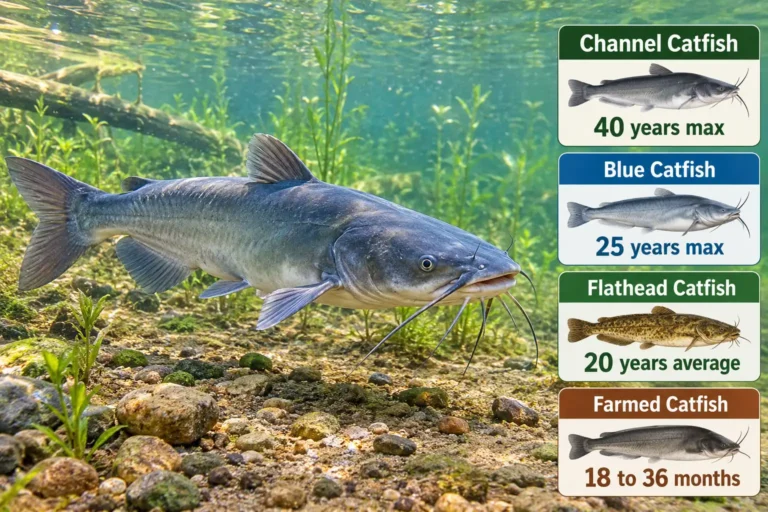
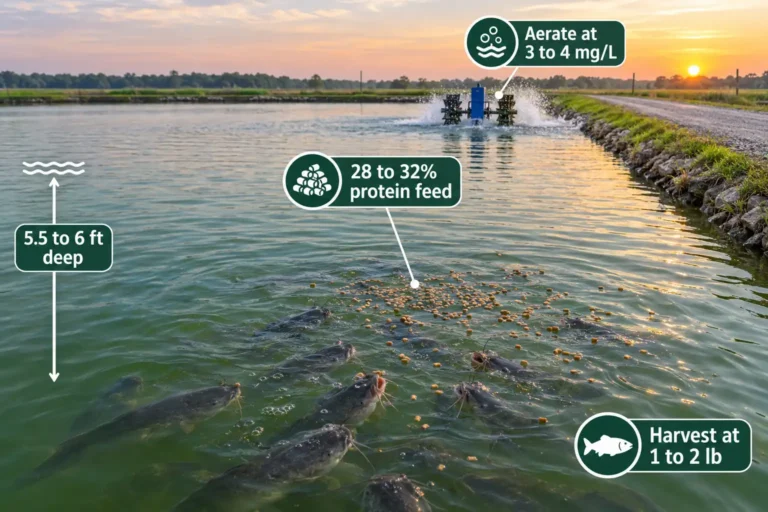
On farms, however, channel catfish never come close. Mississippi State University Extension says farms harvest food-size channel catfish at 1 to 2 pounds. That takes roughly 18 to 36 months from the egg.
The biggest channel catfish on a farm are the broodfish. Mississippi State says they need to be at least 3 years old and 3 pounds to spawn reliably. Prime spawners are 4 to 6 years old and weigh 4 to 8 pounds. USDA NASS, by comparison, defines the most desirable broodfish size as 3 to 10 pounds. The two ranges answer different questions: one describes spawning performance, while the other sets a survey category.
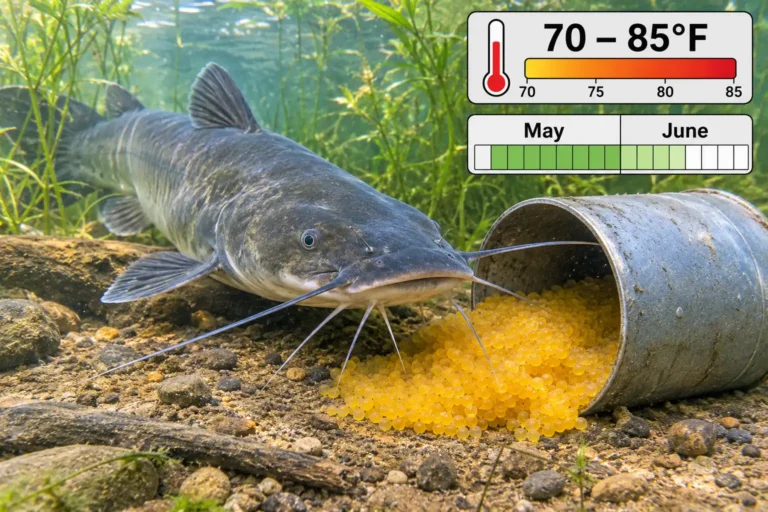
Size also drives egg numbers. Mississippi State says 4- to 8-pound channel catfish females typically lay 3,000 to 4,000 eggs per pound of body weight. So a 6-pound female works out to roughly 18,000 to 24,000 eggs.
For the full cycle from fingerling to harvest, see the guide to pond growout for food-size catfish.
How Big Do Bullhead Catfish Get?
Bullheads are among the smaller North American catfish. IGFA’s all-tackle black bullhead record is 8 pounds 2 ounces. The brown bullhead record is 7 pounds 6 ounces, and the yellow bullhead record is 6 pounds 6 ounces. The black and brown bullhead records both came from New York lakes, in 2015 and 2009. Meanwhile, the yellow bullhead record came from Drexel, Missouri.
So even the black bullhead record is only about one-seventh of the channel catfish record.
The white catfish (Ameiurus catus) sits between the two groups. It shares a genus with the bullheads. Yet IGFA’s all-tackle white catfish record is 19 pounds 5 ounces, from Oakdale, California, in 2005.
How Big Do Wels Catfish Get?
The wels catfish (Silurus glanis) is the giant catfish of Europe. IGFA’s all-tackle wels record is 297 pounds 9 ounces, from Italy’s River Po in 2010.
Anglers have measured longer wels since then. Guinness World Records cites a 285-centimeter (9-foot 4-inch) wels from the River Po in June 2023. It also cites a 292-centimeter (about 9-foot 7-inch) wels from Poland’s Rybnik Reservoir in October 2025. Guinness gives no weight for either fish.
In the US, though, wels catfish are off-limits without federal permission. The US Fish and Wildlife Service (USFWS) lists the wels as injurious wildlife under the Lacey Act. That listing took effect October 31, 2016.
How Big Do Cory Catfish Get?
Most cory catfish stay under 4 inches long. UF/IFAS Extension Circular 54 says most armored catfish species (family Callichthyidae) measure under 100 millimeters, about 4 inches. Corydoras is the family’s best-known genus in the aquarium trade.
Cory catfish also breathe air. According to UF/IFAS, they dart to the surface, gulp a bubble, and absorb oxygen from it in the gut.
Florida farms raise many of them. UF/IFAS says freshwater tropical ornamental fish culture is Florida’s largest aquaculture sector. It supplies about 95 percent of the ornamental fish produced in the US.
Plecos are a different story. UF/IFAS lists common and gibbiceps plecos at about 18 inches, while bushy-nose plecos reach about 5 inches. So check the exact species before you buy any catfish for a home tank.
How Big Are Farm-Raised Catfish at Harvest?
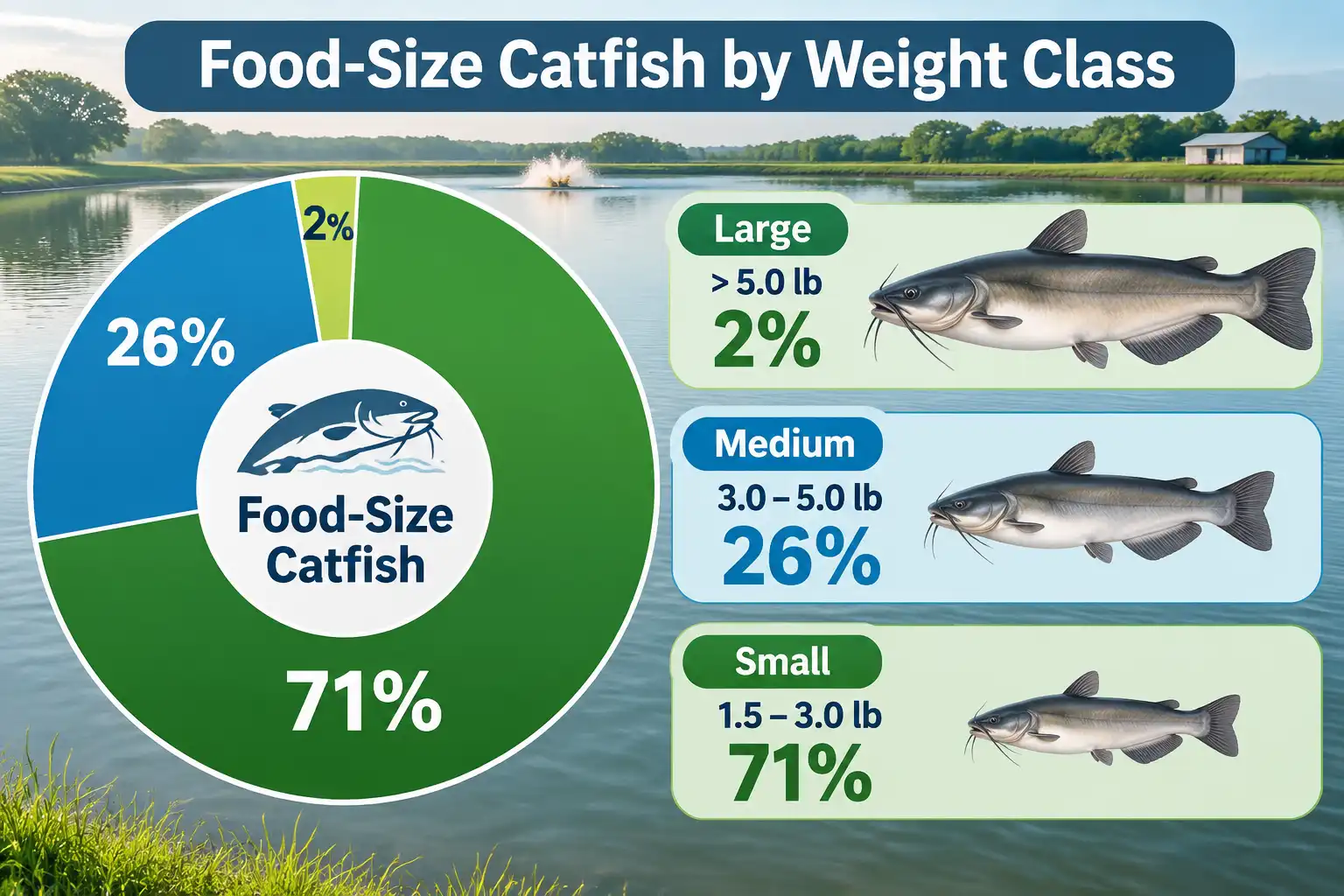
Most food-size catfish on US farms weigh 0.75 to 3 pounds, based on USDA NASS counts from the three major producing states. The NASS July 2026 Catfish Production report sorts them into three weight classes. On July 1, 2026, farms in Alabama, Arkansas, and Mississippi held 93.4 million food-size catfish:
| Size class | Weight per fish | Catfish on hand, July 1, 2026 | Share of food-size inventory | Average weight |
|---|---|---|---|---|
| Small | Over 0.75 to 1.5 lb | 66.6 million | 71% | 1.0 lb |
| Medium | Over 1.5 to 3 lb | 24.6 million | 26% | 1.9 lb |
| Large | Over 3 lb | 2.19 million | 2% | 3.5 lb |
In other words, catfish over 3 pounds made up only about 2 percent of food-size inventory. Farms sell their catfish long before the fish approach their size potential.
Grading decides which catfish leave the pond. Mississippi State University Extension describes in-pond graders that sort sub-harvestable catfish out of the seine right after harvest. For the steps, see seining and grading catfish ponds.
Farm-Raised Catfish Size at Each Life Stage
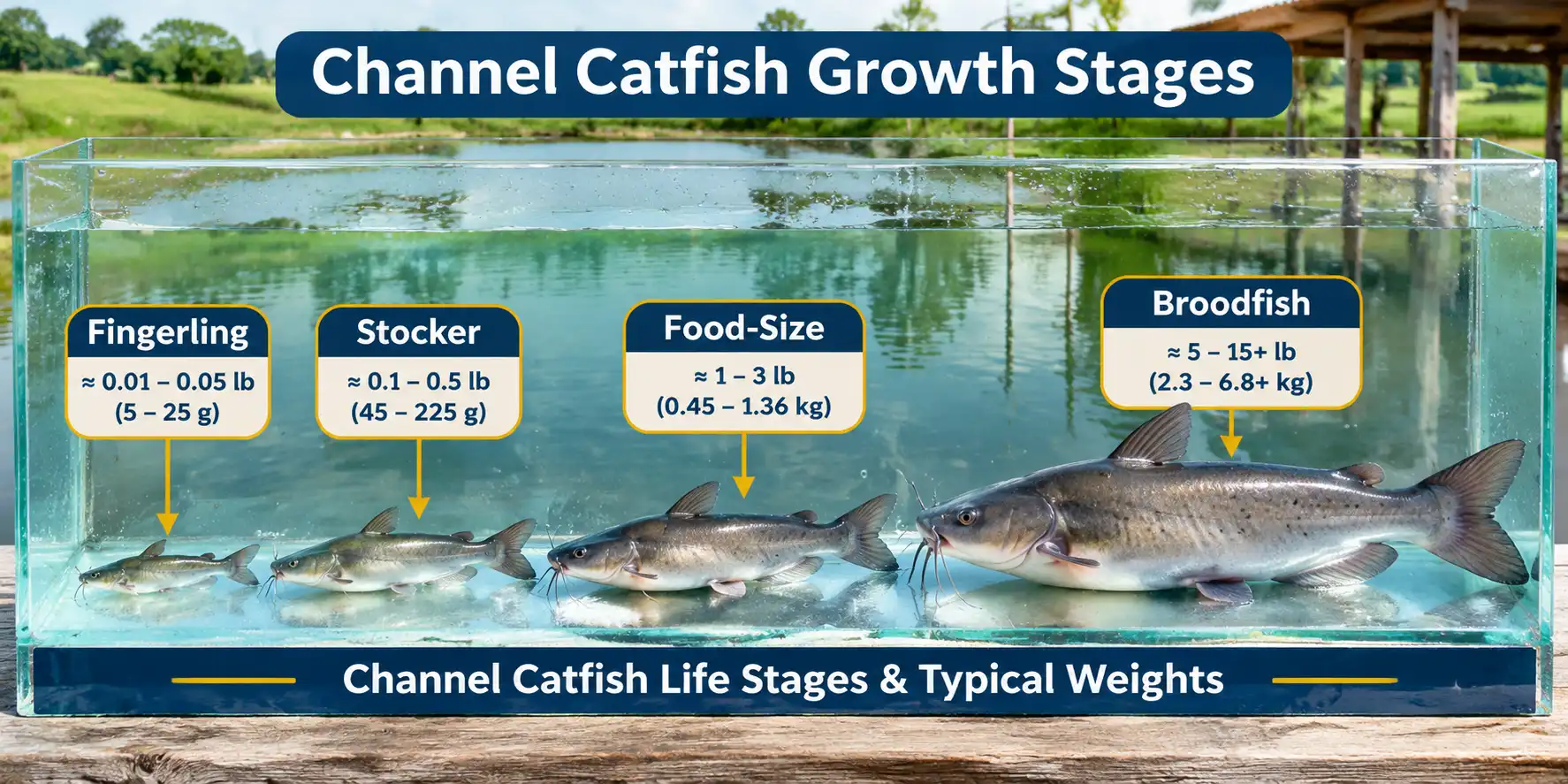
A farmed catfish passes three named size stages on its way to market. A few stay on as broodfish. USDA NASS defines each stage by length or by pounds per 1,000 fish, shown here per fish:
| Life stage | USDA NASS definition | Weight per fish | Timing for channel catfish (Mississippi State) |
|---|---|---|---|
| Fingerling | 2 to 6 inches, or 2 to 60 lb per 1,000 fish | Under 1 oz | Grown 5 to 10 months, harvested in autumn or winter |
| Stocker | Over 60 to 750 lb per 1,000 fish; small stockers over 6 inches | About 1 to 12 oz | One growing season from small fingerlings |
| Food-size | Over 0.75 lb | 0.75 lb and up | 18 to 36 months from egg; harvested at 1 to 2 lb |
| Broodfish | Most desirable size 3 to 10 lb | 3 to 10 lb | Prime spawners 4 to 6 years old |
The early steps move fast. Mississippi State says channel catfish eggs hatch after 5 to 8 days of incubation. Fry then spend 4 to 10 days in the hatchery before nursery ponds.
The two sources define fingerlings differently. NASS counts them as 2 to 6 inches. Mississippi State, however, describes nursery ponds producing 3- to 8-inch fingerlings. One is a survey category; the other describes a nursery season’s output.
Size at stocking sets your timeline, so check what you’re getting when buying fingerlings from a hatchery.
How Many Catfish Fill a Processor Harvest?
About 5,700 to 25,000 catfish, depending on their size. Mississippi State University Extension notes that producers selling to a large processor usually wait for a full load. They don’t schedule a harvest until 20,000 to 25,000 pounds of graded catfish will stay in the net. Dividing that weight by the July 2026 NASS average weights gives the fish count:
Small class, 1.0 lb average:   20,000 to 25,000 lb / 1.0 = 20,000 to 25,000 catfish
Medium class, 1.9 lb average:  20,000 to 25,000 lb / 1.9 = about 10,500 to 13,200 catfish
Large class, 3.5 lb average:   20,000 to 25,000 lb / 3.5 = about 5,700 to 7,100 catfish
Your own count will differ. So weigh a sample from your pond before you book a harvest. Then use your average weight in place of the USDA figure.
Can You Farm Giant Catfish in the US?
Not the biggest foreign species. USFWS lists two groups of catfish as injurious wildlife under the Lacey Act:
- Walking catfishes (family Clariidae): listed effective January 1, 1970. The USFWS summary counts 118 species in the family.
- Wels catfish (Silurus glanis): listed effective October 31, 2016.
The rule at 50 CFR Part 16 restricts importing, moving, or acquiring them or their eggs without a USFWS permit. For wels, the listing covers hybrids too. The rule also bars releasing them into the wild unless the state wildlife agency approves. The Clariidae listing includes the sharptooth catfish (Clarias gariepinus), the species behind IGFA’s 128-centimeter length record from South Africa.
Native catfish come with rules, too. Your state decides which species you may buy, stock, or sell, and many states require an aquaculture license. So check your state fish and wildlife agency’s restricted species list before you buy any catfish. Also confirm state aquaculture licenses and permits early.
Finally, never release farmed catfish into public waters. It’s often illegal, and escaped farm fish can spread disease or become invasive.
FAQs About Catfish Size
What is the biggest catfish on record in North America?
IGFA’s all-tackle blue catfish record is the biggest, at 143 pounds from Kerr Lake, Virginia, in June 2011. The flathead catfish record of 123 pounds, from Kansas in 1998, ranks second.
How long does a catfish take to reach 1 pound?
On catfish farms, channel catfish reach food size of 1 to 2 pounds about 18 to 36 months after the egg stage, per Mississippi State University Extension. Stocking rate, cropping system, and fingerling size drive much of that spread.
Can a catfish grow to 100 pounds in a farm pond?
Not on a food-fish farm, which sells catfish long before that. Mississippi State Extension says farms harvest food-size channel catfish at 1 to 2 pounds, and USDA NASS counted only 2 percent of July 2026 food-size inventory above 3 pounds.
How big is a catfish fingerling?
USDA NASS defines catfish fingerlings as fish 2 to 6 inches long, or 2 to 60 pounds per 1,000 fish. That works out to less than 1 ounce for each catfish fingerling counted.
How much does a stocker catfish weigh?
USDA NASS defines catfish stockers as 60 to 750 pounds per 1,000 fish, or about 1 to 12 ounces each. Mississippi State University Extension describes channel catfish stockers of 0.1 to 0.25 pounds, near the small end of that range.
Can you keep a wels catfish in the US?
Not without a federal permit. USFWS listed the wels catfish as injurious wildlife under the Lacey Act effective October 31, 2016, restricting imports, movement, and acquisition of live fish, eggs, and hybrids.
Before You Stock
Record catfish make good headlines, but they tell you little about a farm pond. For food fish, plan around a channel catfish harvest weight of 1 to 2 pounds. Mississippi State University Extension puts the egg-to-harvest timeline at 18 to 36 months. Then weigh your own fish before you book a processor harvest. Also check your state’s restricted species list before you buy any catfish. Wels and walking catfish need a federal permit, too. For water, feed, and pond setup by species, start with the catfish species guide.