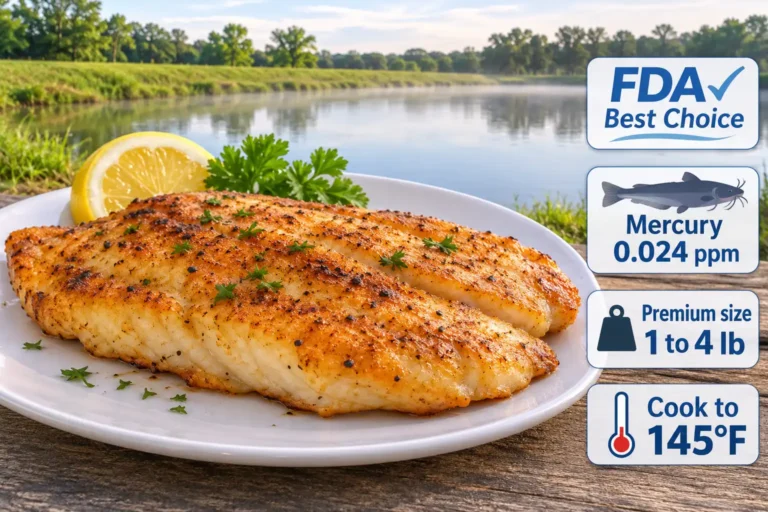
Catfish Farming Guide: Stocking Rates, 28% Protein Feed, and Harvest
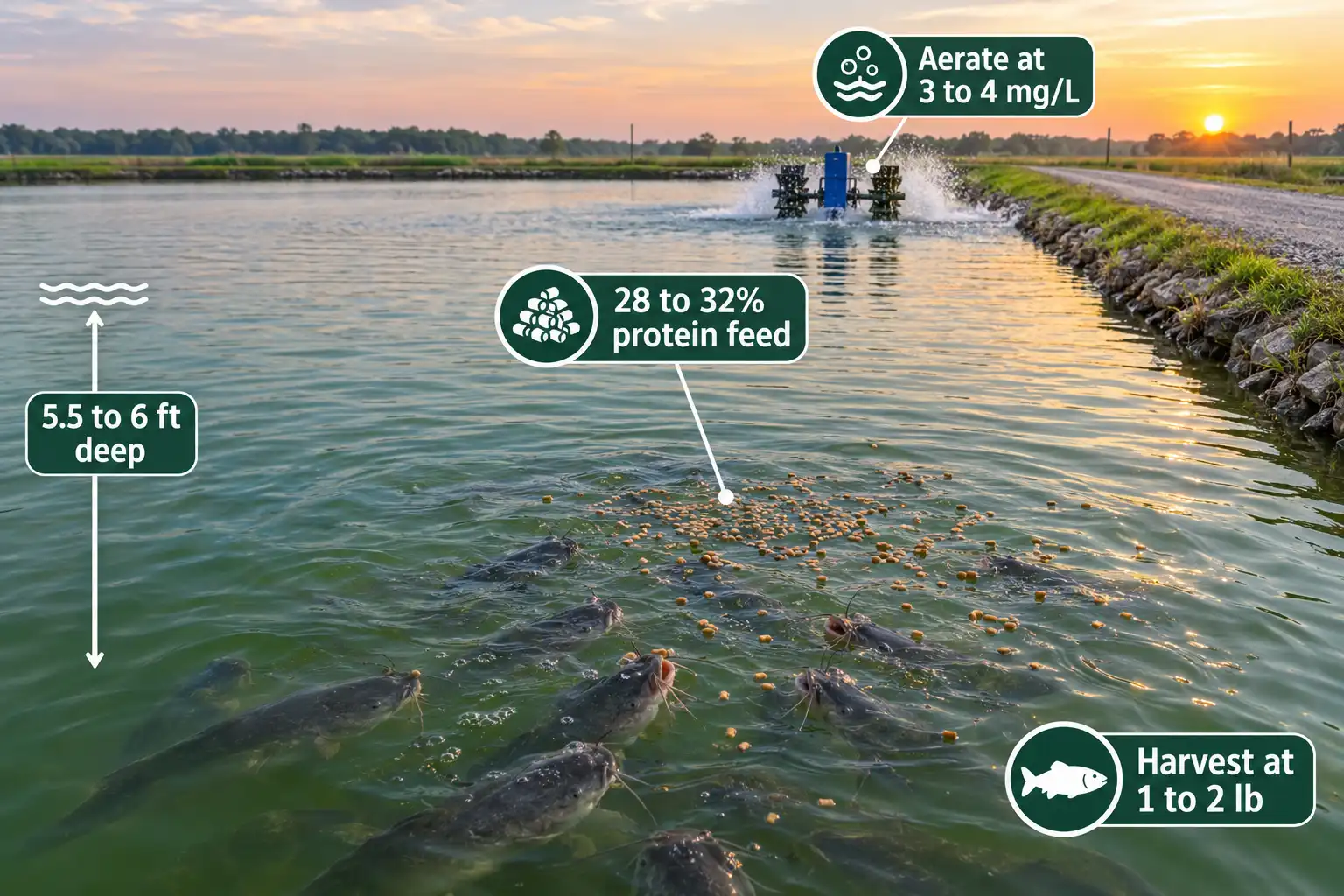
Catfish farming earns more than any other US food fish, and nearly all of it happens in earthen ponds. Here are the numbers behind a crop: what to stock, how to feed and aerate, and when to sell.
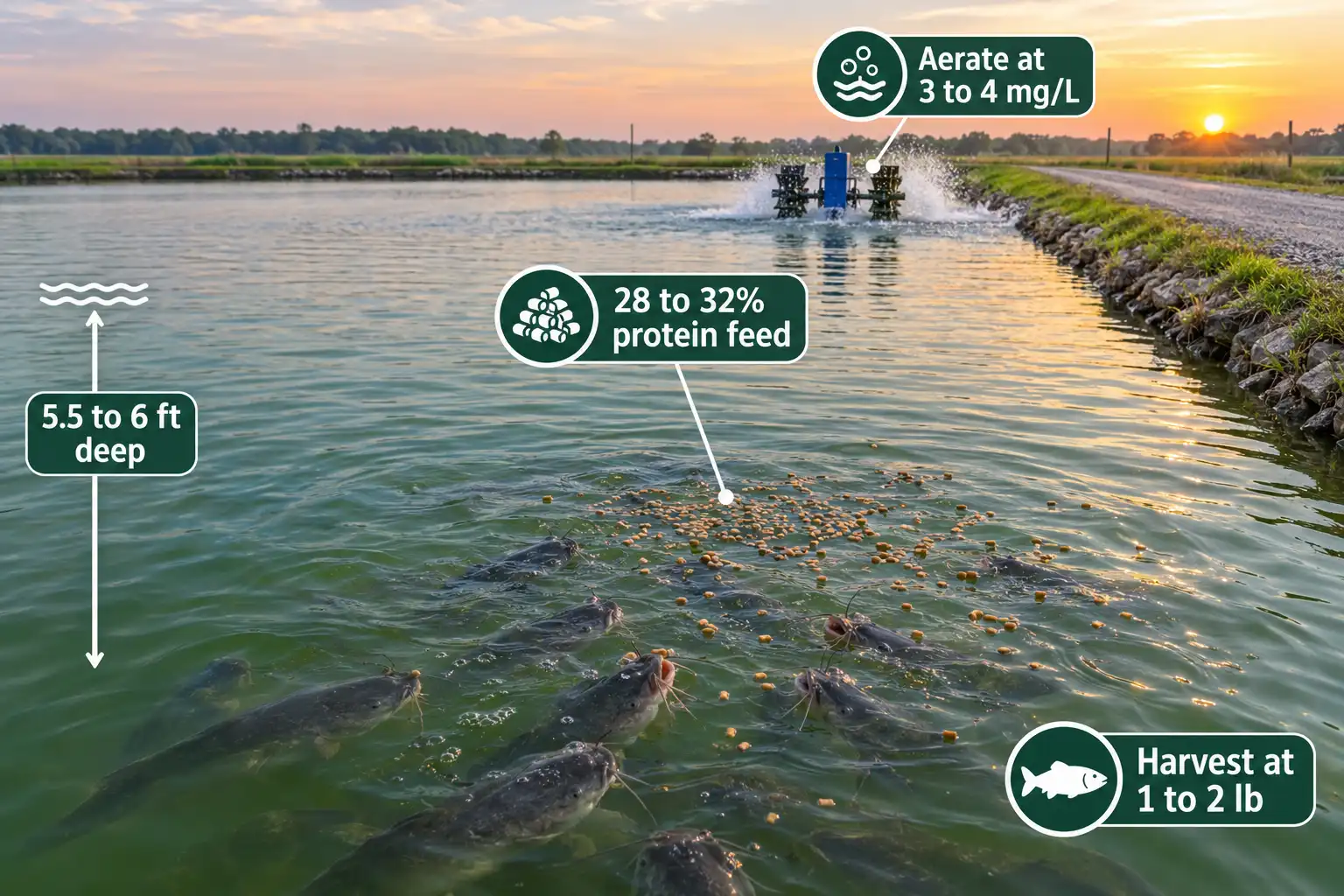
Catfish farming raises channel or hybrid catfish in earthen ponds. Mississippi State Extension says food-size catfish eat 28 to 32 percent protein pellets. Catfish ponds need aerators at 3 to 4 mg/L, and fish sell at 1 to 2 pounds.
US Catfish Farming by the Numbers
Catfish lead US food fish sales by a wide margin. USDA NASS valued 2023 catfish sales at $480 million in its 2023 Census of Aquaculture. That was 59 percent of all US food fish sales.
The industry is shrinking, though. NASS’s February 2026 Catfish Production report counted 48,115 catfish water acres on January 1, 2026. That’s down 8 percent in one year. Growers sold $394 million of catfish in 2025, up 1 percent from 2024. Mississippi, Alabama, Arkansas, and Texas made 96 percent of those sales.
The same report shows a typical sale. In 2025, food-size catfish averaged 1.5 pounds each and sold for $1.11 per pound live weight. Processors bought 92.7 percent of them. So most farms grow for a plant, and the plant’s schedule shapes the farm’s year.
Costs matter as much as price. Since 2023, production costs on many catfish farms have run above the fish price. Mississippi State economist Ganesh Kumar made that point in an August 2026 Extension report. One caution: the census and the annual report use different surveys, so their sales totals differ.
Channel or Hybrid Catfish: Which Should You Stock?
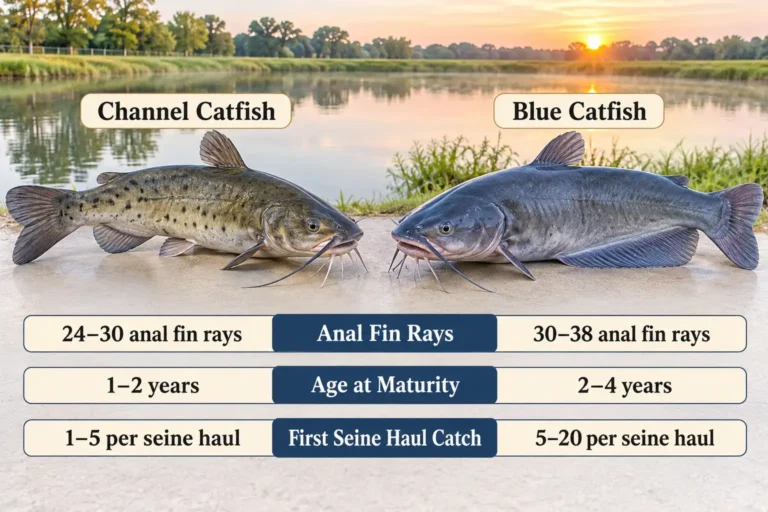
Hybrid catfish suit intensive, heavily aerated ponds. Channel catfish are simpler if you spawn your own fry. The hybrid is a channel catfish female crossed with a blue catfish male. Mississippi State Extension says most commercial producers stock hybrids in their intensive ponds.
| Trait | Channel catfish | Hybrid catfish (channel x blue) |
|---|---|---|
| How fry are produced | Pond spawning in containers, no hormones needed | Hormone-induced spawning and hand stripping in a hatchery |
| Fingerling survival | 50 to 60 percent | 80 to 85 percent |
| Food-fish survival | About 70 percent | About 90 percent |
| Feed conversion on farms | Baseline | 10 to 20 percent better |
| Harvest by seine | Five or more hauls may not catch all | Two or three hauls catch nearly all |
| Disease resistance | Baseline | Higher against ESC, columnaris, Aeromonas, and ich |
| Small cages | Grow faster | Grow poorly |
The fry row comes from Mississippi State Extension. The rest comes from SRAC Publication 190 (June 2012 revision). It draws on 30 years of Auburn University research plus commercial farm results.
Sources split on feed efficiency, however. SRAC 190 credits hybrids with better on-farm feed conversion. A 2015 Mississippi State information sheet, though, calls the reports conflicting. So treat the feed advantage as likely, not certain.
Hybrid fry also cost more to make, because they need hormone-induced spawning. SRAC 190 notes that hatcheries have used those hormones under FDA’s Investigational New Animal Drug program. Hybrids’ small heads and sharp spines can also gill them in large-mesh seines.
How Long Does a Catfish Crop Take?
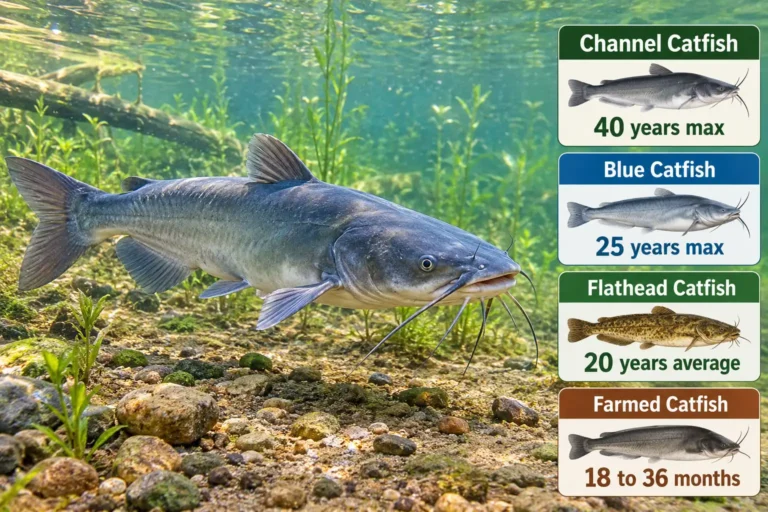
Producing a food-size channel catfish from an egg takes roughly 18 to 36 months, per Mississippi State Extension. Most of that time is pond growout.
| Stage | What happens | Time |
|---|---|---|
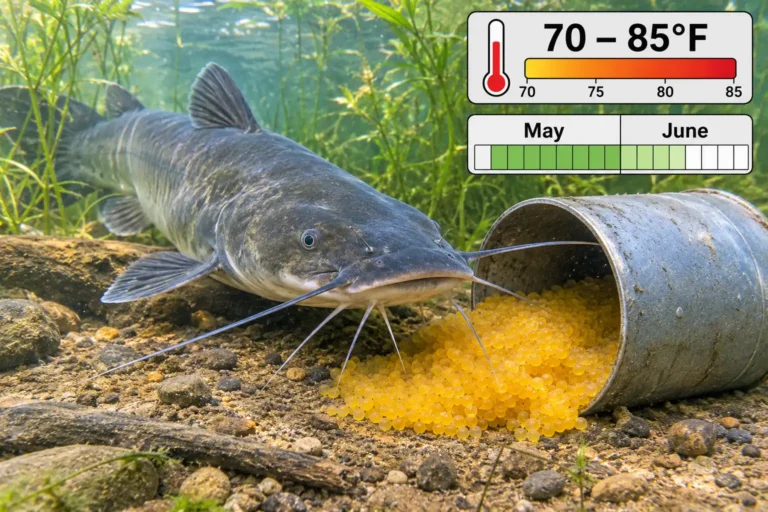
| Spawning | Channel catfish broodstock spawn in containers once water holds near 75°F | Spring |
| Hatching | Eggs incubate in troughs stirred by paddles | 5 to 8 days |
| Fry rearing | Fry absorb the yolk sac, then start on feed in the hatchery | 4 to 10 days |
| Nursery pond | Fry grow into 3 to 8 inch fingerlings | 5 to 10 months |
| Growout | Fingerlings grow into 1 to 2 pound food fish | Most of the remaining time |
Broodstock need age and space. Mississippi State says channel catfish must be at least 3 years old to spawn reliably. Channel catfish brood ponds also stay under 2,000 pounds per acre. Fry survival swings widely between ponds. So a farm-wide average above 60 percent, fry to fingerling, counts as very good.
Processing plants buy catfish all year. As a result, most commercial ponds hold several sizes of channel catfish at once.
Catfish Ponds: Levee, Watershed, and Intensive Systems
Ponds grow over 95 percent of US channel catfish, per Mississippi State Extension, because they pay best. Two pond types dominate.
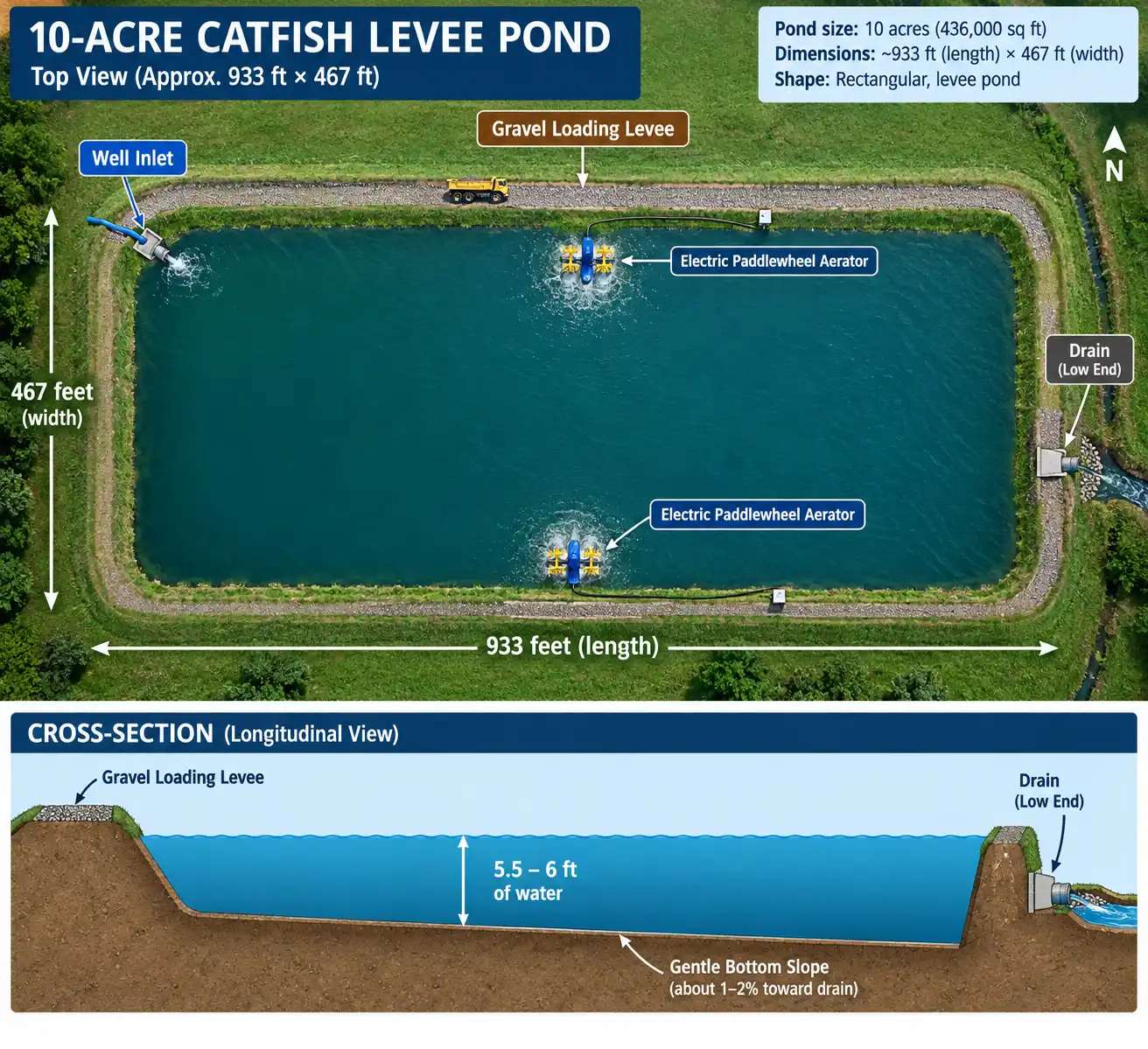
Levee ponds sit on flat land, mostly in the Mississippi and Arkansas Delta. They’re usually rectangles, 2:1 to 3:1 long to wide. New catfish levee ponds average 8 to 12 acres and hold 5.5 to 6 feet of water where possible. A bottom slope of 0.2 to 0.3 feet per 100 feet lets each pond drain on its own. Wells are the preferred source, since groundwater carries no wild fish.
Watershed ponds dam a valley and fill from runoff, as in eastern Mississippi and western Alabama. They cost less and need no well. Still, the bottom must stay smooth and nearly flat for seining. Dam and spillway design belongs to NRCS staff or a licensed engineer under state dam safety rules.
Main levees need gravel for the hauling trucks. Check soil, slope, and water supply before building levee or watershed ponds.
Intensive Pond Systems
Two newer designs push yields higher, mostly with hybrid catfish, per Mississippi State Extension. Split ponds hold all the catfish in 15 to 20 percent of the area. The rest treats the water. Over nine years, hybrid catfish in split ponds produced 15,000 to 20,000 pounds per acre a year.
Small intensive catfish ponds of 4 to 8 acres run 5 to 10 horsepower of aeration per acre. They yield 12,000 to 18,000 pounds of hybrid catfish per acre. Both systems need mechanical aeration every night.
Worked Example: Sizing a 10-Acre Catfish Pond
Take a 10-acre catfish levee pond built 2:1 at 5.5 feet average depth. Swap in your own acreage and depth.
- Volume: 10 acres x 5.5 feet = 55 acre-feet. At 325,851 gallons per acre-foot, that’s about 17.9 million gallons.
- Shape: 10 acres is 435,600 square feet. A 2:1 pond that size runs about 933 by 467 feet.
- Seine: Mississippi State Extension sizes catfish seines at 1.5 times the pond’s widest section. That’s about 700 feet here. Food-size catfish seines for Delta ponds usually run 9 feet deep.
The stocking, feed, aeration, and permit sections below carry this same pond forward.
How Many Catfish to Stock Per Acre
Commercial channel catfish ponds hold anywhere from under 3,000 to over 18,000 fish per acre. Mississippi State Extension notes there’s no consensus on the best rate. Aeration, cropping system, and fingerling size decide where you land.
Without aeration, stay low. Kentucky State University’s guide WKY-211 sets a ceiling for warmwater ponds without aerators. Stock no more than 2,000 warmwater fish per acre. Feed those fish no more than 25 to 30 pounds per acre a day.
Single-batch or multiple-batch. Single-batch means you stock one group of fingerlings, harvest them all, then restock. Multiple-batch means you seine out the biggest fish (“topping”) and add fingerlings to replace them (“understocking”). That can go on for years without draining. It keeps fish flowing to the plant. However, Mississippi State notes it makes true inventory nearly impossible to know.
Hybrid targets. SRAC Publication 190 gives single-crop results for spring-stocked hybrid catfish fingerlings 7 inches or longer:
- 3,000 hybrids per acre gave about 5,500 pounds of marketable fish by fall.
- 5,000 hybrids per acre gave about 9,000 pounds by fall.
At 6,000 hybrids per acre, SRAC 190 calls 12,000 to 13,000 pounds per acre a reasonable average. These yields assume near-satiation feeding and enough aeration. In the 10-acre pond, 5,000 hybrids per acre means 50,000 fingerlings and about 90,000 pounds at harvest.
Water Quality Targets for Channel Catfish
Mississippi State Extension ranks oxygen, carbon dioxide, ammonia, and nitrite as the catfish pond measures that matter most. They change fast. The table gathers the main channel catfish targets with their sources.
| Measure | Channel catfish figure | Source |
|---|---|---|
| Best growth temperature | 75 to 85°F | Mississippi State Extension |
| Best growth temperature | About 85°F | SRAC Publication 180 (1988) |
| Feeding slows | Below 70°F | Mississippi State Extension |
| Feeding nearly stops | About 50°F | Mississippi State Extension |
| Long-term survival limit | About 95°F | Mississippi State Extension |
| Growth slows | Oxygen under 4 mg/L | SRAC Publication 180 |
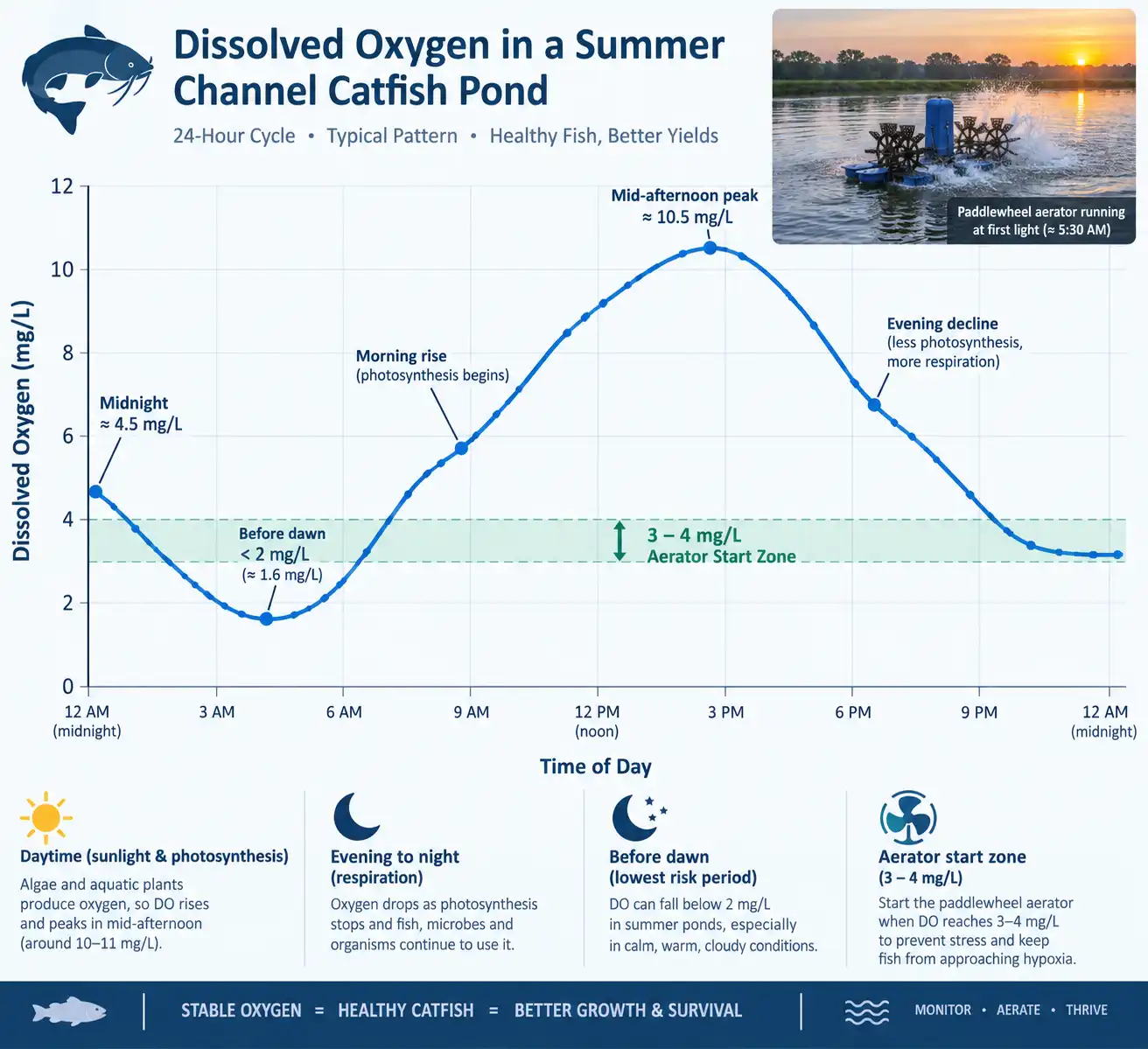
| Start aerators | 3 to 4 mg/L | Mississippi State Extension |
| Lethal oxygen | About 1 mg/L | SRAC Publication 180 |
The two growth figures overlap. Mississippi State gives a range, while SRAC 180 names one best point near 85°F.
Oxygen swings every day. Mississippi State Extension notes that nearly every catfish pond drops below 2 mg/L at dawn in midsummer. Those lows usually last 3 to 6 hours a night. That’s why oxygen levels before dawn are the reading that matters most.
Nitrite needs a plan too. It builds when ammonia runs high and can poison channel catfish. Still, Mississippi State says losses are now rare, because farms monitor it and use common salt to prevent it. Test chloride and nitrite together. Then let your extension aquaculture specialist set the salt amount.
How Much Aeration Does a Catfish Pond Need?
Plan on 1.5 to 2 horsepower per acre for a traditional catfish pond, and far more for an intensive one. The two figures answer different questions.
SRAC Publication 3700 (2005) puts commercial catfish ponds at 1.5 to 2 horsepower per acre, trending toward 2 to 3. SRAC adds that many farms keep tractor-driven paddlewheels for emergencies, often one per four or five ponds. Meanwhile, Mississippi State Extension describes 4 to 8 acre hybrid catfish ponds running 5 to 10 horsepower per acre.
Feeding rate drives the gap. Kentucky State’s WKY-211 suggests 1 horsepower per 22 pounds of daily feed per acre in intensive warmwater ponds. At 120 pounds of catfish feed per acre a day, that’s about 5.5 horsepower per acre.
For the 10-acre catfish pond, 1.5 to 2 horsepower per acre means 15 to 20 horsepower. That’s about two 10-horsepower paddlewheels. Feed it 120 pounds per acre daily, though, and the Kentucky State rule calls for about 55 horsepower.
Start catfish pond aerators when oxygen falls to 3 to 4 mg/L, per Mississippi State Extension. Run them until past dawn, once oxygen readings start rising. Aerators belong on ground-fault protected circuits installed by a licensed electrician. Match each unit’s rating to your target when comparing paddlewheel aerators.
Feeding Catfish: Protein and Pellet Size
Food-size channel catfish grow well on 28 percent protein feed. Mississippi State Extension says advanced catfish fingerlings and food fish usually get floating pellets of 28 to 32 percent protein. The pellets run 5/32 to 3/16 inch across. In Mississippi State research, channel catfish on 28 and 32 percent feeds grew about the same from stocker to market. Their feed conversion ratios were 1.65 and 1.67.
Younger catfish need more protein. Channel catfish fry in hatcheries get 45 to 50 percent protein meal, per Mississippi State. Larger catfish fingerlings get 1/8-inch floating pellets at 35 percent. Use a non-medicated feed labeled for catfish of the size you’re feeding.
How Much and How Often to Feed Catfish
Feed once a day, as much as the fish will eat without waste. Mississippi State Publication 2414 (2022 printing) adds these guides for food-size channel catfish:
- Keep long-term catfish feeding at or below about 120 to 150 pounds per acre a day. Mississippi State’s catfish feeding page gives a tighter 100 to 125 pounds.
- Feed in the morning as oxygen rises. Avoid feeding near dark without ample aeration, since pond oxygen demand peaks 6 to 12 hours after catfish eat.
- Blow feed along the upwind side so it doesn’t wash ashore.
- Skipping Sunday feeding cut channel catfish net production 3.3 percent in Mississippi State trials. It also improved feed conversion 4.8 percent.
For the 10-acre catfish pond, 100 to 150 pounds per acre means 1,000 to 1,500 pounds a day. That’s 20 to 30 fifty-pound bags.
Winter Feeding
Channel catfish feed erratically below 70°F and nearly stop at 50°F, per Publication 2414. Even so, feeding pays in mild winters. In Auburn University research cited there, unfed food-size catfish lost up to 9 percent of body weight over winter. Catfish fed 1 percent of body weight on days above 55°F gained 18 percent. For winter, pick an extruded slow-sinking pellet, because it holds together longer than a pellet-mill feed.
Feed Conversion and Feed Cost Per Pound
Budget on farm-level feed conversion, not research results. Mississippi State’s Information Sheet 1364 (2015) sets out the gap. Channel catfish grown to about 1.5 pounds in research ponds routinely convert at 1.8 or better. Across the industry, though, the farm-level catfish ratio averaged about 2.5 over five years. Unrecorded deaths, wasted feed, and catfish left past about 3 pounds explain most of it. The sheet also puts feed near 60 percent of catfish variable costs.
Now run it for the 10-acre hybrid example. Say your hybrid fingerlings weigh about 100 pounds per 1,000 fish. That’s your number to replace. Then 50,000 fingerlings weigh about 5,000 pounds. Growing those hybrids to 90,000 pounds adds 85,000 pounds of gain.
- At a feed conversion ratio of 1.8, that’s 153,000 pounds of feed, about 76 tons.
- At 2.5, it’s 212,500 pounds, about 106 tons.
Mississippi State Extension reported catfish feed above $400 per ton in August 2026. At $400 a ton, the crop needs roughly $30,600 to $42,500 of feed. That’s 36 to 50 cents per pound of gain. The sheet’s figures come mostly from channel catfish, so hybrids may land nearer the low end.
Compare that with the 2025 average food-size catfish price of $1.11 per pound, from USDA NASS. Feed alone takes a third to nearly half of it. Fingerlings, power, labor, and loans come out of the rest. That’s why small gains in feed conversion on catfish farms change the whole budget.
Catfish Health: What to Watch and Who to Call
Fish health and reporting: If catfish go off feed or start dying, check dissolved oxygen first, ideally before dawn. Low oxygen, gill disease, parasites, and bacterial infections can look alike from the levee. So a fish health lab confirms the cause before anything is treated. Delta farms use Mississippi State’s Aquatic Research and Diagnostic Laboratory in Stoneville. Elsewhere, your extension aquaculture specialist can name the nearest lab. Report heavy, unexplained losses to your state veterinarian or aquatic animal health official.
Infectious disease is now the main limit on catfish production, per Mississippi State Extension. It causes about 45 percent of inventory losses on catfish fingerling farms. Of those disease losses, about 60 percent are bacterial and 30 percent parasitic. Fungi cause 9 percent and viruses 1 percent. Mixed infections are common.
SRAC publishes a fact sheet on each major catfish disease. They cover enteric septicemia of catfish (ESC), columnaris, motile Aeromonas septicemia, proliferative gill disease, and ich. Read them to learn what each looks like and when it appears. Then let the lab confirm what your fish have.
Prevention beats treatment. SRAC 190 reports that hybrids resist ESC, columnaris, Aeromonas, and ich better than channel catfish. In August 2026, Mississippi State catfish specialist Jimmy Avery said surviving farms are also buying vaccinated fingerlings. Buy fingerlings with fish health records, and hold new fish apart where you can. If a die-off hits, follow the steps for handling a fish kill.
Catfish Drugs and Treatment Records
The FDA approves a small number of medicated feeds for catfish. Each one needs a Veterinary Feed Directive from a licensed veterinarian. The label and the directive set the species, the use, and the withdrawal time before harvest. Never move or sell fish from a pond with unexplained losses until the lab and your specialist clear it. Keep every treatment and water quality record, too. Under FSIS Directive 14,000.1, plant inspectors may review pond treatment records.
Fish-Eating Birds on Catfish Ponds
Fish-eating birds are a real cost, and you can’t simply shoot them. Mississippi State Extension lists bird depredation among the main challenges facing catfish producers. SRAC Publication 400 names double-crested cormorants and American white pelicans among the main predators at southern fish farms. It notes that all fish-eating birds are protected under the Migratory Bird Treaty Act. SRAC lists nonlethal harassment as an option. Lethal control, however, needs a depredation permit from the US Fish and Wildlife Service.
Federal help exists. In August 2026, Mississippi State Extension reported a USDA ELAP payment for bird losses. It pays eligible catfish producers $600 per acre per year. You need evidence of the loss, and you apply at your local Farm Service Agency office.
Off-Flavor: Why Harvest Gets Delayed
A pond of market-size catfish can’t go to the plant until it passes a flavor check. Mississippi State Extension says plants usually test catfish three or four times. Checks come about two weeks before harvest, the day before, and the day of harvest. One off-flavored sample stops the harvest.
SRAC Publication 192 (1999) ties the two most common off-flavors to blue-green algae. 2-methylisoborneol (MIB) gives a musty, medicinal taste. It leads in northwest Mississippi, southeast Arkansas, and northeast Louisiana. Geosmin gives an earthy, muddy taste and is often more common outside the Mississippi River floodplain. Neither harms consumers, per Mississippi State Extension, but plants won’t take tainted fish.
Nobody can predict how long it lasts. The odor-producing algae may vanish in a week or stay for months. SRAC 192 adds that large, fatty catfish in cold water purge slowest. Farms can wait, move fish to clean water, or use algicides. Algicides are EPA-registered pesticides, so the label governs every use.
Fuel is a risk too. SRAC 192 cites lab work suggesting 1 or 2 gallons of diesel can taint catfish in a 10-acre pond. So keep fuel storage away from ponds. Every week of delay costs feed and exposes fish to birds and disease. That’s why managing musty and earthy flavors belongs in your harvest plan.
Harvesting Food-Size Catfish
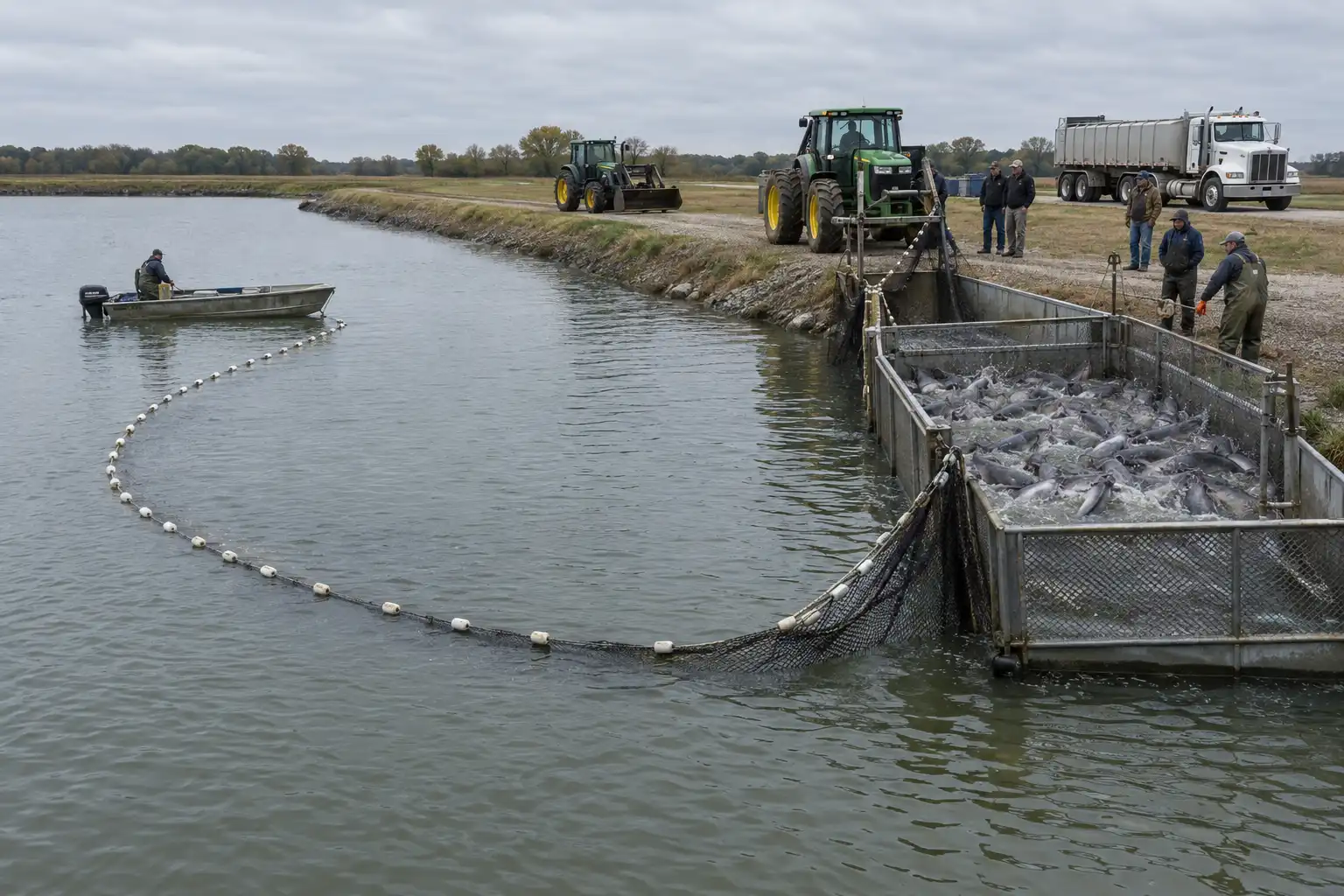
Harvest starts with a schedule, not a seine. Mississippi State Extension says farms selling to large processors usually wait for 20,000 to 25,000 pounds of graded catfish. That’s enough to fill a hauling truck. Once flavor checks pass, the plant books a slot. Take catfish off feed 2 to 3 days before harvest to empty their guts and cut transport stress. Fish treated with any drug stay in the pond until the label’s withdrawal time passes.
Seining needs a crew of at least five, two tractors, a hydraulic seine reel, a boat, and live cars. Even so, one haul seldom lands more than two thirds of the channel catfish in a levee pond. So plan repeat hauls. Hybrids seine more easily: two or three hauls usually catch nearly all of them, per SRAC 190.
Next, catfish rest in a grading sock at least 4 to 6 hours, often overnight, so small fish slip out. A tractor-driven paddlewheel on the bank pulls oxygenated water through the sock. Then a hydraulic loader lifts and weighs the fish into the hauling tank. Keep the landing area clear of overhead power lines. Many farms hire custom seining crews for this work.
Processing and Selling Catfish: The FSIS Rules
Catfish are inspected like meat. USDA’s Food Safety and Inspection Service took over catfish inspection in 2016. Full enforcement began on September 1, 2017. Under FSIS Directive 14,000.1, the Federal Meat Inspection Act exemptions for custom and on-farm processing don’t apply to fish. So talk to FSIS before planning any on-farm processing or fillet sales. Plants run under an FSIS-verified HACCP plan, so anyone planning to process needs formal HACCP training first.
The directive also limits the name “catfish” to the family Ictaluridae, which includes channel catfish, blue catfish, and their hybrid. Live sales stay small. In 2025, NASS counted live haulers and brokers at 2.6 percent of food-size catfish sales. Retail outlets took 1.9 percent and recreational stocking 0.7 percent. So line up a buyer before you stock.
Permits and Rules to Check Before You Stock
Check rules first, because some can’t be fixed once the pond is full.
State license and species rules. Many states require an aquaculture license. Each state also decides which catfish species and hybrids you may stock. So call your state aquaculture coordinator or agriculture department before you buy fingerlings.
Discharge permits. EPA’s aquaculture NPDES rules set the federal line for warmwater fish farms. A warmwater farm discharging at least 30 days a year and producing 100,000 pounds or more needs coverage. Closed ponds that discharge only during excess runoff are excluded. Smaller farms with a discharge may still need a permit, so ask your state NPDES permitting office. At about 90,000 pounds, the 10-acre example sits just under the line. A second pond like it would cross it.
Moving live fish. Shipping live catfish across state lines often needs a health certificate or import permit from the receiving state.
No releases. Never release farmed catfish into public waters. It’s often illegal, and it can spread disease.
FAQs About Catfish Farming Guide
How long does it take to raise catfish to market size?
Mississippi State Extension puts egg-to-food-fish time for channel catfish at roughly 18 to 36 months. Water temperature and the size of fingerlings you stock decide where your crop falls in that range.
How many catfish can I stock in a 1-acre pond?
Without an aerator, Kentucky State University advises no more than 2,000 fish per acre in warmwater ponds. With nightly aeration, commercial channel catfish ponds run from under 3,000 to over 18,000 per acre, per Mississippi State Extension.
What protein feed do catfish need?
Food-size channel catfish do well on 28 to 32 percent protein floating pellets, per Mississippi State Extension. Channel catfish fry need 45 to 50 percent protein, and larger fingerlings about 35 percent.
Why are my catfish gasping at the surface in the morning?
Low dissolved oxygen is the first suspect, because pond oxygen bottoms out near dawn. Check it right away and start aerators; if deaths continue after oxygen recovers, send samples to a fish health lab.
Can I process and sell my own catfish?
Not without inspection, because catfish fall under USDA FSIS meat inspection. The on-farm processing exemption doesn’t cover fish, so talk to FSIS before planning any on-farm processing or direct fillet sales.
Are hybrid catfish better than channel catfish?
For intensive ponds, usually yes, since SRAC Publication 190 reports better survival, seining, and disease resistance in hybrid catfish. However, hybrid fry need hormone-induced spawning, and hybrids grow poorly in small cages.
Before You Stock
Line up a processor or live buyer first. Ask about their size range and flavor-check schedule. Next, confirm your state license and whether your ponds need a discharge permit. Get aeration and an oxygen meter in place before the first warm night. Finally, budget catfish feed at a farm-level conversion near 2.5, not the research 1.8. Treat any better year as a bonus.