
Dissolved Oxygen in Fish Ponds: When to Run Aerators
Low dissolved oxygen kills more pond fish than any other water problem, and it usually strikes before dawn. Knowing when to run pond aerators comes down to one oxygen reading, the hour, and the weather. Below are the start and stop points, each tied to its extension source.
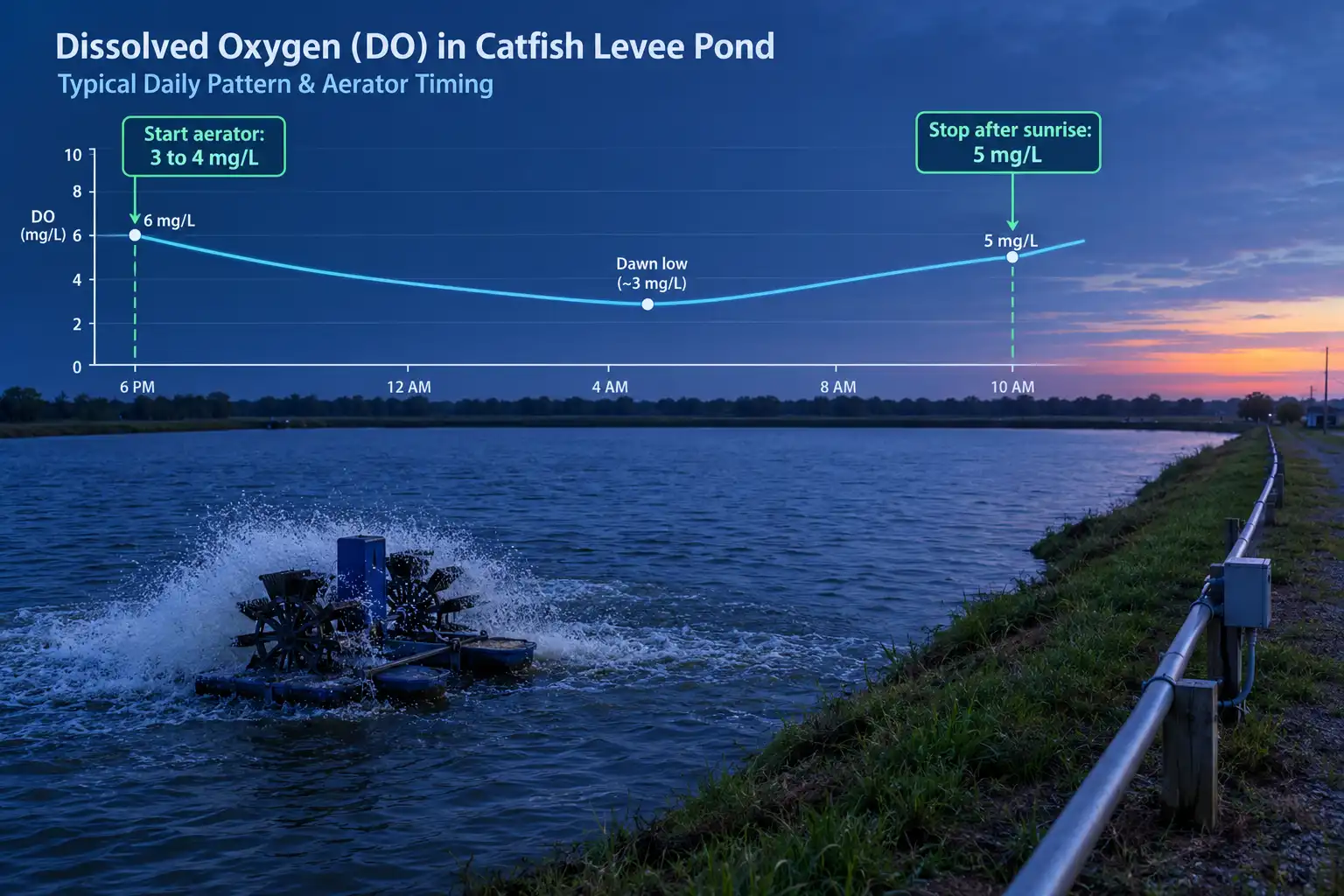
Run pond aerators at night. Per Kentucky State and UF/IFAS Extension, switch them on before oxygen in warmwater ponds drops below 3 to 4 mg/L. Then leave them on past sunrise until oxygen holds at 5 mg/L.
Why Pond Oxygen Is Lowest Just Before Dawn
Algae and aquatic plants make most of the oxygen in a fish pond, and they make it only in daylight. New Mexico State University Extension’s Guide W-104, revised in June 2026, lays out the daily cycle. During the day, photosynthesis pushes oxygen up. At night, algae, fish, and bacteria keep using oxygen, but nothing replaces it. So oxygen peaks around dusk and hits its low just before dawn.
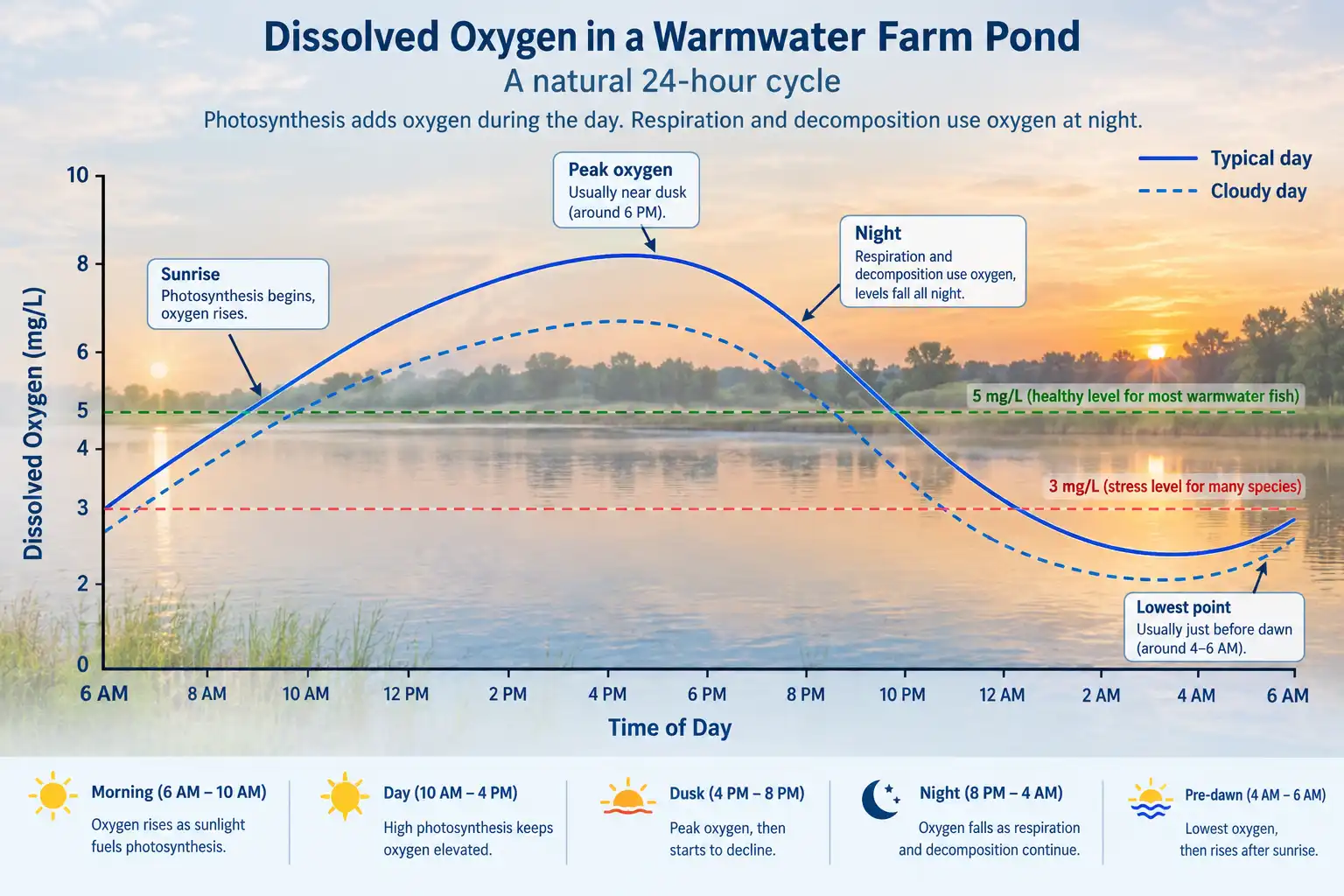
Water temperature widens that swing. The same guide notes that water at 52°F holds 40 percent more oxygen than water at 80°F. UF/IFAS Extension’s FA27 puts saturated water at 7.4 mg/L at 90°F, against 11.9 mg/L at 45°F. Warm water also speeds up fish metabolism, so demand rises just as supply shrinks.
That’s why hot summer nights carry the most risk. It’s also why a noon reading tells you little about 5 a.m.
How Much Oxygen Pond Fish Need
Warmwater pond fish need about 5 mg/L (5 ppm) of dissolved oxygen to stay healthy, per NMSU Guide W-104. The guide names bass, bluegill, and catfish in that group. Coldwater fish need more, and the sources give slightly different targets.
| Fish group, as the source names it | Healthy level | Lethal level | Source |
|---|---|---|---|
| Warmwater fish (bass, bluegill, catfish) | About 5 mg/L | Below 3 mg/L | NMSU Guide W-104 |
| Coldwater fish (trout, salmon) | About 6.5 mg/L | Below 5 mg/L | NMSU Guide W-104 |
| Coldwater fish such as trout | 7 mg/L | Not given | Kentucky State University |
| Most fish species | 5 mg/L or more | Usually below 2 mg/L | UF/IFAS FA27 |
The lethal lines differ too. NMSU says levels under 3 mg/L kill warmwater fish. UF/IFAS says most species show distress at 2 to 4 mg/L and usually die below 2 mg/L. Both figures stand. UF/IFAS adds that the death toll depends on how low oxygen falls and how long it stays there. Larger fish usually suffer first.
Still, don’t aim for “just above lethal.” NMSU notes that fish held at low, nonlethal levels stay stressed, stop eating, and fall sick more easily. SRAC Publication 3700 (2005) adds slower growth and poorer feed conversion. So 5 mg/L is the working target for warmwater ponds, not 3.
The Oxygen Reading That Should Start Your Aerators
Start aerators in a warmwater fish pond before dissolved oxygen falls below 3 mg/L. That’s the line Kentucky State University sets in its WKY-211 fact sheet. UF/IFAS uses 4 mg/L, and the gap comes down to who each source wrote for.
| Source | Start aerators when oxygen | Written for |
|---|---|---|
| Kentucky State University, WKY-211 | Is about to fall below 3 mg/L | Commercial warmwater ponds |
| UF/IFAS Extension, FA27 | Drops below 4 mg/L, or fish show signs of low oxygen | Recreational ponds and part-time fish farms |
| SRAC Publication 3700 | Falls below each farmer’s chosen level, usually 3 to 5 mg/L | Commercial channel catfish ponds |
Commercial catfish farms send night crews to check every pond about every two hours, per UF/IFAS. With that many readings, a trigger near 3 mg/L still leaves time to react. UF/IFAS notes that checking all night isn’t practical for recreational owners and part-time farmers. For them, 4 mg/L buys a margin for the hours nobody watches.
So pick your trigger by how often you check. If you take readings through the night, start aerators at 3 to 4 mg/L. If you only check at dusk, use the two-reading projection below and treat 4 mg/L as the line.
Trout are the exception. None of these start points is written for coldwater fish, and NMSU puts their lethal level at 5 mg/L. A 3 or 4 mg/L trigger comes too late for a trout pond. Ask your extension aquaculture specialist for a coldwater start point.
How Long to Run Aerators Each Night
Keep aerators running past sunrise until oxygen climbs back to 5 mg/L or higher. Kentucky State’s nightly schedule switches aerators on between 10 p.m. and midnight. They then run until 10 a.m., or until oxygen holds at 5 mg/L. On catfish farms, SRAC Publication 3700 says aeration continues past dawn until readings show algae producing oxygen again.
Don’t shut off at first light. Oxygen sits near its daily low around sunrise, and algae need sunlight to restart. On a cloudy morning, that recovery takes longer. So take a reading before you switch off, rather than trusting the clock.
Timers help, but they don’t replace readings. For recreational ponds, UF/IFAS suggests timers that start between 10 p.m. and midnight and stop around 7 to 8 a.m. Even so, the same fact sheet warns that a pond with a timed aerator can still suffer a fish kill.
Fixed timers also cost more to run. A 10 p.m. to 10 a.m. schedule logs 12 hours a night, or about 1,440 hours over a 120-night summer. By contrast, SRAC reports that catfish ponds aerated only as needed log 500 to 1,000 hours a summer. That averages about 3 to 6 hours a day. That’s the trade SRAC describes: starting every pond at a set time saves labor but raises power costs.
Emergency, Nightly, or Continuous: Which Schedule Fits Your Pond
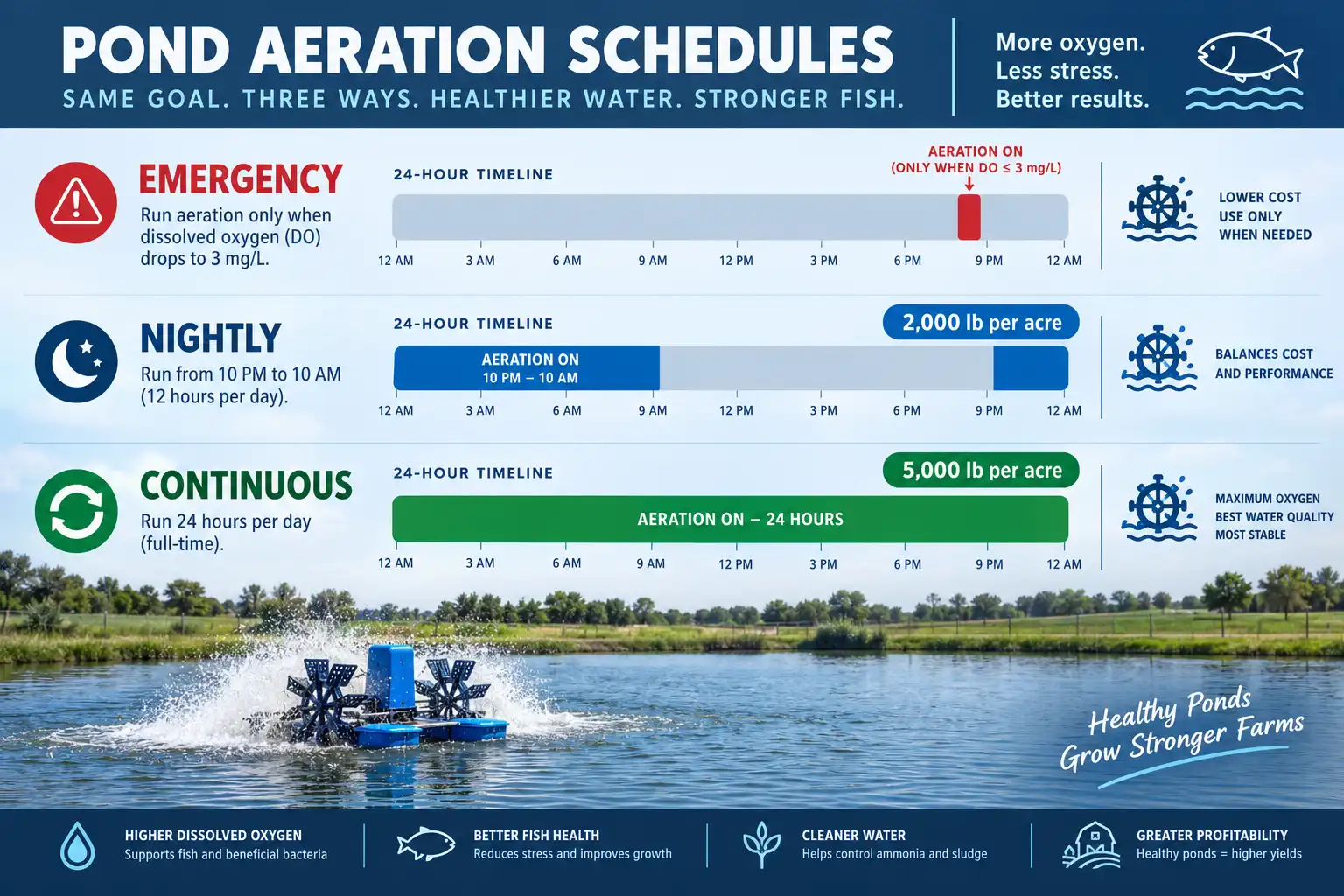
The right schedule depends mainly on how many pounds of fish the pond carries. Kentucky State’s WKY-211 sets out three schedules for warmwater production ponds:
| Schedule | When aerators run | When Kentucky State recommends it |
|---|---|---|
| Emergency | Only once oxygen reaches 3 mg/L or lower, until it holds at 5 mg/L | During a crisis, often with tractor-driven paddlewheels or irrigation pumps |
| Nightly (supplemental) | On between 10 p.m. and midnight, off at 10 a.m. or at 5 mg/L | Above 2,000 pounds of fish per acre, and in the last 2 to 3 months of the season |
| Continuous | 24 hours a day from July to the end of September, or until water cools to 65 to 68°F and keeps falling | Above 5,000 pounds of fish per acre, after checking the economics |
Ponds with no aeration equipment need lighter stocking. In that case, the same fact sheet advises no more than 2,000 fish per acre in warmwater production ponds.
Season matters as much as stocking. SRAC Publication 3700 notes that low oxygen is rare in catfish ponds below 60°F and common above 80°F. In northwest Mississippi, that makes aeration frequent from mid-May through mid-September and uncommon from mid-November through February. Your local climate shifts those dates, so go by water temperature rather than the calendar.
Should Pond Aerators Run During the Day?
Usually not, if they’re surface aerators in a pond with a healthy algae bloom. On sunny afternoons, algae often push oxygen above saturation. SRAC Publication 3700 explains that aerating supersaturated water drives oxygen out into the air, a process called degassing. Even near saturation, an aerator adds very little oxygen, so the power goes to waste. Aerators transfer oxygen fastest when the water is low in it, which is another reason the night shift matters most.
UF/IFAS gives recreational pond owners the same advice. It adds one rule: if you run an aerator by day for looks, keep it running all night as well.
Daytime running does make sense in three cases:
- Long spells of warm, cloudy weather. SRAC notes that most catfish ponds may need aeration around the clock for several days at a time.
- Ponds above 5,000 pounds of fish per acre on a continuous schedule, per Kentucky State.
- Bottom diffuser systems in ponds 8 feet or deeper. These run all through the warm season to keep the water mixed.
Why Diffusers Go In Before the Pond Layers
A bottom diffuser prevents oxygen problems, but it won’t rescue a pond in crisis. Kentucky State University’s guide to aeration in recreational ponds says diffusers do little to correct a crash once it starts.
Timing matters for a second reason. A diffuser works by lifting bottom water to the surface. In a deep pond that has already layered in midsummer, that bottom water may hold no oxygen at all. The guide warns that sudden mixing of layered water can trigger an algae die-off, a fish kill, or both.
So install diffusers in spring, before layers form, as Kentucky State advises. If a deep pond is already layered, ask your extension specialist before you switch one on.
Weather and Pond Changes That Call for Extra Aeration
Run aerators early, before the dusk reading looks bad, when any of these conditions build. Kentucky State and UF/IFAS name the same main triggers:
- Two to three days or more of hot, cloudy, still weather. Clouds slow photosynthesis, and calm air stops surface mixing. Kentucky State says this weather is common from late July to early September.
- A cold front or heavy rain on a deep pond. In summer, ponds 8 feet or deeper form layers, and the bottom layer loses its oxygen. Kentucky State says 2 to 3 inches of rain or a strong cold front can mix that water up. Run aerators just before and throughout the front.
- A sudden algae die-off. Kentucky State says the water can turn black or clear overnight. UF/IFAS adds brown or gray water and a putrid smell. Dead algae use oxygen as they decay.
- Late summer. Fish weight, feed, and waste all peak then, so oxygen demand peaks too.
Ponds carrying a dense algae bloom are the most likely to crash. UF/IFAS explains why: the algae that make most of the oxygen by day also use the most at night.
Turnover isn’t only a summer risk, either. Kentucky State notes it often follows the first cool days of fall. Chilled surface water sinks and pushes stale bottom water up. So keep checking deep ponds after the first autumn cold snap.
How to Predict a Dawn Oxygen Crash From Two Evening Readings
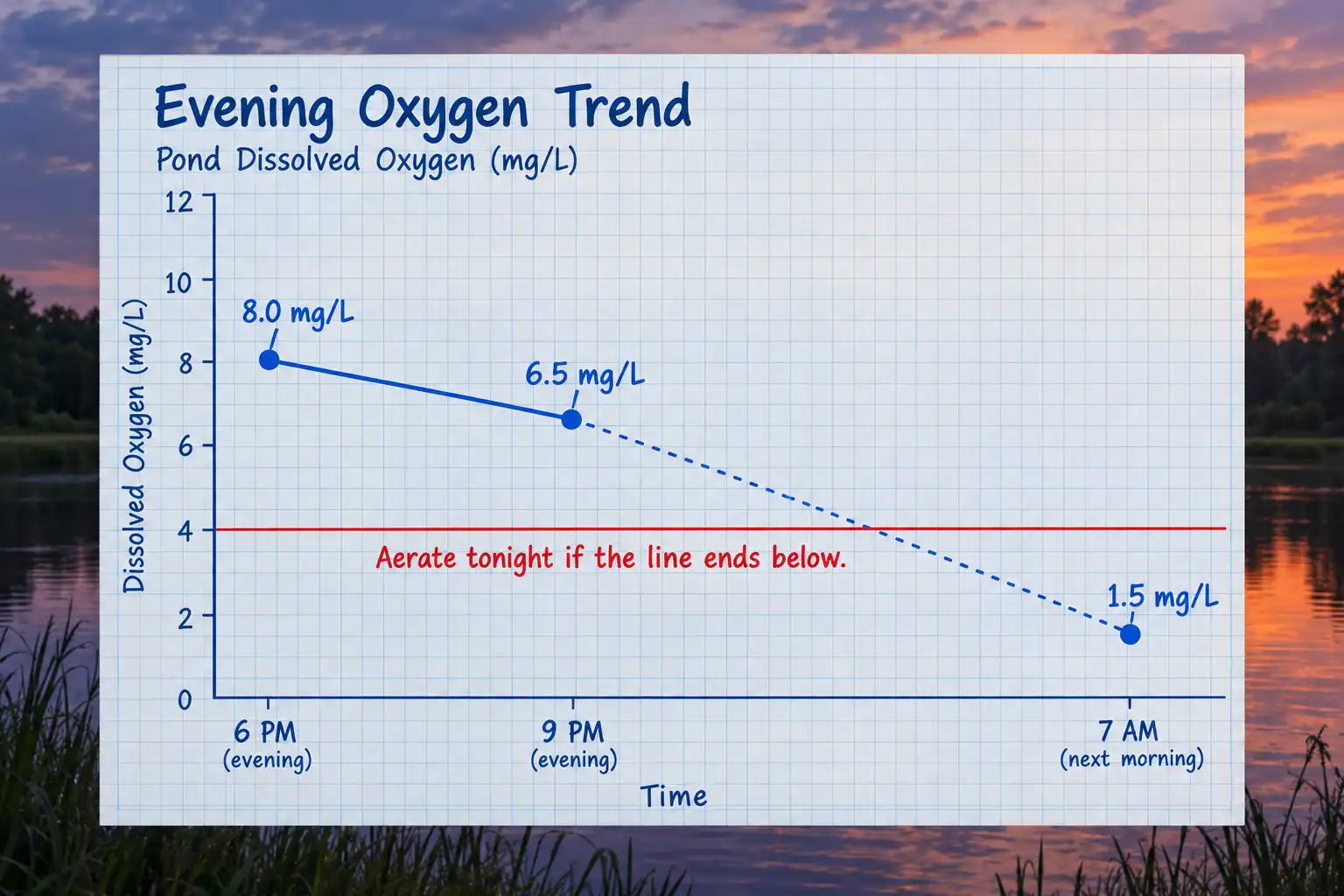
Take two evening oxygen readings, draw a straight line through them, and see where it lands at 7 a.m. UF/IFAS describes this method for pond owners who can’t check all night:
- Take the first reading in late afternoon, between 5 and 6 p.m.
- Take the second in late evening, between 8 and 10 p.m.
- Plot both on graph paper, oxygen against time, and extend the line to 7 a.m.
- If the line lands below 4 mg/L, run emergency aeration that night.
For example, say you read 8.0 mg/L at 6 p.m. and 6.5 mg/L at 9 p.m. That’s a drop of 0.5 mg/L per hour. Ten hours remain until 7 a.m., so expect another 5.0 mg/L drop, leaving about 1.5 mg/L at dawn. That’s far below 4 mg/L, so the aerator goes on tonight.
Hourly drop      = (first reading minus second reading) / hours between them
Projected 7 a.m. = second reading minus (hourly drop x hours until 7 a.m.)
Treat the answer as an estimate. A storm or an algae die-off after your second reading can speed up the drop. So check again around midnight if you can.
An electronic meter is the fastest tool for these readings, per UF/IFAS. Chemical test kits take more work but are accurate and cost less. Sensor type and the calibration routine matter most when choosing a dissolved oxygen meter.
Signs Oxygen Is Already Too Low
Fish gulping air at the surface around dawn are the classic sign. When fish go off feed or start dying, check dissolved oxygen first. NMSU names low oxygen as the leading cause of fish kills. Gill disease, parasites, and toxins can look similar from the bank. So if oxygen reads normal, call your extension aquaculture specialist or a fish health diagnostic lab. Report heavy, unexplained losses to your state veterinarian or state aquatic animal health official. Don’t move or sell fish from that pond until you know the cause.
UF/IFAS lists these signs of low oxygen:
- Fish at the surface gulping air, called piping
- Fish that suddenly stop feeding
- Water that turns brown, black, or gray fast
- A putrid smell from the pond
- In a kill, fish dying at about the same time, often overnight, with larger fish first
If fish are already in trouble, turn on an aerator right away. UF/IFAS calls that the most important step, and test oxygen while it’s happening to confirm the cause. With a portable aerator, SRAC advises placing it where stressed fish have gathered, or beside the existing aerator. That way, fish don’t swim through low-oxygen water to reach it. Once oxygen recovers, turn to disposal and reporting after a fish kill.
Do You Have Enough Aeration Horsepower?
Check your horsepower against your feeding rate. For intensive warmwater ponds, Kentucky State’s WKY-211 suggests 1 horsepower for every 22 pounds of feed per acre per day.
Run it with your own numbers. Say you feed a 5-acre pond 50 pounds per acre per day; your feeding rate goes here. That’s 250 pounds of feed daily. Divide by 22, and you get about 11 horsepower, or roughly 2.3 horsepower per acre.
That falls inside the range catfish farms are moving toward. SRAC Publication 3700 puts commercial catfish ponds at 1.5 to 2 horsepower per acre, trending to 2 to 3. Lighter jobs need less. UF/IFAS, in fact sheet FA6, notes that stationary emergency aerators are often sized at about 1 horsepower per surface acre. Kentucky State’s recreational pond guide gives 0.5 to 1. For small ponds, SRAC says vertical pump aerators, usually under 1 horsepower, suit ponds under about 1 acre.
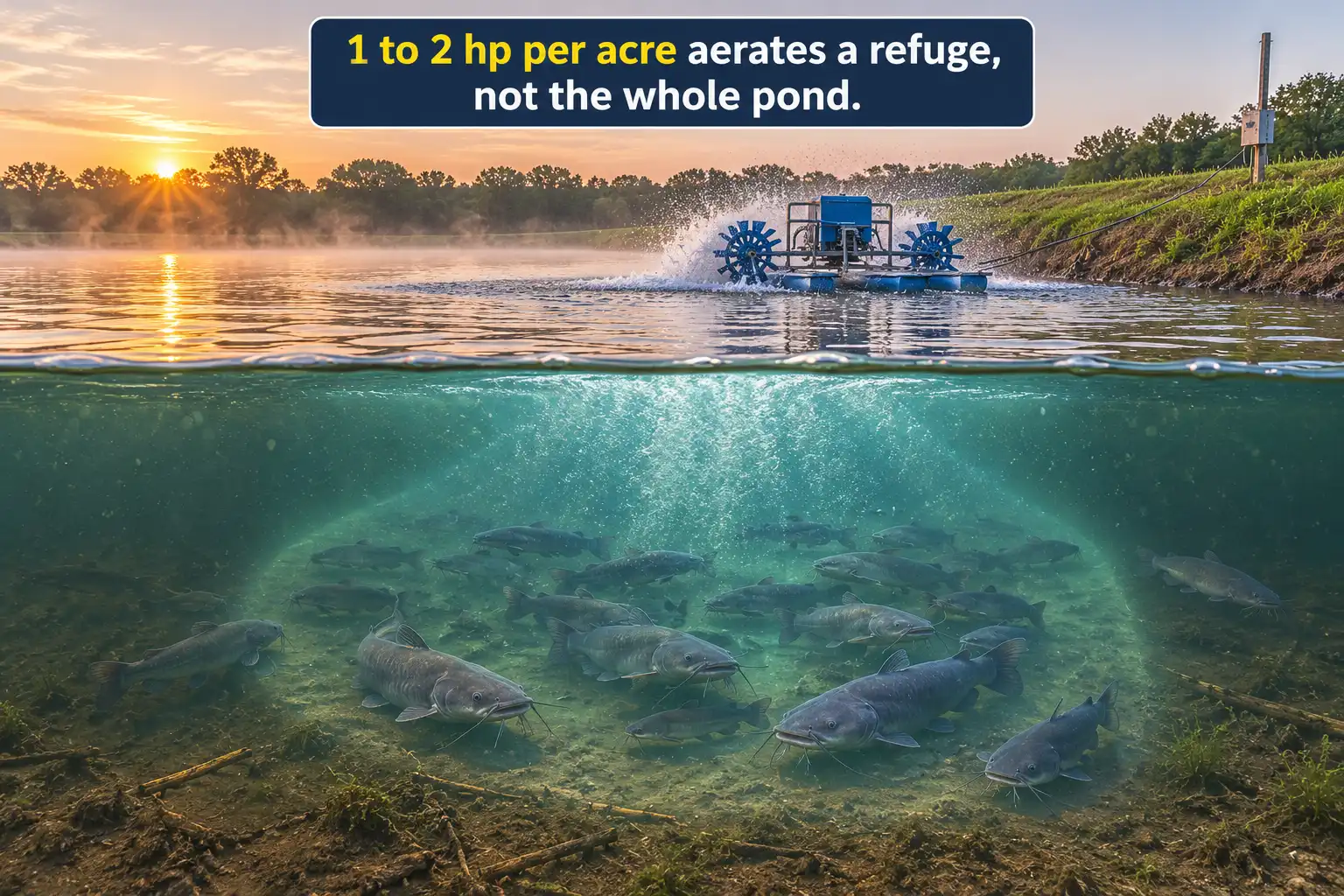
SRAC also makes a point that shapes how you run them. At 1 to 2 horsepower per acre, aerators can’t raise oxygen across a whole commercial pond. Instead, they hold a refuge of oxygenated water where fish crowd until the pond recovers. That refuge has to exist before fish need it, which is one more reason to start early. Depth, pond shape, and the type of aerator you choose all change the horsepower a pond needs.
Backup Power and Electrical Safety
A dead aerator on a hot night is the same as no aerator. So plan for power failures before summer, not during one.
Aerators and pumps belong on ground-fault protected circuits installed by a licensed electrician. Also, stay out of the water near a running aerator.
If you keep a backup generator, run it outdoors, because its exhaust carries carbon monoxide. The CDC warns never to use one inside a home, garage, or carport, or near doors, windows, or vents. It advises keeping generators at least 20 feet from those openings.
Per SRAC Publication 3700, many catfish farmers also keep tractor-driven paddlewheels for emergencies, often one per four or five ponds. SRAC adds that anyone running one needs training to place and use it safely. Pair the aerators with a standby generator and an oxygen alarm, so a 3 a.m. power cut doesn’t go unnoticed.
FAQs About Dissolved Oxygen in Fish Ponds
Should I run my pond aerator 24 hours a day?
Usually not, because aerating supersaturated water on sunny afternoons drives oxygen out of the pond, per SRAC Publication 3700. Run surface aerators at night instead, and add daytime hours only during long spells of hot, cloudy weather.
What time should a pond aerator turn on at night?
Between 10 p.m. and midnight suits most nightly schedules, per Kentucky State University and UF/IFAS Extension. On cloudy, still nights, check two evening readings and start sooner if dawn oxygen projects below 4 mg/L.
Can you over-aerate a fish pond?
Yes, in one sense: on sunny afternoons, surface aeration strips oxygen from supersaturated water, per SRAC Publication 3700. At night, aerating water that is still near saturation mainly adds to the power bill.
How can I tell if pond oxygen is low without a meter?
Fish gulping at the surface or suddenly refusing feed are two signs UF/IFAS Extension lists. So is water that turns brown, black, or gray fast, especially after hot, cloudy weather or a summer storm.
Do pond aerators need to run in winter?
Rarely for oxygen, since SRAC Publication 3700 notes low-oxygen problems in catfish ponds are rare while water stays below 60°F. Kentucky State University notes that some pond owners run bottom diffusers in winter to keep ponds from freezing over.
Why are my fish gasping at the surface in the morning?
Low oxygen before dawn is the most likely cause, so turn on an aerator and check oxygen right away. If oxygen reads normal, gill disease, parasites, or toxins can look similar, so call a fish health lab.
Putting This Into Practice
SRAC says low oxygen turns common in catfish ponds above 80°F. From that point, take an evening oxygen reading every day. On hot, cloudy, or stormy nights, add a second reading and project it to 7 a.m. Start aerators before oxygen in a warmwater pond drops below 3 to 4 mg/L. Leave them on past sunrise until it holds at 5 mg/L. Keep surface aerators off on sunny afternoons. Then, before next summer, test the backup power and check your horsepower against your feeding rate.