What Do Crawfish Eat? Wild Diet, Pond Forage, and Feeding Crawdads
Crawfish eat almost anything they can catch or scavenge. Yet the plants they chew on supply little of their nutrition. Knowing what crawfish eat explains why pond farmers plant rice instead of buying feed, and why a pet crawdad needs more than lettuce.
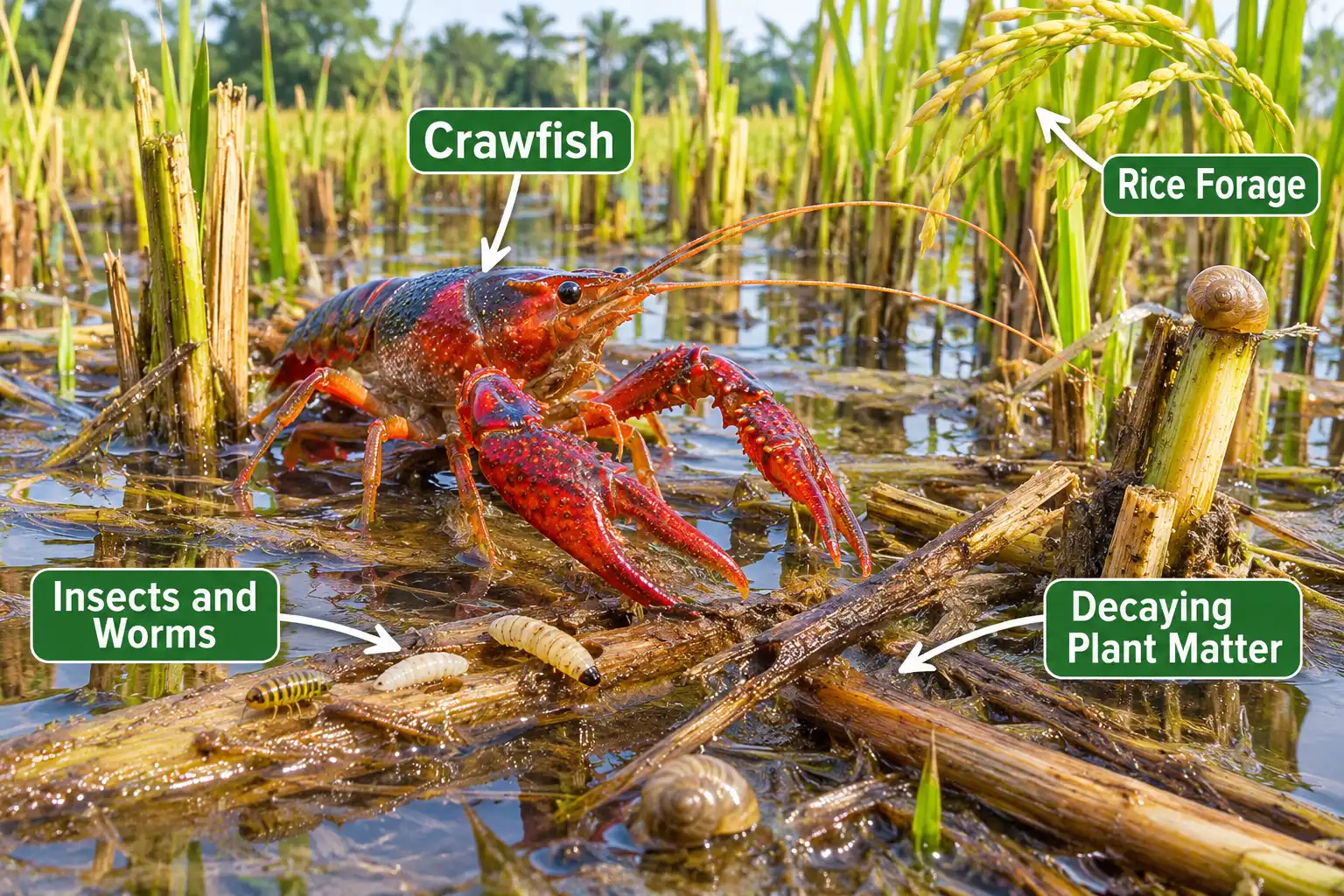
What crawfish eat is mostly small animals: insects, worms, snails, and the microbes on decaying plants. Pond farmers rarely feed pellets. Instead, they plant rice or sorghum-sudangrass, which breaks down slowly and fuels that food web.
What Do Crawfish Eat in the Wild?
Wild crawfish eat living and decaying plants, seeds, algae, microbes, insects, worms, snails, and the odd small fish. SRAC Publication 2403 (2007), written by LSU AgCenter scientists, says the menu shifts with habitat.
Researchers once called crawfish herbivores, detritivores, or omnivores. More recently, they have been classed as obligate carnivores. That means they need some animal matter to grow and stay healthy.
Not every food carries the same value, though. SRAC 2403 rates them this way:
| Wild food | What it gives crawfish |
|---|---|
| Living plants | Plenty to eat, but little direct nourishment |
| Starchy seeds | Energy |
| Tough, fibrous plant parts | Limited energy and nutrients; eaten when other food runs short |
| Detritus (decaying plants and their microbes) | Higher food value, but not enough protein and energy alone for top growth |
| Insects, worms, snails, and small crustaceans | High-quality nutrition |
| Small fish and other small vertebrates | Eaten when caught |
Crawfish also eat each other. A crawfish is most at risk while it molts, so cover matters in any pond or tank.
That broad diet causes trouble where red swamp crawfish have spread outside their native range. The Michigan Department of Natural Resources reports that they outcompete native crayfish, amphibians, invertebrates, and juvenile fish for food. They can also badly damage aquatic plants.
How Farm Ponds Feed Crawfish: The Detrital Food Web
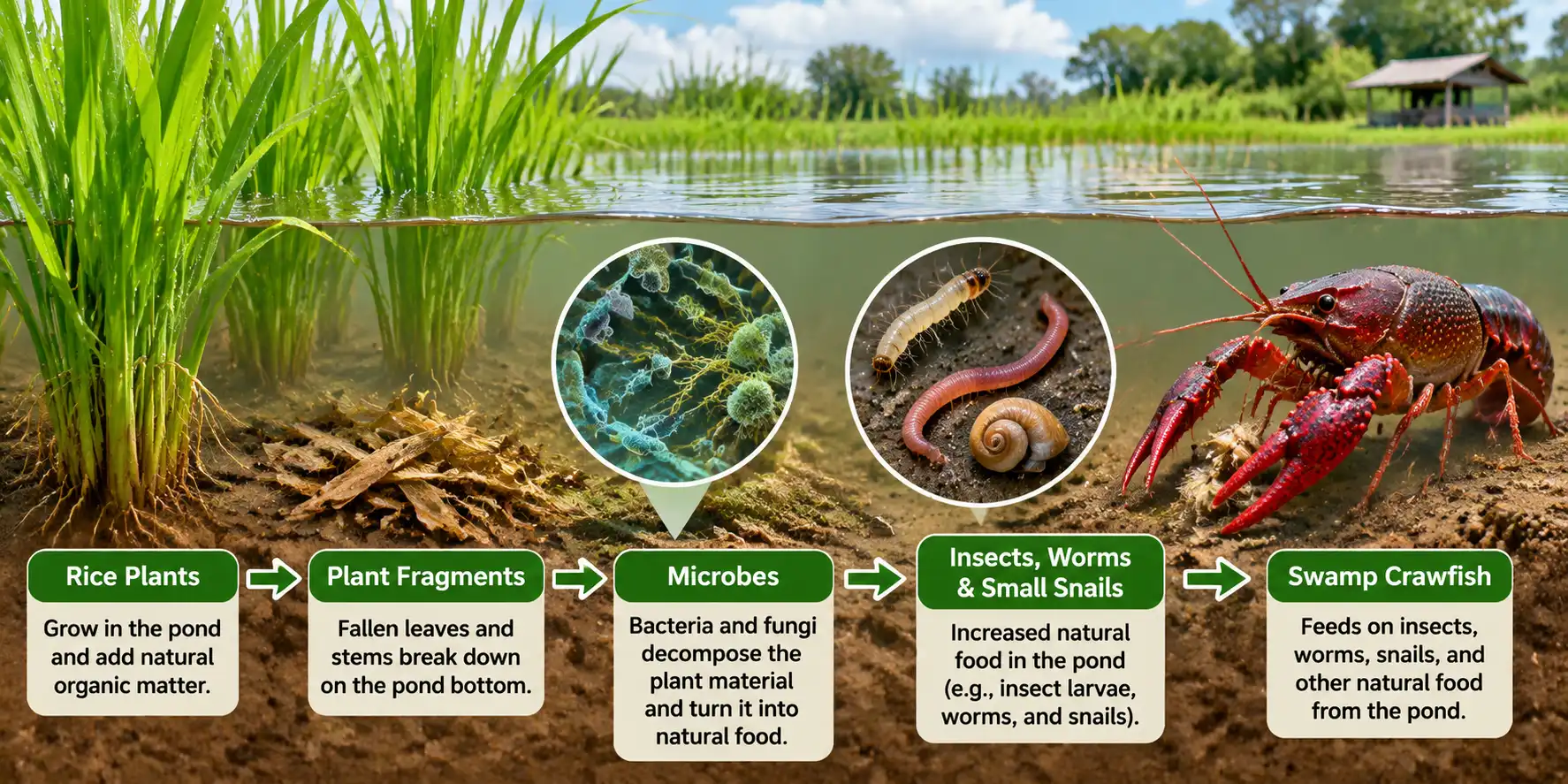
Farm ponds feed crawfish indirectly. The farmer grows a forage crop, the crop decays underwater, and the small animals living on that decay become crawfish food.
The LSU AgCenter Crawfish Production Manual (Publication 2637, 2007) treats the forage crop as the pond’s energy source. Crawfish sit at the top of the web it supports. The chain runs like this:
- Rice or another forage crop grows while the pond is drained in summer.
- After the fall flood, plant fragments break off and start to decay.
- Bacteria and other microbes colonize those fragments.
- Insects, worms, clams, snails, and zooplankton feed on the decaying material.
- Crawfish eat those animals, plus some detritus and seeds.
SRAC Publication 241 (1998 revision) says crawfish favor aquatic invertebrates, though they also take detritus and growing plants. In fact, those invertebrates make up most of the crawfish diet. So LSU AgCenter notes that pond crawfish are not routinely fed pelleted rations.
The plants do more than feed the web. Per the LSU manual, standing forage hides crawfish from predators and from each other. Its stems also give them a route to the surface when oxygen runs low.
Which Forage Crops Feed a Crawfish Pond?
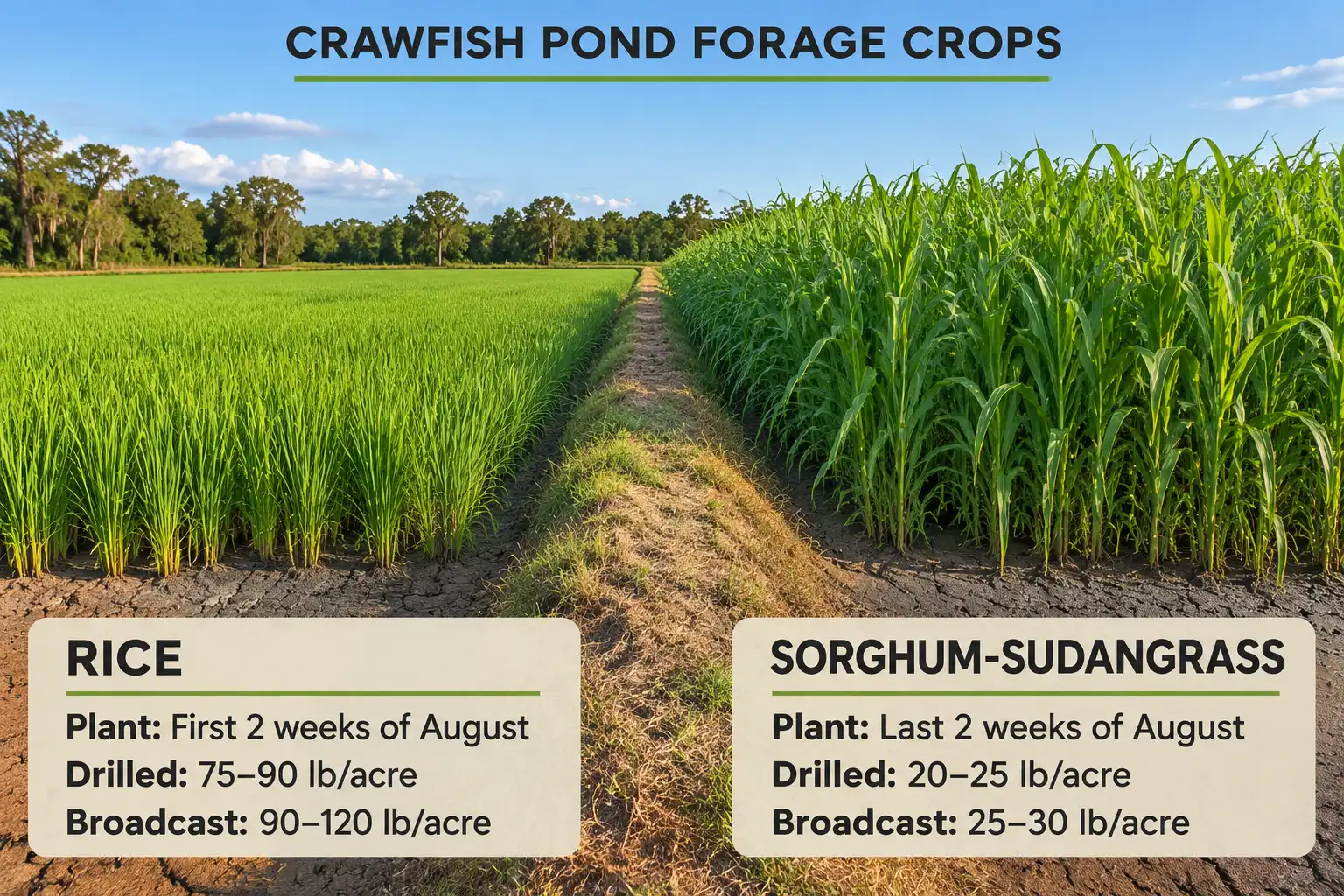
Rice is the standard crawfish forage, and sorghum-sudangrass is the main alternative, per the LSU AgCenter manual. Both shed plant matter into the water through the season, which is what the food web needs.
Rice is semi-aquatic, so it holds up in a flooded pond and feeds the detritus pool steadily. In 2004, LSU AgCenter released Ecrevisse, the first rice variety bred for crawfish-only ponds. Sorghum-sudangrass can produce nearly twice the forage of rice and tolerates drought. However, it can’t sit in saturated soil for long while young.
Volunteer vegetation costs less but is less reliable. Land grasses die when flooded, break down fast, and cause water quality problems. Alligatorweed and smartweed fare better, yet they fragment unevenly and generally can’t match rice or sorghum-sudangrass yields. Millets, grain sorghum, and soybean stubble also showed limited potential.
In rice and crawfish rotations, the grain crop does double duty. LSU AgCenter notes that the stubble, straw, and regrowth left after grain harvest build the food web for the crawfish season.
Planting Dates and Seeding Rates
LSU AgCenter gives these figures for crawfish-only ponds in southern Louisiana. It recommends earlier planting farther north.
| Forage | Planting window, south Louisiana | Drilled seed | Dry-broadcast seed | Main strength |
|---|---|---|---|---|
| Rice | First two weeks of August | 75 to 90 lb/acre | 90 to 120 lb/acre | Steady breakdown under long flooding |
| Sorghum-sudangrass | Last two weeks of August | 20 to 25 lb/acre | 25 to 30 lb/acre | Nearly twice the forage of rice; needs less irrigation |
Seed for a 20-Acre Pond
Carry the rates through to your own acreage. For a 20-acre pond:
- Rice, dry-broadcast at 90 to 120 lb/acre: 1,800 to 2,400 pounds of seed, or about 36 to 48 fifty-pound bags
- Sorghum-sudangrass, drilled at 20 to 25 lb/acre: 400 to 500 pounds of seed, or about 8 to 10 fifty-pound bags
Swap in your own surface acres. Then have your extension agent or state aquaculture specialist confirm variety, timing, and fertilizer for your soil.
Why Crawfish Ponds Run Out of Food
Forage ponds often run short of food by late winter or early spring, per the LSU AgCenter manual. Once the forage is gone, the invertebrates that crawfish eat decline with it.
Several things speed that up:
- High crawfish numbers, which can strip forage early even in a well-run pond
- Rice planted too early, which sets grain before winter and then breaks down too soon
- Deep water, which uses up most forage faster
- Birds drawn to ripening grain, which knock the crop down early
- Too much plant matter entering the water at once, which is wasted and can pull oxygen down
Food shortage shows up as stunting. SRAC Publication 2403 explains that water above 80°F, overcrowding, and scarce food together can push red swamp crawfish to mature below market size. LSU AgCenter adds that once density gets too high, growth slows or stops even with plenty of forage and good water.
There are a few ways back. Lowering the water level in spring can expose rice stems to light and warmth, which encourages regrowth. An LSU AgCenter research bulletin also tested relaying. Small, stunted crawfish moved from a crowded, food-short pond into a rice field kept growing and gained market value.
Do Farmed Crawfish Need Supplemental Feed?
Usually not, at least in forage ponds. LSU AgCenter says supplemental feeding hasn’t been shown to reliably raise yields or harvest size. It offers no dependable feeding recommendation for these ponds.
Its manual sums up what farmers and researchers have tried:
- Hay: often little or no gain, and sometimes poorer water. Bales covered little of the pond, stayed nutritious for days to weeks, and leftover hay could deplete oxygen.
- Manures and farm byproducts, such as sweet potatoes and sugarcane: mostly no gain or a marginal one. Handling and feeding frequency were the main problems.
- Pelleted feeds like catfish feed: inconsistent results that often didn’t pay. Extra yield often came as more small, low-value crawfish.
- Cheap single grains or seeds, such as rice or whole soybeans: promising in controlled trials, with problems in the field
Feed can also cut your catch. Fed crawfish may enter traps less, and the feed competes with your bait. Trapping 3 to 4 days a week, with rest days between, lowers that risk, per LSU AgCenter’s management chapter. Still, it doesn’t always remove it.
Broodstock may be the exception. LSU AgCenter suggests that feeding broodstock before capture could build energy reserves for spawning, but that research is ongoing.
Feeding Crawfish in Ponds Without Planted Forage
Some ponds skip the forage crop and feed the crawfish instead. SRAC Publication 2401 (2004), by Mississippi State University researchers, covers this semi-intensive system. It grows red swamp crawfish in northeast Mississippi ponds about 4 feet deep and 1 to 5 surface acres.
For direct eating, it recommends a highly water-stable, extruded sinking feed. Options include a 32 percent crude protein sinking catfish pellet or a 28 to 30 percent protein extruded sinking diet. Only sinking feed reaches crawfish on the bottom, so check the label against these sinking and floating pellet types.
Cheaper options exist. Alfalfa or range pellets can replace two-thirds of the catfish feed. In research, rejected soybeans plus alfalfa hay (28 percent protein combined) matched formulated feed. Either way, the feed breaks apart quickly, so SRAC 2401 says it mostly fertilizes the microbes crawfish eat.
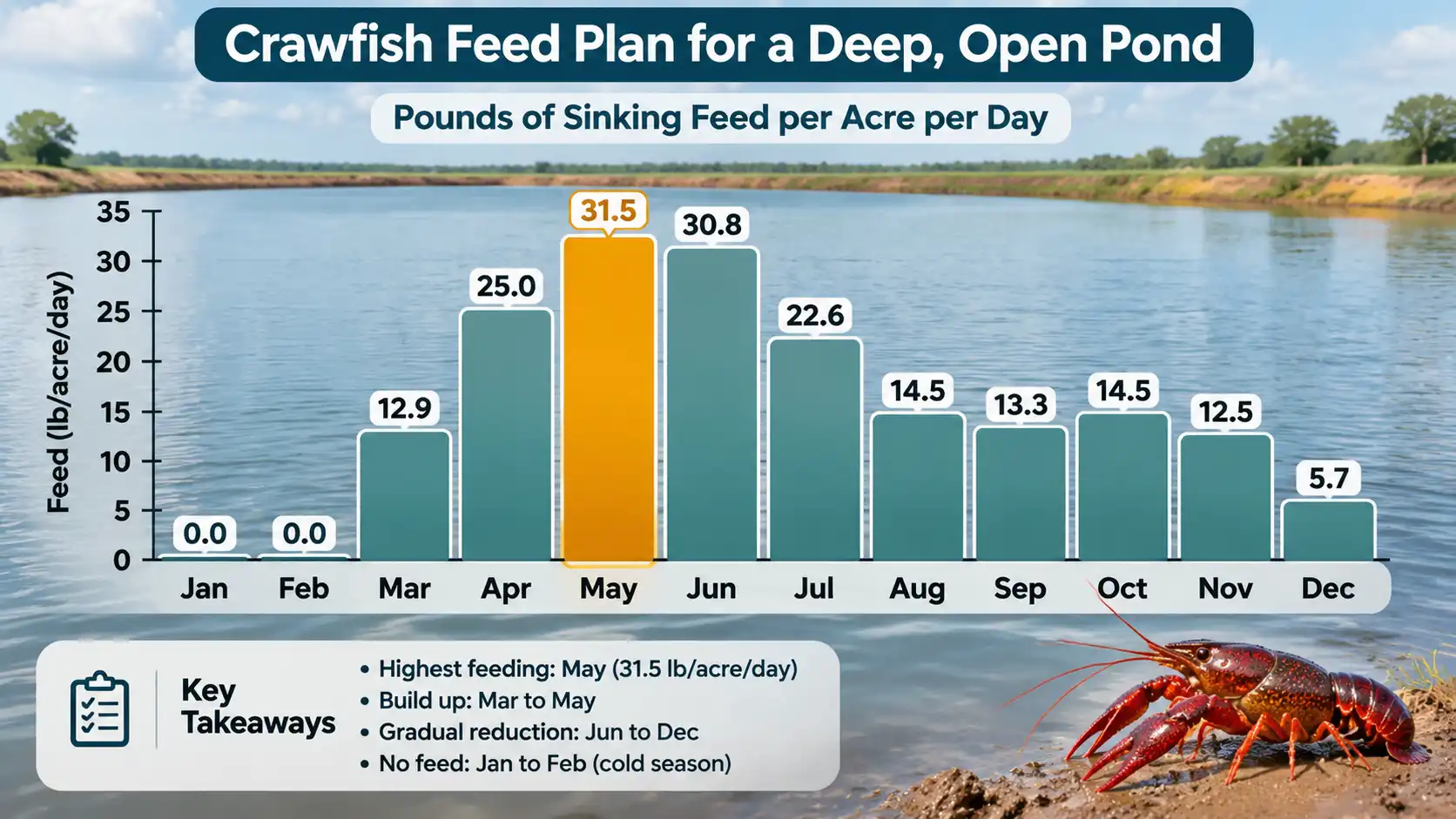
Daily rates for these red swamp crawfish ponds run 5.6 to 31.5 pounds per acre, set from crawfish biomass and water temperature. There’s no feeding in January or February. Feeding peaks at 31.5 pounds per acre a day in May and totals 5,600 pounds per acre a year. Small experimental ponds yielded 1,800 to 2,300 pounds of red swamp crawfish per acre. Feed in mid-afternoon, when oxygen is comparatively high, even though crawfish forage most in the evening.
Feed for a 2-Acre Pond
At SRAC 2401 rates, a 2-acre semi-intensive red swamp crawfish pond needs about 11,200 pounds of feed a year. That’s 224 fifty-pound bags. May alone takes 1,950 pounds, or about 63 pounds a day. Dividing the 5,600-pound season total by the 2,200-pound yield in the same table gives about 2.5 pounds of feed per pound of crawfish.
Two cautions apply. First, these figures come from small experimental ponds in one region. The commercial budget in the same publication assumed a lower 1,805 pounds per acre. Second, SRAC 2401 warns that organic fertilizers can sharply cut dissolved oxygen in warm water.
Bait Is Not Feed: What Crawfish Eat in Traps
Trap bait lures crawfish in rather than growing them. Still, it is what they eat at harvest, and it costs real money. SRAC Publication 2400 (2004) puts bait at about 30 percent of per-acre production costs for single-crop crawfish in southwest Louisiana.
Two kinds of bait dominate:
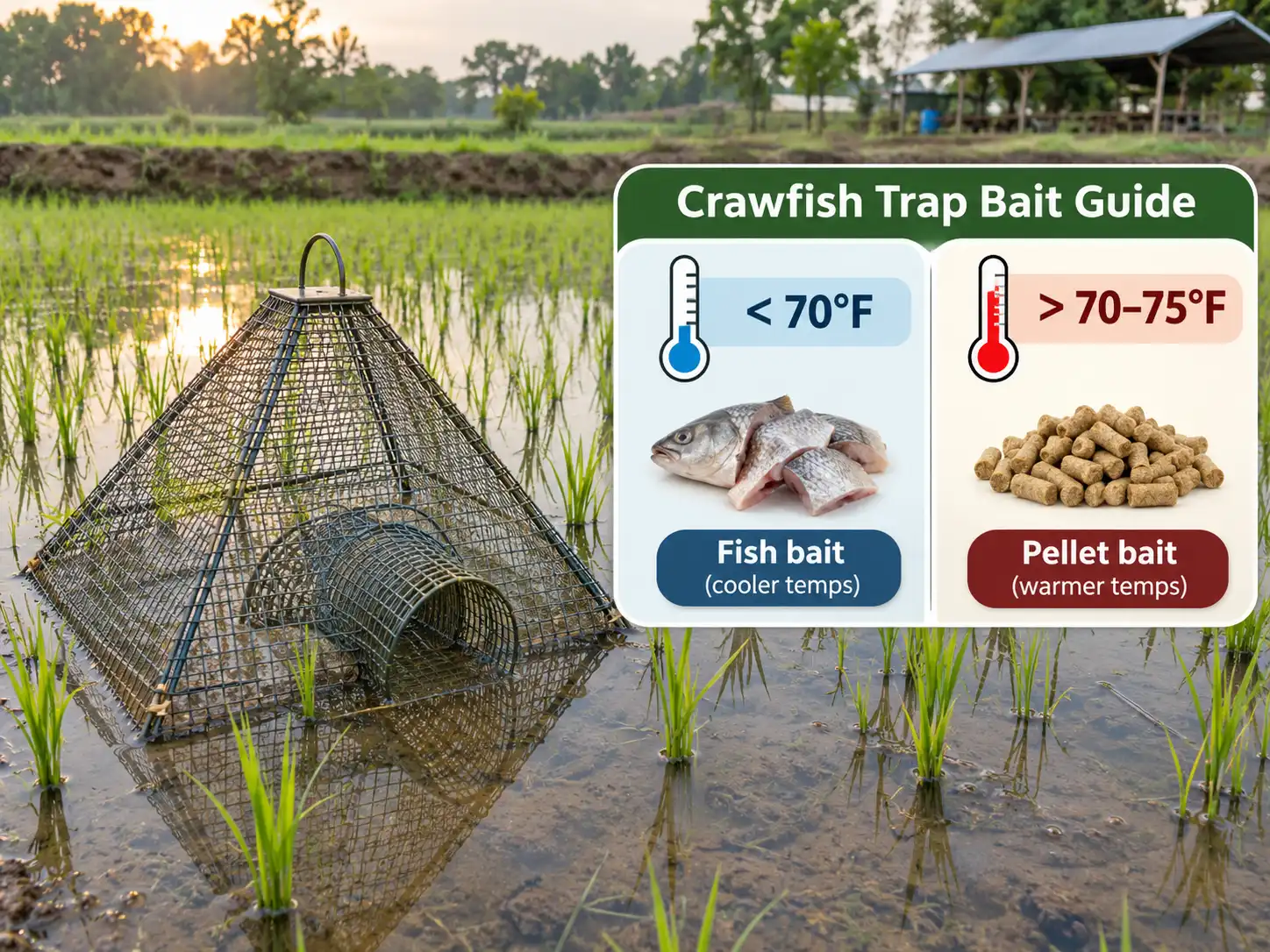
- Fish baits: gizzard shad and Gulf menhaden, plus herrings, common carp, suckers, and catfish or buffalofish heads. They’re sold frozen, then cut, with the swim bladder punctured so pieces sink.
- Formulated baits: cylindrical pellets of cereal grains, grain byproducts, flavoring, and a binder, sold in 50-pound bags. They need no refrigeration.
Beef pancreas, sold as beef melt, draws crawfish well but costs too much for commercial use.
Water temperature decides which bait works. Below 70°F, shad and menhaden outfish formulated bait. Above 70 to 75°F, formulated bait does as well or better, especially once forage runs out. Between 65 and 75°F, mixing the two in roughly equal parts can raise the catch by up to one-third.
Bait for a 10-Acre Pond
SRAC 2400 recommends 20 to 24 pyramid traps per acre where crawfish yields should top 1,000 pounds per acre. Bait runs about 1/4 pound per trap in winter and 1/3 pound in spring.
So a 10-acre crawfish pond with 200 traps at 1/3 pound needs about 67 pounds of bait per trapping day. That’s roughly 1.3 bags of formulated bait, since one 50-pound bag baits about 150 traps. Alternatively, it’s two-thirds of a 100-pound box of fish bait, which baits about 300 traps. At 3 to 4 trapping days a week, plan on about 200 to 270 pounds a week.
Use fresh bait each trapping day. Also, don’t dump leftover bait in the pond, because it pulls crawfish away from freshly baited traps. Trap layout and timing are covered in the guide to pond harvest methods.
How Temperature and Oxygen Change Crawfish Feeding
Red swamp crawfish eat less as water cools and stop eating below 50°F, per SRAC 2401. They also stop feeding while molting, so catches drop during a mass molt, according to SRAC 2400. Cold fronts usually cut the catch too.
Water Targets for Red Swamp Crawfish
SRAC Publication 240 (2012 revision) gives these ranges for red swamp crawfish ponds. We converted its temperatures from Celsius.
| Measure | Desirable | Lethal |
|---|---|---|
| Water temperature | 70 to 81°F | 32°F low, 93°F high |
| Dissolved oxygen | Above 2 to 3 mg/L | Below 0.5 mg/L |
| pH | 6.5 to 8.5 | Below 3.0 or above 10.0 |
| Total hardness | Above 50 mg/L as calcium carbonate | None listed |
| Total alkalinity | Above 20 mg/L as calcium carbonate | None listed |
| Salinity | Below 6 ppt | 15 ppt |
Hardness matters for feeding as well as for water. After a molt, crawfish take calcium from the water as they start eating again and their new shell hardens, per SRAC 2403. You can test hardness and alkalinity with a standard kit.
Low Oxygen Stops Feeding
Check dissolved oxygen first whenever crawfish stop feeding or start dying. The LSU AgCenter manual’s water quality chapter sets these markers for pond crawfish:
- Above 2 ppm: the target for good production, though hard to hold in warm months
- Below 1 ppm all day for several weeks: crawfish may stop feeding, and growth and catch fall
- Below 0.5 ppm all day for a week or more: newly hatched young and molting crawfish may die
The first two to six weeks after flood-up carry the most risk for young crawfish. Flooding onto decaying vegetation drives oxygen demand up. LSU AgCenter notes that oxygen loss from decay doubles as water warms from 70 to 80°F. Stressed adults climb vegetation or traps toward the surface.
The two sources set different action points because the ponds differ. LSU AgCenter targets 2 ppm for crawfish in shallow forage ponds. In contrast, SRAC 2401 advises aerating fed, 4-foot-deep red swamp crawfish ponds at 1.5 horsepower per acre when oxygen falls, or may fall, below 3 mg/L. Floating electric aerators belong on ground-fault protected circuits installed by a licensed electrician.
Measure with a meter, not by water color or smell. Oxygen also swings overnight, which the guide to why pond oxygen falls before dawn explains.
If Crawfish Start Dying
If crawfish die in numbers and oxygen reads normal, call your extension aquaculture specialist or an aquatic animal diagnostic lab before treating anything. Report heavy, unexplained losses to your state veterinarian or aquatic animal health official. Until then, don’t move or sell crawfish from that pond.
What to Feed Crawdads in a Tank or Bait Bucket
Check whether you may keep them first. Then feed a sinking food with some animal protein, in small amounts, and remove leftovers before they rot.
Check Your State’s Rules First
Live crawdads are restricted in some states. Michigan has prohibited red swamp crayfish since 2014. It’s illegal there to knowingly possess, import, sell, or release them alive.
In October 2026, the Michigan DNR reported red swamp crayfish in Cass County for the first time. It linked infestations to released aquarium pets, live bait, and live crawfish brought in for boils. It also noted that pet-trade red swamp crayfish come in blue, orange, and white.
So ask your state fish and wildlife agency before you buy, keep, or move live crawdads. Never release them into any pond, stream, or ditch. Released crayfish can outcompete native species and become invasive quickly.
Feeding a Tank of Crawdads
Published feeding research covers farm ponds, not aquariums. We found no extension feeding schedule for a home tank. So the points below carry the pond research over to a tank. Treat them as principles, not a tested routine.
- Some animal protein. SRAC 2403 notes that crawfish need some animal matter, and living plants give them little direct nourishment.
- A sinking, water-stable food. The pond guidance in SRAC 2401 uses sinking pellets at 28 to 32 percent crude protein for red swamp crawfish.
- Small amounts, leftovers removed. Uneaten feed decays and uses up oxygen, the same problem LSU AgCenter describes with leftover hay.
- Hiding places. Shelter cuts cannibalism, which is worst during molting.
- Hard water. Molting crawfish draw calcium from the water, and SRAC 240 lists total hardness above 50 mg/L as calcium carbonate for red swamp crawfish ponds.
- Skipped meals. Crawfish stop eating in late premolt, and red swamp crawfish stop eating below 50°F.
Plug tank pumps and heaters into ground-fault protected outlets. Fence or cover any backyard pond or open tank a child could reach. For live bait, Michigan DNR advises using it only in the water where it was caught and throwing away what’s left.
Common Feeding Problems in Crawfish Ponds
Most feeding problems in crawfish ponds trace back to too many crawfish, too little forage, or too little oxygen.
- Lots of small crawfish that stop growing. Usually there are too many crawfish for the food. Water above 80°F speeds early maturity in crowded, underfed red swamp crawfish, per SRAC 2403.
- Forage gone by February. Rice went in too early, water stayed too deep, or the population is dense. LSU AgCenter puts rice planting in the first two weeks of August in south Louisiana.
- Oxygen crash soon after flood-up. The pond flooded onto too much dead vegetation too early. LSU AgCenter advises holding full flood-up until early October, and mid-September at the earliest.
- Catch falls after feeding starts. Feed is competing with bait, or the crawfish are full.
- Poor catch in thick vegetation. Natural food is plentiful and bait scent spreads poorly, per SRAC 2400. Short rains and moving water help spread it.
- A planned spray on a rice and crawfish field. SRAC 241 notes that grain rice often needs pesticides and water management that don’t suit crawfish. The pesticide label sets what’s allowed around aquatic animals, so read it and ask your extension agent first.
Why Most Crawfish Feeding Research Comes From Louisiana
Crawfish farming sits mostly in one state. In the 2023 Census of Aquaculture, USDA NASS counted 751 crawfish farms, 97 percent of them in Louisiana. Crawfish raised for food sold for $122.8 million, or 70 percent of US crustacean sales.
As a result, most guidance here comes from LSU AgCenter and SRAC. It centers on two species: the red swamp crawfish and the white river crawfish. Crawfish, crayfish, and crawdad are regional names for the same group of animals.
Farmers north of the Gulf Coast should check timing with their own state. SRAC 2400 notes that in northern areas, harvest seldom starts before March and often runs into late July. For stocking, systems, and markets, see the full crawfish species guide.
FAQs About Catfish Diet
Do crawfish eat rice?
Only a little directly, though they do eat some seeds and decaying stems. Mostly, rice feeds the insects, worms, and snails that crawfish eat, which is why LSU AgCenter treats rice as food web fuel.
Can I feed crawfish catfish feed?
Yes, if it sinks and holds together in water. SRAC Publication 2401 lists a 32 percent crude protein sinking catfish pellet for red swamp crawfish ponds without forage, but LSU AgCenter found pellets often didn’t pay in forage ponds.
What do baby crawfish eat?
Young crawfish rely on the same pond food web as adults, built on decaying plants, microbes, and small invertebrates. SRAC Publication 2403 adds that juveniles benefit from bait left over from harvesting and suffer most from chronic low oxygen.
Do crawfish eat fish?
Sometimes, but fish are not their main food. SRAC Publication 2403 lists small fish among wild crawfish foods, while SRAC 241 says invertebrates such as insects, worms, and snails make up most of what crawfish eat.
How often should I feed a pet crawdad?
We found no extension feeding schedule for home tanks, so feed small amounts you can watch disappear, then remove leftovers. Expect skipped meals around molts and in water below 50°F, when red swamp crawfish stop eating.
Do crawfish eat each other?
Yes, especially where cover is scarce. SRAC Publication 2403 notes that molting crawfish are most at risk, and that young left too long in a burrow with their mother can be eaten.
What is the best bait for crawfish traps?
It depends on water temperature. SRAC Publication 2400 finds gizzard shad and menhaden work best below 70°F, while formulated pellet baits match or beat fish above 70 to 75°F, and a mix helps between 65 and 75°F.
Do crawfish eat in winter?
They eat less as water cools, and red swamp crawfish stop eating below 50°F, per SRAC Publication 2401. That slower feeding is why SRAC 2400 notes farmers often leave traps for 48 hours in late fall and winter.
Putting This Into Practice
Feed the food web, not the crawfish. In a forage pond, that means planting rice or sorghum-sudangrass on time, flooding once the weather cools, and watching dissolved oxygen through the first weeks. Save pellets for unplanted, semi-intensive ponds, where SRAC 2401 gives the rates. For a tank, check your state’s rules first, feed sparingly, and never release the animals.