Where Do Crawfish Live? Habitats, US Range, and Common Names
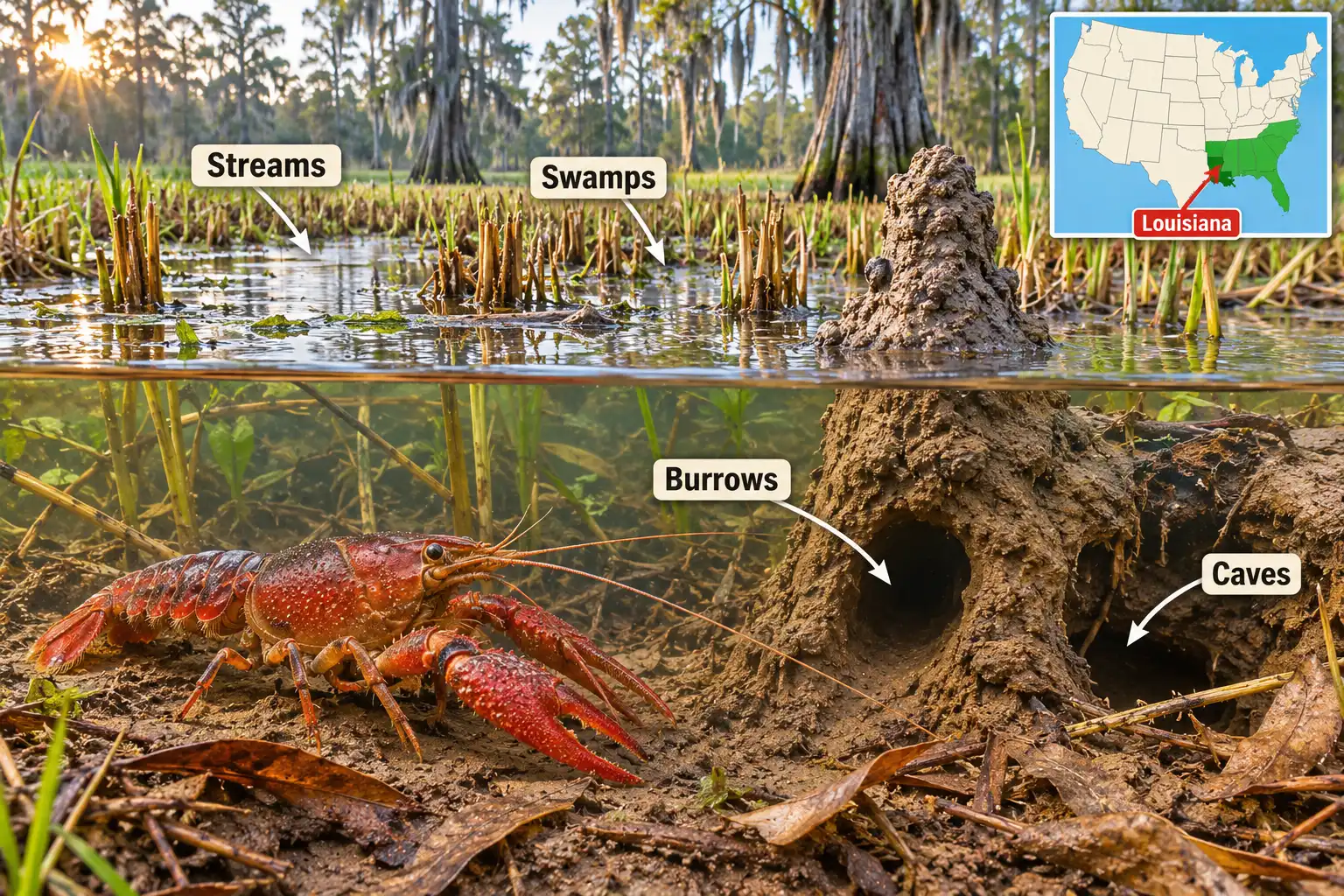
Crawfish turn up in creeks, swamps, rice fields, and even soggy lawns. So where do crawfish live, and why does the Southeast hold so many species while Arizona has none? The answer depends on the species, the water, and the soil.
Crawfish live in fresh water: streams, rivers, lakes, ponds, swamps, roadside ditches, and burrows in wet soil. North America holds most of the world’s species, and the southeastern United States, especially Tennessee, Alabama, and Mississippi, holds the most.
The Main Places Crawfish Live
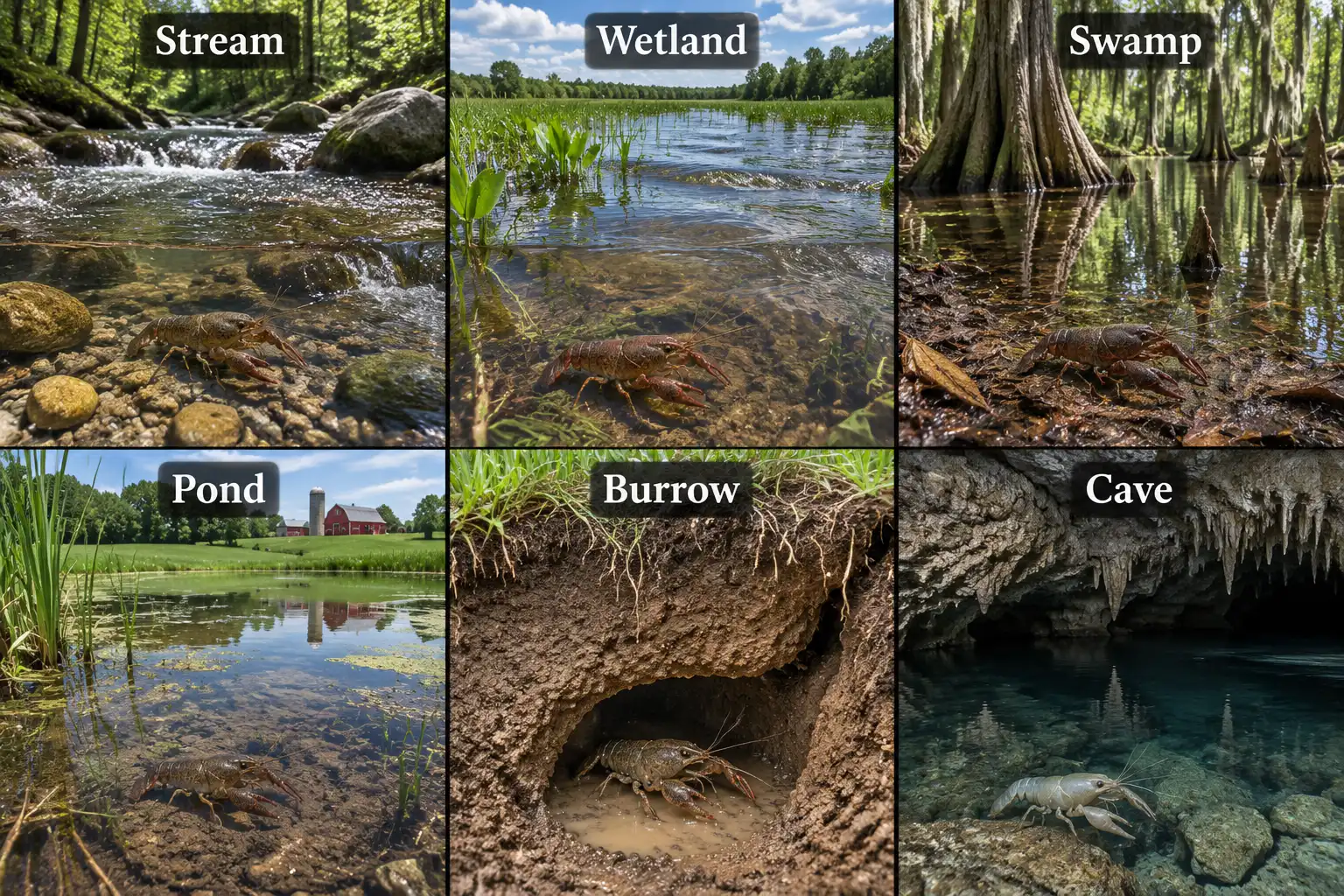
Crawfish need fresh water or wet soil at every stage of life. Within that limit, each species claims its own niche. A global review in Philosophical Transactions of the Royal Society B lists rivers, streams, and lakes, both permanent and seasonal. It adds freshwater caves, springs, and burrows on land.
| Habitat | Typical residents | What they rely on |
|---|---|---|
| Streams and rivers | Many native stream species | Moving water |
| Flooded wetlands with current | White river crawfish | Flowing, well-oxygenated water |
| Swamps, sloughs, and ditches | Red swamp crawfish | Still or slow water |
| Lakes, ponds, and reservoirs | Native species, plus introduced red swamp crawfish | Water that lasts all year |
| Burrows in wet soil | Burrowing species, and red swamp crawfish in dry months | A water table they can dig down to |
| Caves and springs | Cave species such as the southern cave crayfish | Stable groundwater |
The two farmed species split the wetland habitat. Red swamp crawfish favor swampy, still water. White river crawfish favor flooded wetlands with flowing, well-oxygenated water, per LSU AgCenter’s Louisiana Crawfish Production Manual (Publication 2637).
Cave crayfish sit at the other extreme. The same global review describes the southern cave crayfish as long-lived, at about 22 years. By contrast, LSU AgCenter puts red swamp crawfish at 2 years or less.
Know more: Crawfish Eat
How Crawfish Survive in Burrows
Crawfish breathe through gills, so they need moisture even out of water. Burrows supply it. In fact, LSU AgCenter’s lawn guide notes that all crawfish dig into soil to reach water.
Red swamp crawfish dig simple, nearly vertical burrows, usually 40 inches deep or less, per the LSU AgCenter manual. Most digging happens at night, and one burrow can take several days. Many burrows end in a mud chimney at the surface. Burrowing peaks in late spring and early summer, as ponds and wetlands dry down.
Then the burrow carries red swamp crawfish through the dry season. It hides them from predators and keeps their gills moist. Females lay eggs underground, and LSU notes that reproduction needs some standing water in the burrow. Still, long confinement costs them, because little food reaches the bottom.
That’s why mud chimneys pop up in Louisiana lawns, mostly in spring. The crawfish don’t actually injure turfgrass, LSU AgCenter notes, though many homeowners dislike the mounds.
A few species go further and live almost entirely in land burrows. So a crayfish can turn up in a wet pasture far from any creek.

Where Do Crawfish Live in the US?
Crawfish live in most of the US, but native species crowd into the Southeast. The global review in Philosophical Transactions B assessed 590 crayfish species described through 2009. Of those, 409 belong to the family Cambaridae, native to North America. The review names the southeastern US, notably Tennessee, Alabama, and Mississippi, as the main hotspot. Biologists keep describing new species, so treat those counts as a floor.
Many of those species have tiny ranges. The same review found that 53 percent of US crayfish species are known from a single state. So one state can hold crayfish found nowhere else on Earth.
The West has far fewer natives. Arizona has none at all. The Arizona Game and Fish Department says crayfish arrived as fishing bait. Others went into irrigation canals and ditches to control weeds. Today they live in lakes, ponds, rivers, and streams statewide.
The red swamp crawfish travels far beyond its home range. That native range runs from northern Mexico along the Gulf Coast, per Pennsylvania Sea Grant. From there it reaches up the Mississippi River drainage to Illinois and Ohio. Today the species has non-native reports from at least 34 states.
Red Swamp vs White River Crawfish
These two species make up Louisiana’s crawfish harvest, from ponds and the wild. LSU AgCenter’s manual separates them this way:
| Trait | Red swamp crawfish | White river crawfish |
|---|---|---|
| Scientific name | Procambarus clarkii | Procambarus zonangulus |
| Native range | Northeastern Mexico and the south-central US | Alabama, Louisiana, Mississippi, and Texas only |
| Preferred habitat | Swamps and still water | Flooded wetlands with flowing water |
| Oxygen | More abundant in low-oxygen water | Prefers well-oxygenated water |
| Egg laying in Louisiana | Any time, mostly fall and winter | Mid to late fall only |
| Life span | 2 years or less | 2 years or less |

What Water Do Red Swamp Crawfish Need?
Red swamp crawfish tolerate tough conditions, but they still have limits. Pennsylvania Sea Grant notes they tolerate low oxygen, temperature extremes, pollution, and slightly brackish water. For Louisiana ponds, Chapter 7 of LSU AgCenter’s manual and its other chapters set these working figures for red swamp crawfish:
| Measure | Red swamp crawfish in Louisiana ponds |
|---|---|
| Dissolved oxygen, target | Above 2 mg/L (2 ppm) for good production |
| Dissolved oxygen, stress | Below 1 mg/L all day for several weeks causes stress and can stop feeding |
| Dissolved oxygen, losses | Below 0.5 mg/L for a week or more may kill newly hatched and molting crawfish |
| Water temperature | Growth slows below about 60°F; oxygen problems likely above 70°F; long periods above 92 to 95°F are not tolerated |
| pH | 6.5 to 8.5 for source water after aeration |
| Total hardness and alkalinity | 50 to 250 mg/L as calcium carbonate |
| Salinity | Ideally 3 ppt or less; hatchlings die at 15 ppt; juveniles die within a week at 30 ppt |
Salinity is the hard wall, and it explains why red swamp crawfish stay out of the sea. LSU also advises source water below 1 ppt when rice or sorghum-sudangrass is the forage crop.
Timing matters too. The manual calls the first two to six weeks after a pond floods the most critical period for juvenile red swamp crawfish. So that’s when oxygen checks count most. For background, see how pond oxygen falls overnight.
If crawfish in a pond start dying, measure dissolved oxygen at dawn first. Then call your LSU AgCenter or local extension aquaculture agent. Heavy, unexplained losses go to your state veterinarian or state aquatic animal health official.
Where Do Farmed Crawfish Live?
Farmed crawfish live in shallow, flooded fields, mostly in south Louisiana. Crawfish raised for food brought in $122.8 million in 2023, per USDA NASS’s 2023 Census of Aquaculture. That was 70 percent of US crustacean aquaculture sales. The census counted 751 crawfish farms, and 97 percent were in Louisiana.
These ponds copy the wild cycle. LSU AgCenter explains that flooding and draining mimic the natural flood and dry cycle of Louisiana’s Atchafalaya River basin. That basin also supplies most of the state’s wild-caught crawfish. Chapter 3 of the LSU manual describes earthen ponds 8 to 24 inches deep for red swamp crawfish. Farmers flood them in fall and drain them in spring.
Many of those ponds are rice fields. In a rice-crawfish rotation, rice grows in summer, then crawfish follow in autumn and are harvested into spring. In fact, the manual places more than half of Louisiana crawfish aquaculture alongside rice. For pond layout, see earthen pond systems.
Farmers don’t stock hatchery young. Instead, they stock adult red swamp crawfish, which spawn in burrows, and holdover crawfish seed later crops. The flooded forage then builds the food web, covered in what crawfish feed on in ponds.
Crawfish Pond Math: Broodstock and Harvest for 20 Acres
LSU AgCenter puts stocking for new monoculture ponds at 40 to 80 pounds per acre of adult red swamp crawfish. Stocking runs from early April to early July. For a 20-acre pond, that works out to:
- Low rate: 20 acres x 40 pounds = 800 pounds of adult red swamp crawfish
- High rate: 20 acres x 80 pounds = 1,600 pounds of adult red swamp crawfish
Harvests swing hard, though. LSU AgCenter’s 2024 Louisiana Summary reports Louisiana farm-raised crawfish yields of 554.4 pounds per acre in 2023 and 348.3 pounds per acre in 2024. At those state averages, the same 20-acre pond yields:
- 2023 average: 20 x 554.4 = about 11,090 pounds of farm-raised crawfish
- 2024 average: 20 x 348.3 = about 6,970 pounds of farm-raised crawfish
Your own yield depends on forage, water, weather, and trapping. So treat state averages as a range, not a forecast. More on the species is in our crawfish farming guides.
What Is a Crayfish?
A crayfish is a freshwater crustacean with ten legs, the front pair built into claws. It belongs to the order Decapoda, alongside lobsters, crabs, and shrimp. Like other crustaceans, it grows by shedding its shell. LSU AgCenter’s manual says red swamp and white river crawfish need about 11 molts to mature. Fall-hatched crawfish of those species reach harvest size 3 to 5 months after hatching.
Crayfish fall into three families, per the global review in Philosophical Transactions B:
- Cambaridae: the largest family, native to North America and East Asia
- Astacidae: native to Europe, plus five species in the US and Canada
- Parastacidae: native to the Southern Hemisphere, including Australasia, Madagascar, and South America
Most crayfish species live at temperate latitudes. Native crayfish are absent from continental Africa and the Indian subcontinent, the same review notes.
Difference Between Crayfish and Crawfish
There is no biological difference. Crayfish and crawfish are two names for the same animals. Scientists generally say crayfish. Louisiana producers, marketers, and diners say crawfish, and LSU AgCenter uses crawfish in its manual for that reason. USDA NASS also reports “crawfish for food” in its census.
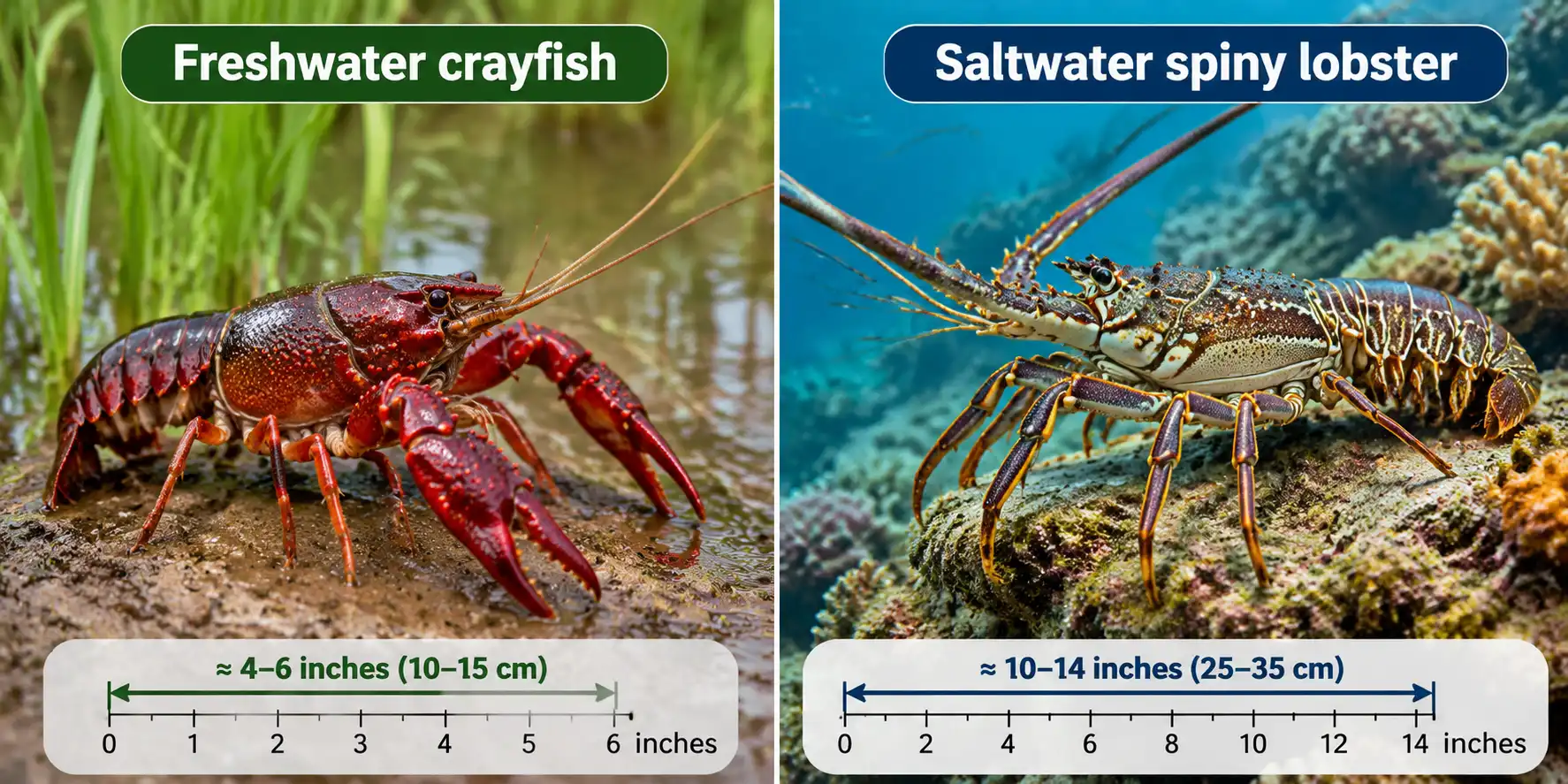
One exception does catch seafood buyers. In Florida and the Caribbean, “crawfish” can mean the Caribbean spiny lobster, a saltwater animal. NOAA Fisheries lists crawfish among its other names, along with rock lobster, bug, and Florida lobster. It lives on the continental shelf from North Carolina to Texas, around Bermuda and the Caribbean, and south to Brazil.
| Name | What it usually means | Water |
|---|---|---|
| Crayfish | Any freshwater crayfish; the scientific term | Fresh |
| Crawfish, Louisiana usage | Red swamp or white river crawfish | Fresh |
| Crawfish, Florida and Caribbean usage | Caribbean spiny lobster | Salt |
| Crawdad, mudbug | Casual names for freshwater crayfish | Fresh |
So read the context. At a Louisiana seafood market, crawfish means a freshwater crayfish. On a Florida Keys menu, it may mean spiny lobster.
Other Names for Crayfish
Crayfish pick up local names wherever they live. These are the common ones:
- Crawfish: standard in Louisiana and in the seafood trade
- Crawdad and crawdaddy: casual names for freshwater crayfish
- Mudbug: a nickname for the red swamp crawfish, which Pennsylvania Sea Grant also lists as the Louisiana crawfish
- Écrevisse: the French word for crayfish
- Yabby: an Australian name for some of its native freshwater crayfish
The “fish” in crayfish is an accident of language. English borrowed the Old French word crevice, and over time speakers reshaped its ending into “fish.” The animal, of course, is a crustacean.
Why Crawfish Turn Up Where They Don’t Belong
Red swamp crawfish outside their native range usually arrive with human help. Pennsylvania Sea Grant traces their spread to both intentional and accidental releases. The species moves through the food, aquarium, classroom, and bait trades. Once loose, it follows connected waterways and can travel several miles overland at night in wet weather.
That spread does real harm. The Arizona Game and Fish Department says introduced crayfish may have played a role in declines of several native species. Its list includes the Chiricahua leopard frog, the Sonoran mud turtle, and the Gila topminnow. Because established crayfish are hard to control, the department calls prevention the best approach.
Rules follow from that. Pennsylvania bars possessing, importing, or transporting any live crayfish, with two exceptions. Crayfish may be used as bait in the water where they were caught, or transported with the head removed above the eyes. Other states set their own rules.
So before you buy, stock, or move live crawfish, check with your state fish and wildlife agency and your state aquaculture coordinator. Many states also require an aquaculture license, covered in state permits and licenses. Moving live crawfish across state lines can require a permit or health certificate from the receiving state.
Never release crawfish, bait included, into public waters. It is often illegal, and it can spread invasive species and disease. See how farmed animals escape and spread.
FAQs About Crawfish Live
Can crawfish live in salt water?
No. LSU AgCenter reports that newly hatched red swamp crawfish die at 15 ppt salinity, and juveniles die within a week at 30 ppt. The manual advises keeping red swamp crawfish ponds at 3 ppt or less.
Can crawfish live out of water?
For a while, yes. Crawfish breathe with gills that must stay moist, so they ride out dry months in damp burrows. Pennsylvania Sea Grant notes red swamp crawfish can travel several miles overland on wet nights.
Why are there mud chimneys in my yard?
Burrowing crawfish build them. LSU AgCenter explains that crawfish dig down to reach water, and the soil they push up forms chimneys, seen most often in spring. The crawfish don’t injure the turfgrass itself.
How deep do crawfish burrow?
Red swamp crawfish burrows usually run 40 inches deep or less, per LSU AgCenter. The burrows are simple, nearly vertical tunnels, dug mostly at night over several days, and many end in a mud chimney.
How long do crawfish live?
It depends on the species. LSU AgCenter puts red swamp and white river crawfish at 2 years or less. By contrast, a global crayfish review reports the southern cave crayfish living about 22 years.
Are there crawfish in every state?
Not as natives. Arizona has no native crayfish, per the Arizona Game and Fish Department, yet introduced crayfish now live statewide. Red swamp crawfish alone have non-native reports from at least 34 states, per Pennsylvania Sea Grant.
Are crawfish and lobsters the same animal?
No, but they are relatives. Both are ten-legged crustaceans, yet crawfish live in fresh water and true lobsters live in the sea. Still, NOAA Fisheries notes the Caribbean spiny lobster is sometimes called crawfish.
Before You Stock or Move Crawfish
Crawfish live wherever fresh water or wet soil lasts long enough, and the Southeast holds the richest mix of species. For a farm pond, red swamp crawfish suit shallow, still water held at 3 ppt salinity or less, per LSU AgCenter. Check your state’s species rules first, because a crawfish that is native in Louisiana can be restricted elsewhere. Then talk with your extension aquaculture agent before you stock.