How Long Do Crawfish Live? Lifespan, Out of Water, and in a Sack
Crawfish lifespan matters in two places: the farm pond and the ice chest. Farmers holding broodstock need to know how long crawfish live. So do cooks keeping a sack alive for the weekend boil, along with what kills them early.
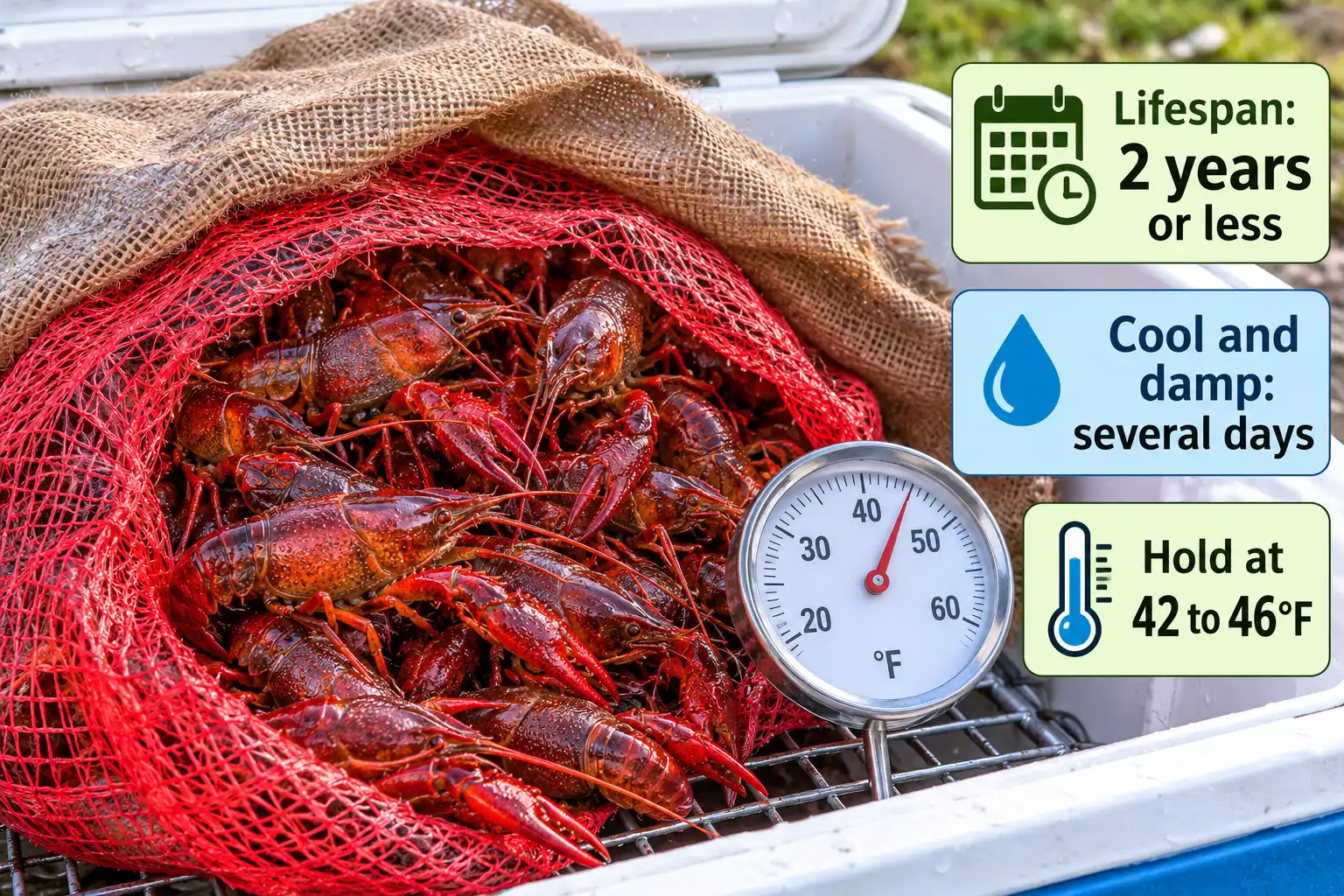
Red swamp crawfish live 2 years or less, per SRAC Publication 2403. Out of water, they survive several days if kept cool and moist. LSU AgCenter recorded low losses after 72 hours in humid storage at 42 to 46°F.
How Long Do Crawfish Live?
Red swamp crawfish live 2 years or less in the Deep South, per SRAC Publication 2403. That fact sheet gives the same short span for white river crawfish, the other farmed species. LSU AgCenter’s Louisiana Crawfish Production Manual also agrees. So on a farm, 2 years is a ceiling, and harvest takes most crawfish well before it.
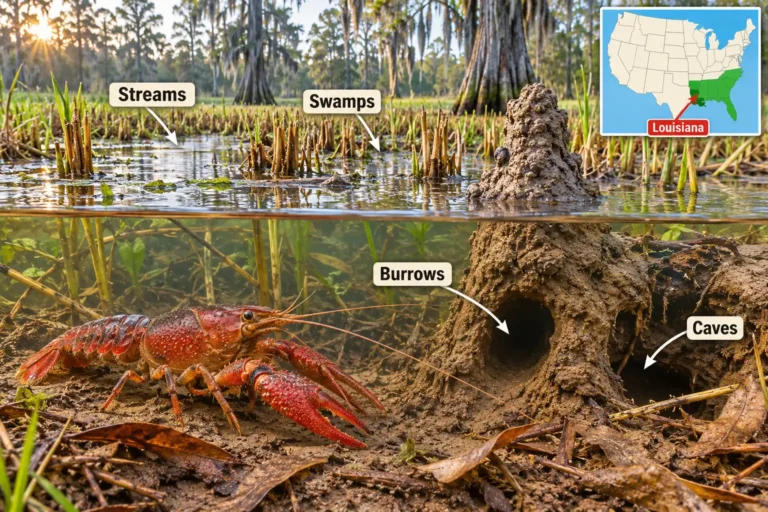
Crayfish as a group live longer. Virginia Cooperative Extension Publication 420-524 says most crayfish live 2 to 4 years, and some cave crayfish pass 10. Still, the two figures don’t conflict. One describes two fast-growing species in warm southern ponds. The other covers about 400 North American species, many of them in cool streams and caves.
Survival outside the pond is a separate question, and temperature drives it. The table pulls the main figures together.
| Situation | Species | How long | Source |
|---|---|---|---|
| Natural lifespan in southern ponds | Red swamp and white river crawfish | 2 years or less | SRAC Publication 2403 |
| Natural lifespan, crayfish in general | Most North American crayfish | 2 to 4 years; some cave species over 10 | Virginia Cooperative Extension |
| Out of water, cool and damp | Red swamp crawfish | Several days | Virginia Cooperative Extension; Ma et al. 2023 |
| Mesh sack in a humid cooler at 42 to 46°F | Red swamp crawfish | 3 days with low losses | LSU AgCenter |
| Out of water at 90°F | Red swamp crawfish | Under 3 days | Ma et al. 2023 |
| Home aquarium | Red swamp crawfish | No published extension data | None found |
Read next: Where Do Crawfish Live? Habitats, US Range, and Common Names
The Red Swamp Crawfish Life Cycle, Season by Season
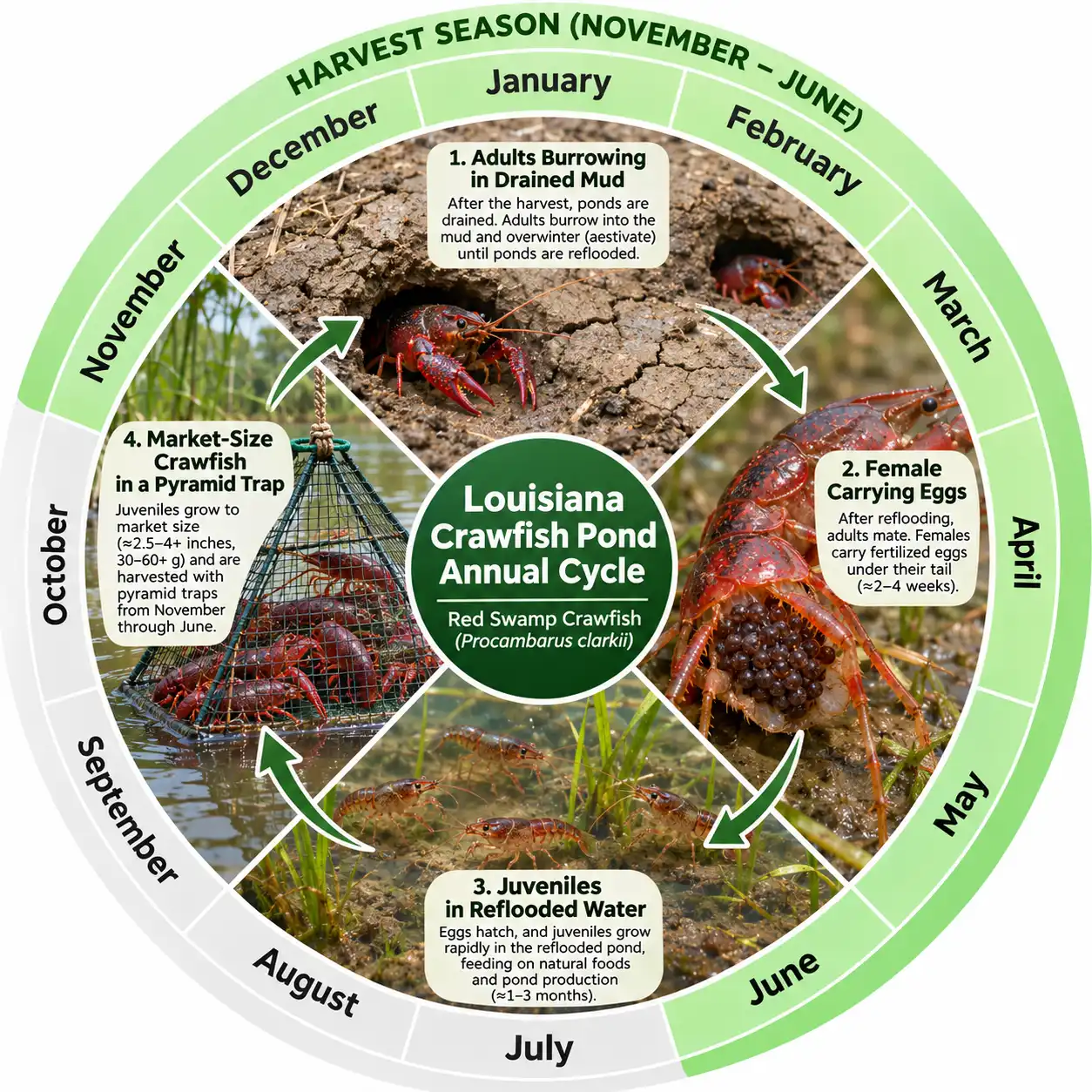
A red swamp crawfish fits its whole life into about two pond seasons. Here is the calendar for a Louisiana single-crop pond, drawn from SRAC Publications 2403 and 241.
| Season | What happens | Source |
|---|---|---|
| Late spring to early summer | Ponds drain, and adults dig burrows, usually 40 inches deep or less | SRAC 2403, SRAC 241 |
| Summer | Crawfish stay in burrows, where wet mud keeps the chamber humid | SRAC 2403 |
| Autumn | Ponds reflood in October, crawfish emerge, and spawning peaks; eggs hatch in about 3 weeks at 74°F | SRAC 2403, SRAC 241 |
| November to May or June | Harvest season; young reach harvest size 3 to 5 months after hatching | SRAC 241, SRAC 2403 |
| Second summer | Survivors burrow again; lifespan in the Deep South is 2 years or less | SRAC 2403 |
Females usually carry 200 to 300 eggs, and large females can carry more than 500, per SRAC Publication 2403. Then, young crawfish molt about 11 times to reach maturity. Under good conditions, one molt can add 15 percent in length and 40 percent in weight.
Heat speeds the clock, though. SRAC 2403 notes that above 80°F, crowded red swamp crawfish short on food can mature at a smaller size than buyers want. That hurts sales, because SRAC Publication 2400 puts minimum market size near 3 inches.
How Long Do Crawfish Live Out of Water?
Crawfish live several days out of water if they stay cool and damp. They breathe through gills, and many can stay out of water a long time in humid conditions, per Virginia Cooperative Extension. So moisture matters as much as cold.
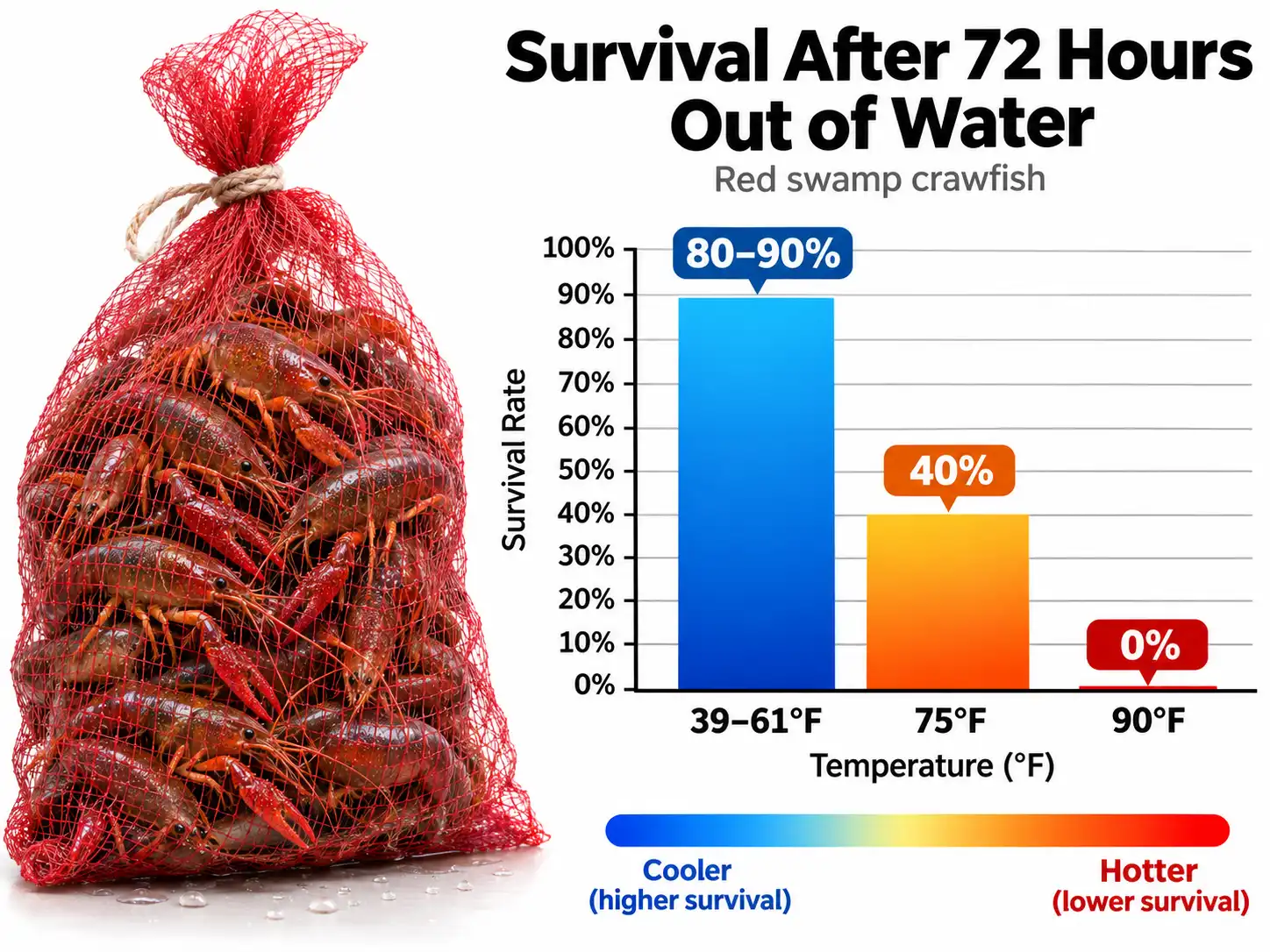
Beyond moisture, temperature sets the pace. A 2023 study by Ma and colleagues held red swamp crawfish without water for 72 hours. It appeared in the Chinese journal Science and Technology of Food Industry.
| Holding temperature | Red swamp crawfish alive after 72 hours |
|---|---|
| 39 to 61°F (4 to 16°C) | 80 to 90 percent |
| 75°F (24°C) | 40 percent |
| 90°F (32°C) | None |
The authors found the best muscle quality at 54 to 61°F (12 to 16°C). Keep in mind that this is one study, on crawfish farmed in China, and US extension trials haven’t repeated it. Even so, it fits LSU AgCenter’s warning that heat, direct sun, and wind kill or badly stress red swamp crawfish broodstock.
Dry air is the second threat. In the wild, wet mud in the burrow chamber acts as a humidifier, per SRAC Publication 2403. A sack on a hot, breezy truck bed gets no such help.
How Long Do Crawfish Live in a Sack?
A mesh sack in a humid cooler keeps red swamp crawfish alive for 3 days with few losses, per LSU AgCenter research. The researchers sacked freshly harvested crawfish and held them in humid refrigerated storage at 42 to 46°F. After 72 hours, crawfish washed in fresh water had lost 1.9 percent. Crawfish given a saltwater bath first lost 6.2 percent.
The sack itself also does part of the work. LSU AgCenter’s field handling fact sheet calls onion sacks excellent for keeping crawfish alive. Farm sacks hold 35 to 45 pounds, per SRAC Publication 2400.
Here is what those loss rates mean for one sack:
- 40-pound sack x 23 crawfish per pound = about 920 crawfish
- 1.9 percent loss after 3 days = about 17 dead
- 6.2 percent loss after a salt bath = about 57 dead
SRAC 2400 notes that consumers prefer crawfish at 23 per pound or larger, so that count fits a common eating grade. Large crawfish run 10 to 15 per pound, so a sack of them holds fewer animals.
Shelf life also starts back in the pond. LSU AgCenter notes that crawfish exposed to low oxygen before harvest keep far less well in the cooler. That makes overnight oxygen checks in ponds part of selling sacks that hold up.
How to Keep Crawfish Alive Overnight
Keep the sack cool, damp, shaded, and open to air. Each step below blocks one common cause of death.
- Leave them in the mesh sack. The open weave lets air reach every layer, and LSU AgCenter rates onion sacks highly for live crawfish.
- Chill them to 42 to 46°F. That matches the LSU AgCenter storage study. A walk-in cooler, a spare refrigerator, or an ice chest all work.
- Keep them damp, not wet. Lay a wet burlap sack or towel over the top. Gills need moisture to work.
- Never seal or flood them. LSU AgCenter warns that crawfish in sealed or water-filled containers quickly die and spoil.
- Raise the sack above any ice. Set it on a rack or an upside-down crate. Then leave the drain plug open and the lid cracked, so meltwater drains and air flows.
- Park the cooler in shade. LSU AgCenter’s seafood fact sheet says to keep live crawfish cool, shaded, and in good air circulation.
- Skip the salt. Instead, wash in plain water for about 10 minutes right before cooking, since LSU AgCenter found salt adds no cleaning benefit.
Finally, check the sack before the boil and pull out any dead crawfish.

What Kills Live Crawfish Before the Boil
Five problems kill crawfish between the pond and the pot.
- Heat. In the 2023 study, survival out of water fell from 80 to 90 percent at 39 to 61°F to 40 percent at 75°F.
- Still water. LSU AgCenter warns against water-filled containers. In 1999 LSU AgCenter research, even managed commercial purging systems lost 8 percent of crawfish in 24 hours. By 48 hours, losses reached 12 percent.
- Salt. A saltwater bath more than tripled 3-day losses in cold storage, from 1.9 to 6.2 percent.
- Low oxygen in the pond. Crawfish stressed before harvest have a shorter cooler life, per LSU AgCenter.
- Rough handling. LSU AgCenter’s production manual notes that rough handling can crack shells and raise deaths.
The salt purge persists anyway. In a 2014 LSU AgCenter release, crawfish researcher Ray McClain said salt gives no significant cleaning advantage. Only a 12 to 24 hour freshwater purge shrinks gut contents much, and he called that impractical for homeowners.
Losses in a pond are a different problem. A few dead crawfish in a sack is normal wear. Heavy deaths in a pond are not. Check dissolved oxygen first, since LSU AgCenter aims to keep crawfish ponds above 2 mg/L. Then call your extension aquaculture specialist or a diagnostic lab. Heavy, unexplained losses may need reporting to your state veterinarian or state aquatic animal health official.
Dead Crawfish and Food Safety
Check crawfish before cooking, not after. LSU AgCenter’s handling fact sheet says to examine crawfish before cooking to be sure they are alive. Its seafood handling guidance also warns that crawfish in sealed or water-filled containers quickly die and spoil.
The straight-tail rule fails as a safety check. For example, LSU AgCenter researchers stored dead crawfish for five days in a 38 to 42°F cooler. When boiled, they curled about as tightly as live ones. Crowded pots can also leave live crawfish with straight tails. So tail shape after cooking says little about whether a crawfish was alive.
Containers matter too. Never put cooked crawfish back into the sack, tub, or cooler that held them live. LSU AgCenter warns that this kind of cross-contamination may cause serious illness. For the rest of the trip from harvest to plate, see our guide to handling seafood safely.
Holding Broodstock Is a Different Job
Crawfish headed for a pond need warmer handling than crawfish headed for a pot. LSU AgCenter’s Louisiana Crawfish Production Manual says to keep red swamp crawfish broodstock clean, moist, and at 60 to 80°F. It also says not to hold broodstock in refrigerated coolers or bury them in ice. A little ice can still help control temperature during transport.
Timing helps, too. The manual suggests harvesting and moving broodstock at dawn, dusk, or night to cut heat stress.
Next, size the haul. The manual puts stocking at 40 to 80 pounds of adult red swamp crawfish per acre. For a 10-acre pond, that works out as:
- 10 acres x 40 pounds = 400 pounds, or about 10 forty-pound sacks
- 10 acres x 80 pounds = 800 pounds, or about 20 forty-pound sacks
SRAC Publication 241 (1998 revision) gives 50 to 60 pounds per acre for new single-crop ponds stocked in April or May. For rice rotations, it gives 40 to 50. The figures differ by system and source, so confirm your rate with your extension aquaculture specialist. For truck setup and handling, see our guide to hauling live animals to ponds and buyers.
Moving broodstock across a state line? Check the receiving state’s rules first, since many require permits or health certificates for live aquatic animals.
How Long Do Crawfish Live in Captivity?
No extension source reports how long red swamp crawfish live in a home aquarium. The figure of 2 years or less comes from southern ponds and wild habitat. So treat any exact aquarium lifespan you see online as unverified.
However, the research does give water targets. SRAC Publication 2403 lists these for red swamp and white river crawfish ponds:
| Measure | Target for crawfish ponds |
|---|---|
| pH | 6.5 to 8.5 |
| Total alkalinity | Above 50 mg/L as calcium carbonate |
| Total hardness | Above 50 mg/L as calcium carbonate |
| Un-ionized ammonia | Below 0.06 mg/L |
| Nitrite | Below 0.6 mg/L |
| Salinity | Below 6 ppt |
| Dissolved oxygen | Stress when below 1 mg/L for weeks; molting and survival drop below 0.5 mg/L |
LSU AgCenter aims higher on oxygen and keeps production ponds above 2 mg/L. Remember that these are pond figures. A tank has far less water to dilute waste, so test it on a regular schedule.
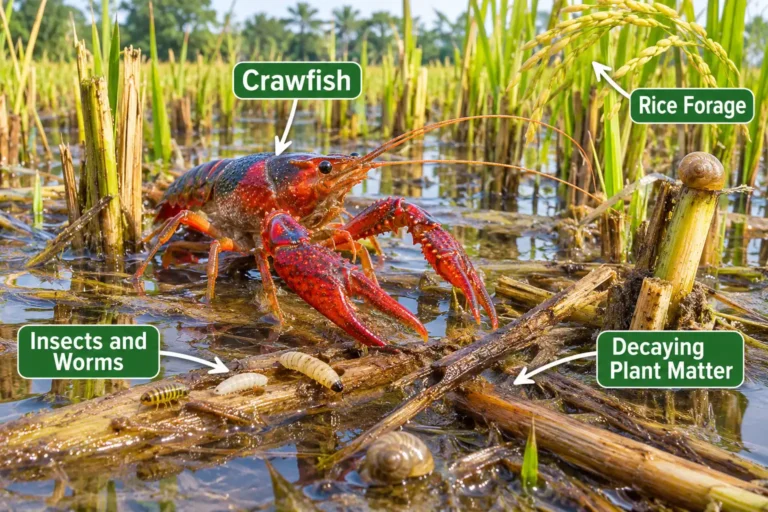
Diet matters as well. Our guide to what crawfish eat in ponds and tanks covers feeding. Before you buy live crawfish as pets, though, check your state’s rules, covered next.
State Rules on Live Crawfish
Check your state’s rules before you buy live crawfish for pets, bait, or stocking. Red swamp crawfish are native to the southern US but invasive in many other places. Michigan, for example, has prohibited the live species since 2014. The Michigan DNR says it is illegal there to knowingly possess, introduce, import, or sell live red swamp crayfish.
The agency also links new infestations to released aquarium pets, live bait, and live crayfish. Escaped red swamp crawfish also burrow into shorelines, which can weaken banks and infrastructure, per the same October 2026 notice.
So never release leftover crawfish into a ditch, pond, or stream, even where the species is native. Cook everything you bought. Your state natural resources or agriculture agency can tell you which crayfish you may hold live. Our page on how escaped farm animals become invasive covers the wider risk.
Crayfish Facts Worth Knowing
Crawfish and crayfish are the same animals. LSU AgCenter’s production manual notes that scientists use crayfish, while Louisiana growers, sellers, and eaters say crawfish.
A few more crayfish facts, from Virginia Cooperative Extension and SRAC Publication 2403:
- North America holds about 400 crayfish species. About 353 live in the US, nearly 70 percent of the world’s total.
- US species run 1 to 6 inches long.
- Young crayfish molt 6 to 14 times in their first year.
- Burrowing species dig 1 to 5 feet deep, or down to the water table.
- More than 240 kinds of North American wild animals eat crayfish.
- US farms raise two species: red swamp crawfish (Procambarus clarkii) and white river crawfish (Procambarus zonangulus).
- Red swamp crawfish usually show a dark stripe under the tail. White river crawfish lack it and have longer, narrower claws.
- Red swamp crawfish now live in at least 19 countries outside their native range.
Farming, though, is concentrated in one state. Crawfish raised for food sold for $122.8 million in 2023, 70 percent of US crustacean aquaculture sales. That figure comes from USDA NASS’s 2023 Census of Aquaculture. Of the 751 crawfish farms counted, 97 percent were in Louisiana. For pond management, harvest, and species basics, see our crawfish farming guides.

FAQs About Crawfish Lifespan
How many crawfish are in a sack?
A farm sack holds 35 to 45 pounds of crawfish, per SRAC Publication 2400, so the count depends on size grade. A 40-pound sack holds about 920 crawfish at 23 per pound, or about 600 at 15 per pound.
Can crawfish stay alive in a bucket of water overnight?
Not in still water, because LSU AgCenter warns that crawfish in water-filled containers quickly die and spoil. Even managed commercial purge systems lost 8 percent of crawfish within 24 hours in LSU research.
Can you put live crawfish directly on ice?
Keep them above the ice, not buried in it, with the drain open so meltwater runs out. LSU AgCenter warns against water-filled containers and advises against icing down broodstock headed for ponds.
Is it safe to boil crawfish that died before cooking?
Don’t knowingly cook crawfish that died before the boil, since LSU AgCenter says to check that crawfish are alive first. Tail curl after boiling won’t tell you, because LSU research found dead crawfish curl like live ones.
Are crawfish and crayfish the same animal?
Yes, they are the same animals under two common names. Scientists say crayfish, while Louisiana growers and buyers say crawfish, and LSU AgCenter’s manual uses crawfish for both farmed species.
How fast do crawfish grow to eating size?
Red swamp crawfish usually reach harvest size 3 to 5 months after hatching in the South, per SRAC Publication 2403. They molt about 11 times before maturity, and each molt can add up to 40 percent in weight.
Key Points Before the Boil
Red swamp crawfish live 2 years or less, and out of water, cold and moisture decide how long they last. Hold food crawfish at 42 to 46°F in a damp, shaded mesh sack, never sealed or flooded. Broodstock are the exception: keep them at 60 to 80°F and out of the refrigerator. Check every crawfish before it goes in the pot, and never release leftovers.