What Do Catfish Eat? Wild Diets, Farm Feeds, and Feeding Rates
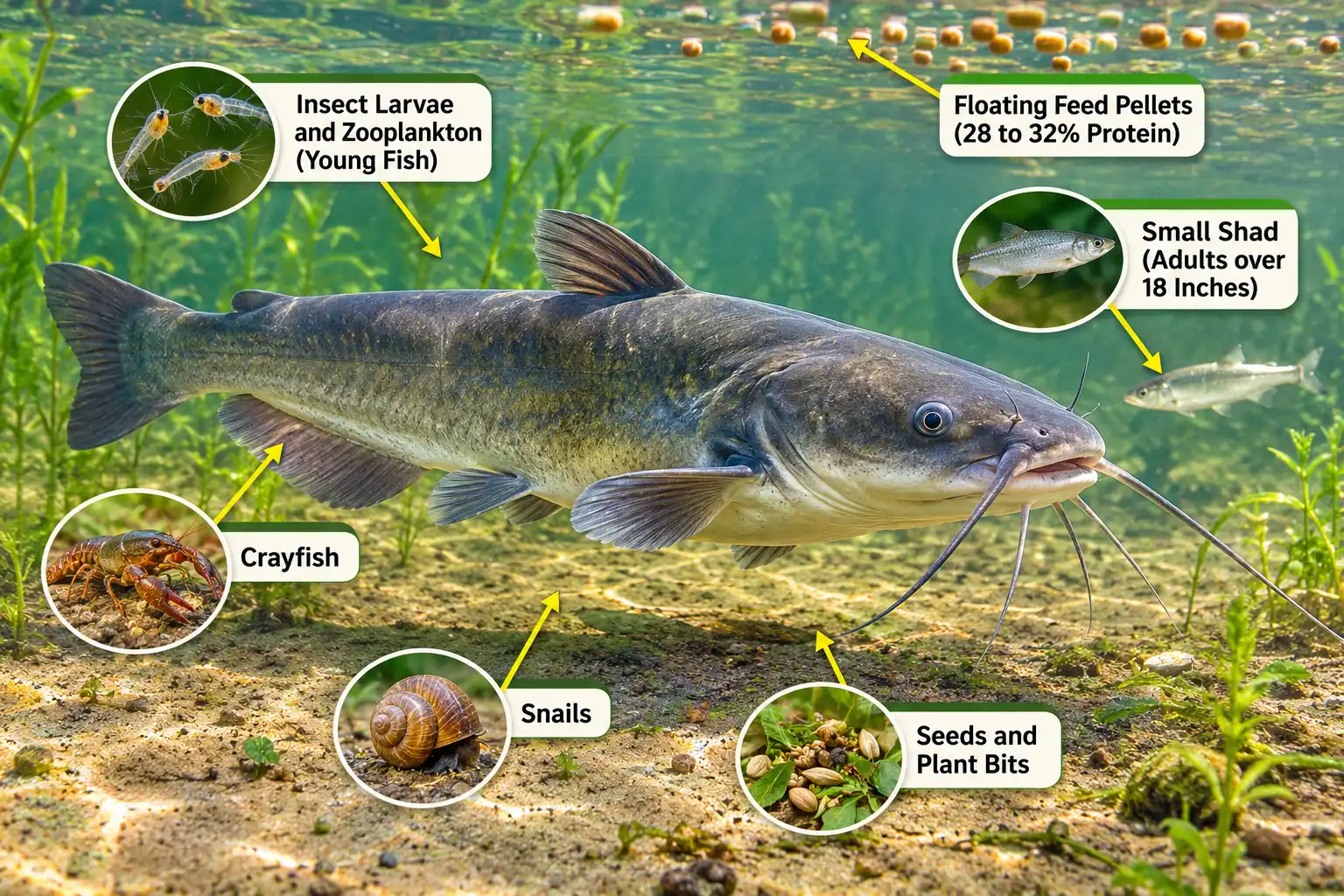
What catfish eat depends on the species, the size of the fish, and where it lives. A wild channel catfish in a river, a farmed one in a pond, and a cory catfish in an aquarium eat differently. Here’s what each eats and how much feed a pond needs.
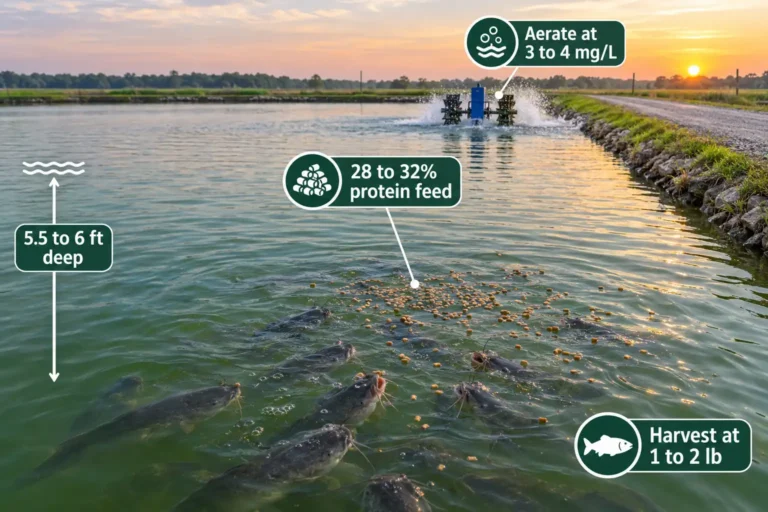
Wild catfish eat insects, crawfish, snails, plants, and small fish, and big blue and flathead catfish eat mostly fish. Food-size farmed channel and hybrid catfish eat floating pellets with 28 to 32 percent protein, per Mississippi State University Extension.
What Are Catfish?
Catfish are fish of the order Siluriformes, named for the whisker-like barbels around the mouth. In the US, the word also has a legal meaning. Under the USDA FSIS inspection rule, only the family Ictaluridae can carry the “catfish” label. FSIS Directive 14,010.1 spells out that definition.
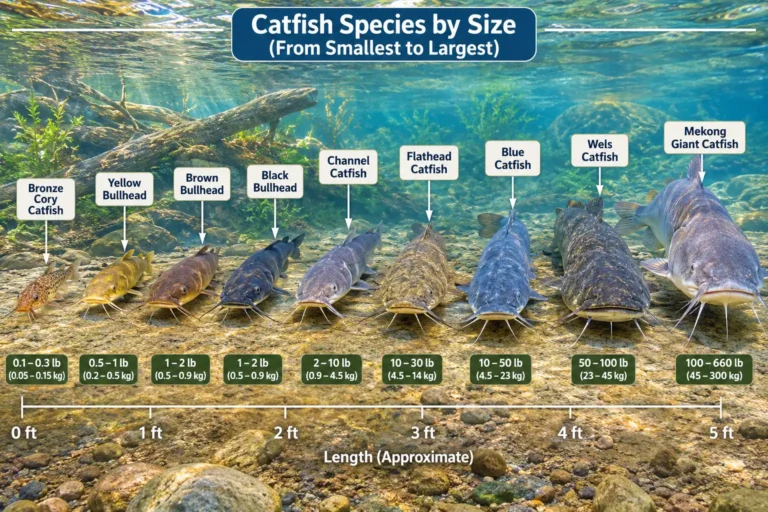
That family holds the catfish most Americans know:
- Channel catfish, the main farmed catfish and a common river, lake, and pond fish
- Blue catfish, a big-river fish that grows even larger than the flathead
- Flathead catfish, a night-feeding predator of large streams
- Bullheads, including black, brown, and yellow bullheads
- Hybrid catfish, a farm cross of a female channel catfish and a male blue catfish
Cory catfish are a different family altogether. UF/IFAS Extension places them in Callichthyidae, a group of small South American catfish sold as aquarium fish.
How Catfish Find Food
Catfish taste their food before they see it. SRAC Publication 180 notes that channel catfish detect food mainly by taste. Their taste buds cover the entire outer body, and they are most numerous on the barbels and gill arches.
Channel catfish often feed at night, per the Missouri Department of Conservation. They use their barbels to find food on the bottom by taste, smell, and touch. Yellow bullheads rely heavily on smell, per the same agency. As a result, catfish find food in muddy water where eyesight does little good.
What Do Catfish Eat in the Wild?
Wild catfish eat insects, crayfish, snails, mussels, plants, and other fish, but each species leans its own way. The table below draws on Missouri Department of Conservation field guides and SRAC Publication 180.
| Species | Young fish eat | Adults eat | How they feed |
|---|---|---|---|
| Channel catfish | Small insects (under 4 inches) | Insects, crayfish, snails, mollusks, seeds, plants, and fish | Omnivore and scavenger; feeds near the bottom but takes food at the surface |
| Blue catfish | Small invertebrates, with some fish from 4 inches | Mostly fish and larger invertebrates once over 8 to 13 inches, plus clams and mussels | Feeds on or near the bottom, sometimes in midwater |
| Flathead catfish | Insect larvae (under 4 inches) | Fish, crayfish, and other crustaceans | Forages at night; rarely eats dead or decaying food |
| Yellow bullhead | Small crustaceans and insect larvae | Crayfish, amphipods, snails, plants, and the odd small fish | Finds food mainly by smell |
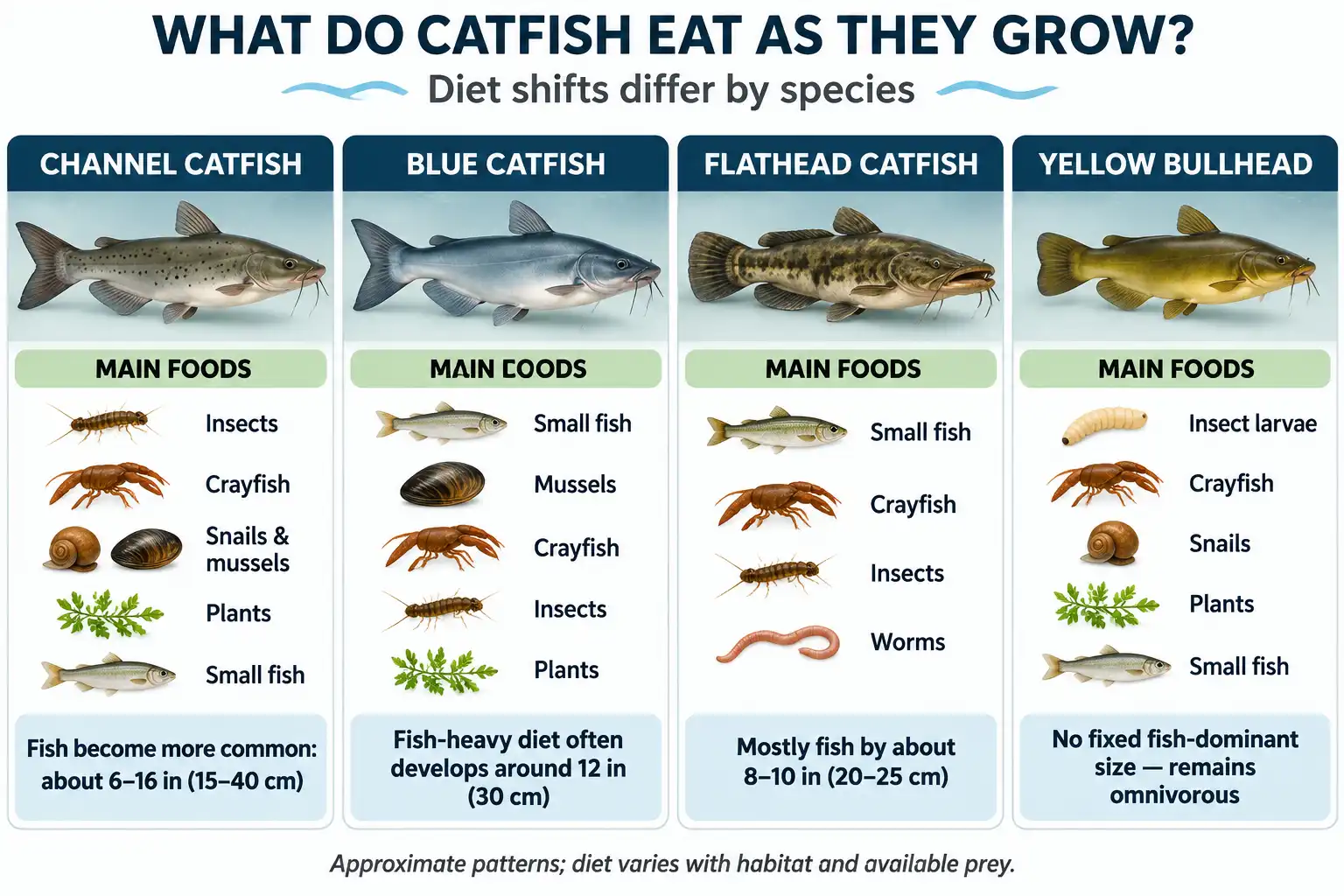
The pattern holds across species. Small catfish eat insects and other invertebrates, and bigger ones turn to fish. Still, the switch comes at different sizes. Blue catfish eat mostly fish once they pass 8 to 13 inches, per the Missouri Department of Conservation. Channel catfish switch later. SRAC Publication 180 says fish become an important food only for channel catfish over 18 inches long. In natural waters, fish can then make up as much as 75 percent of a large channel catfish’s diet.
What Do Channel Catfish Eat?
Channel catfish eat almost anything that fits in their mouths. SRAC Publication 180 lists insects, snails, crawfish, green algae, aquatic plants, seeds, and small fish. It also records land insects and even the occasional bird.
That range is wide. A Missouri Department of Conservation field guide cites one Des Moines River study. It found insects from 50 different families in channel catfish stomachs.
Channel catfish feed day or night, mostly near the bottom, according to SRAC Publication 180. However, they also rise to take food at the surface, and catfish farms depend on that habit.
What Do Baby Catfish Eat?
Baby catfish eat tiny animals. In the wild, Missouri Department of Conservation guides say channel and flathead catfish under 4 inches eat mostly small insects and larvae.
Pond-raised fry start the same way. In a well-fertilized pond, channel catfish fry can get most of their nutrients from natural foods, per Mississippi State University Extension. Those foods are large zooplankton, small insects, and insect larvae.
So farmers prepare nursery ponds before the fry arrive. SRAC Publication 181, revised in 2008, explains why. A nursery pond full of natural food at stocking gives newly stocked channel catfish fry the best growth and survival. Prepared feed plays a supporting role at this stage. In fact, the same publication notes that fry feed works partly as a fertilizer that keeps the pond productive.
Texture matters as much as protein for these tiny fish. Newly hatched fry need a fine meal, not pellets. From there, starter feeds for catfish fry step up in particle size as the fish grow.
What Do Farmed Catfish Eat?
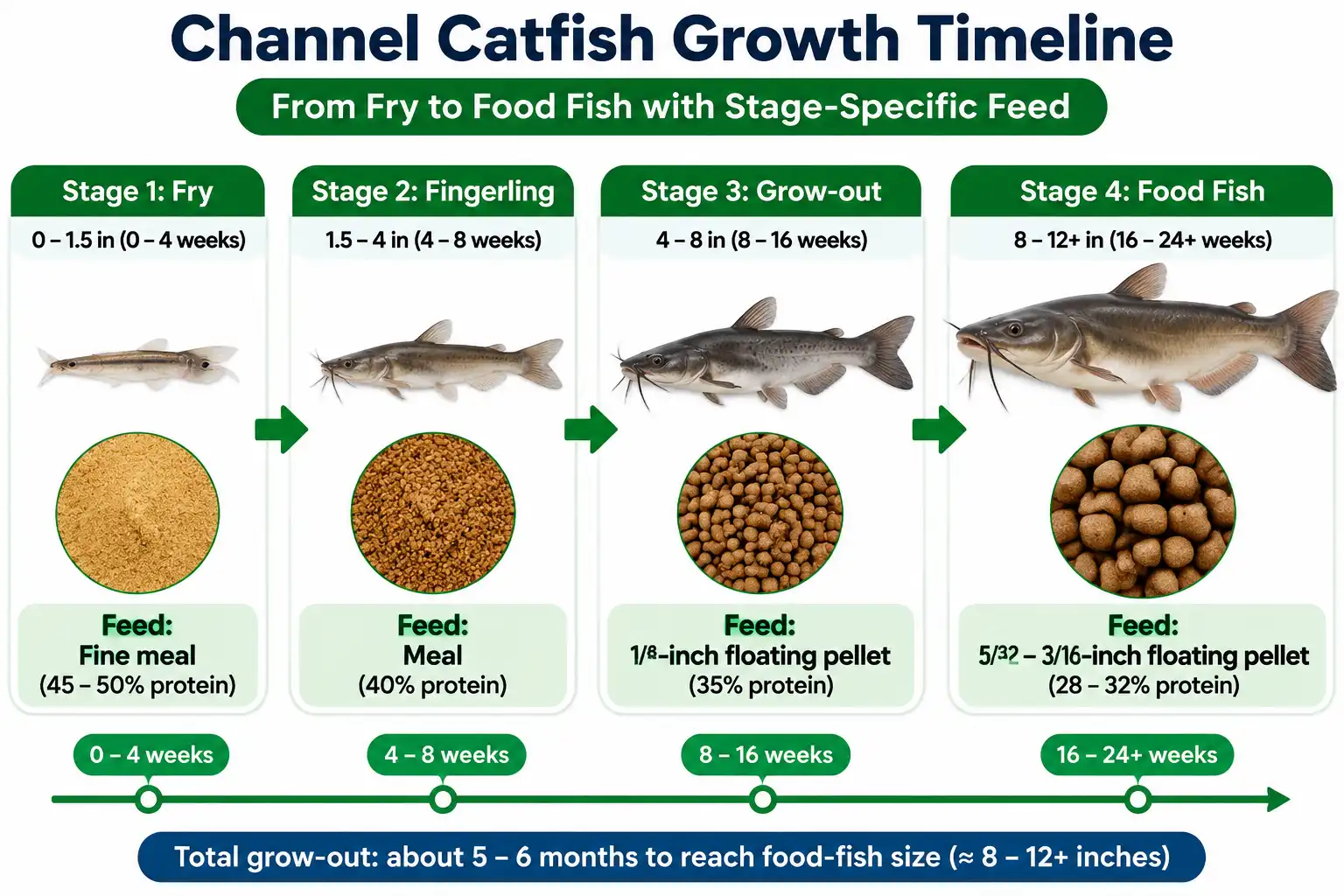
Farmed catfish eat a manufactured feed matched to their size. Mississippi State University Extension gives the feed for each stage of channel catfish:
| Life stage | Feed form | Crude protein |
|---|---|---|
| Hatchery fry | Finely ground meal or flour | 45 to 50% |
| Fry in nursery ponds | Meal-type feed | About 40% |
| Larger fingerlings | Small floating pellets, 1/8 inch | 35% |
| Advanced fingerlings (5 to 6 inches) and food fish | Floating pellets, 5/32 to 3/16 inch | 28 to 32% |
Food-size channel catfish don’t need the high end of that range. Mississippi State Extension calls 28 percent protein adequate for channel catfish growout when fish eat their fill daily. Hybrid catfish need about the same protein as channel catfish, Mississippi State research found. Blue catfish, however, appear to need 32 percent protein for best growth.
The ingredients are mostly plants. Mississippi State Extension lists soybean meal, cottonseed meal, corn, and wheat by-products as the main ingredients in channel catfish feeds. Only feeds for fry and small fingerlings contain some fish meal.
Why Farm Feed Floats
Floating feed lets the farmer see the fish eat. SRAC Publication 181 says producers prefer floating feed because it makes feeding behavior easy to watch. As a result, the person feeding can stop when the fish slow down, before pellets go to waste.
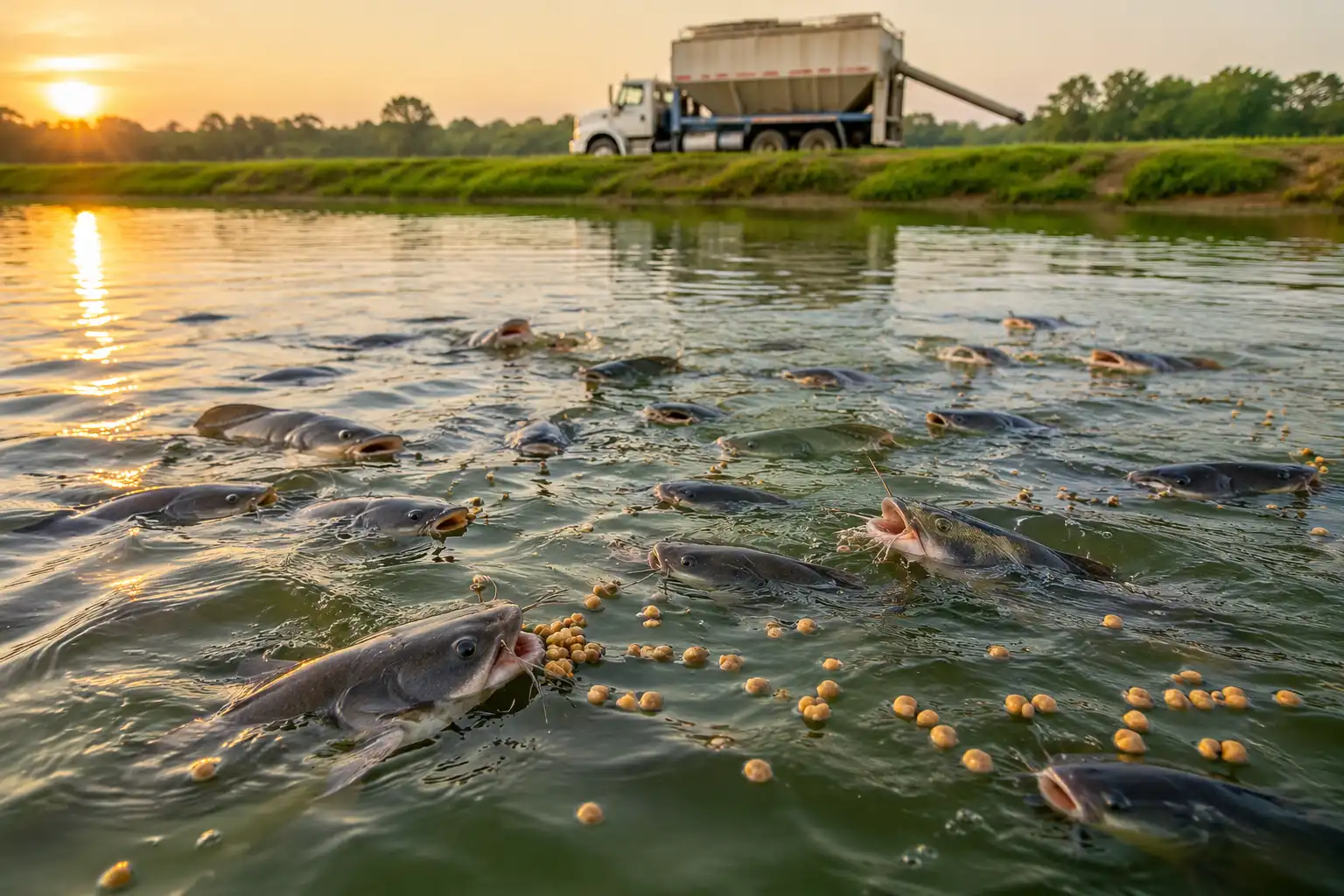
Winter changes that. Cold channel catfish are slow to come to the surface. So some producers switch to a slow-sinking extruded feed in winter, per Mississippi State Extension.
Feed is only one part of the plan for raising catfish in ponds, alongside stocking, aeration, and harvest timing.
How Much Do Catfish Eat?
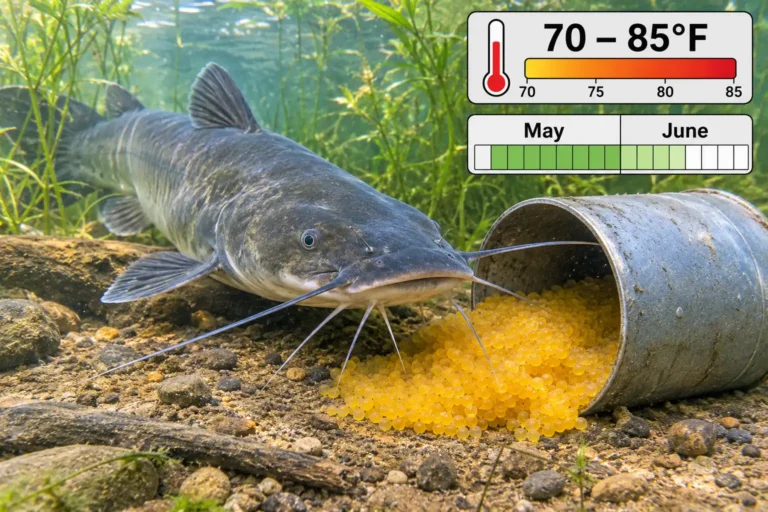
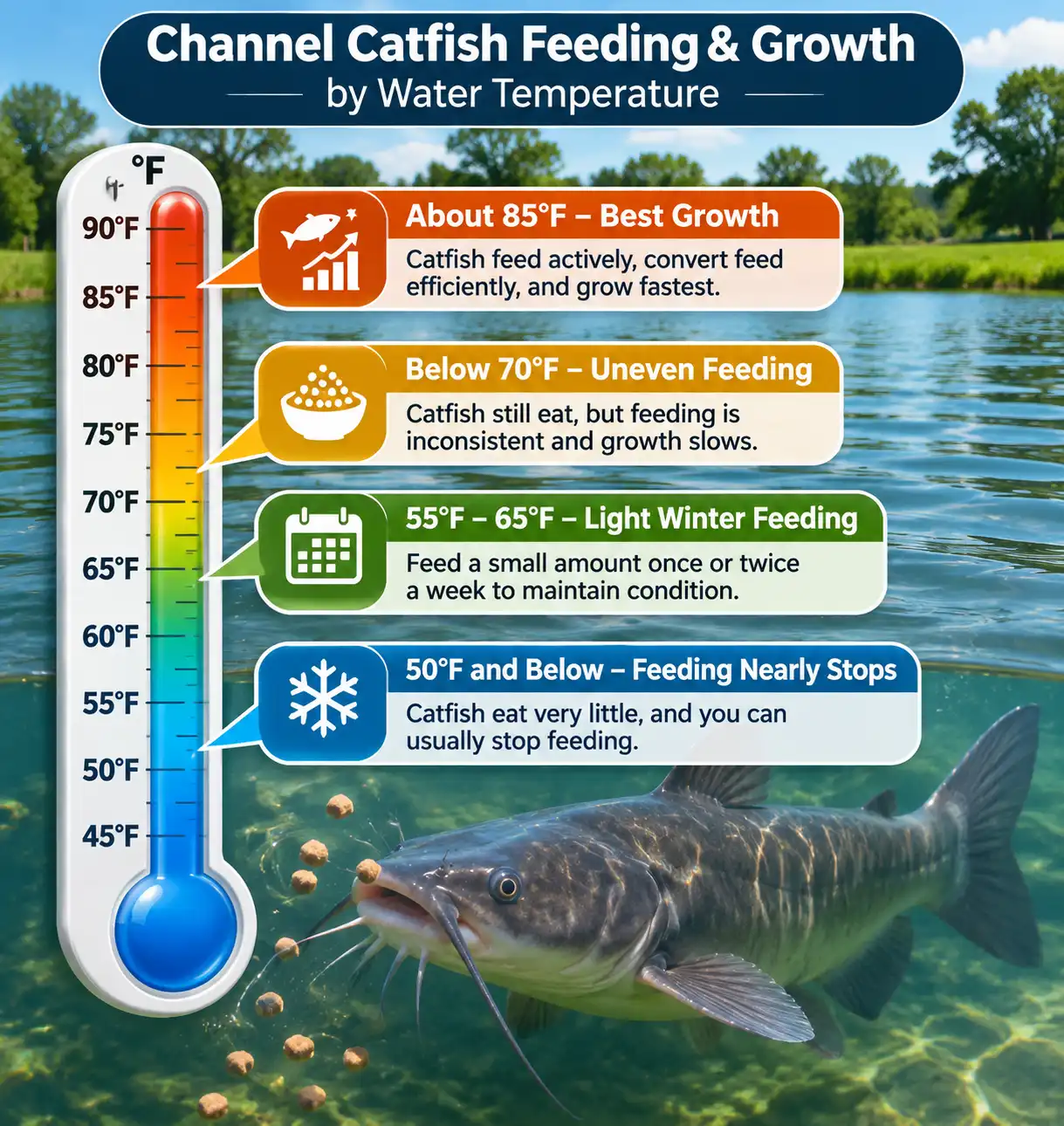
Water temperature decides how much catfish eat. SRAC Publication 180 says channel catfish grow best at about 85°F. Their appetite rises in warmer water and falls in cooler water. Then SRAC Publication 181 sets the cold-weather feeding points:
| Water temperature | Channel catfish feeding |
|---|---|
| About 85°F | Best growth (SRAC 180) |
| Below 70°F | Fish no longer feed consistently |
| Above 65°F in winter | Feed two or three times a week |
| 55 to 65°F | 20 to 30 pounds per acre, once or twice a week |
| 50°F and below | Fish more or less stop eating |
How Much Feed per Acre?
In warm weather, most producers feed channel catfish once a day, 7 days a week, per Mississippi State University Extension. Channel catfish fingerlings, by contrast, grow better when fed twice a day.
The daily ceiling comes from water quality, not appetite, and the two main sources differ. SRAC Publication 181 says long-term average feeding of channel catfish should not exceed 120 to 150 pounds per acre per day. Mississippi State Extension is more cautious, at 100 to 120 pounds per acre per day for traditional channel catfish ponds. For split ponds and intensively aerated channel catfish ponds, it allows about 300 pounds. Both caps exist to protect dissolved oxygen. The lower figure is the safer cap for a pond with limited aeration.
For a 10-acre traditional channel catfish pond, the two sources put the ceiling at 1,000 to 1,500 pounds of feed a day. That’s 20 to 30 fifty-pound bags.
How Much Feed Does a Whole Crop Need?
Multiply the weight you plan to add by the feed conversion ratio (FCR). FCR is the pounds of feed per pound of gain.
A 2015 Mississippi State University information sheet gives the range. Channel catfish grown from fingerlings to about 1.5 pounds in research ponds routinely convert at 1.8 or less. On commercial channel catfish farms, however, the average runs about 2.5 to 2.6.
Say your goal is to add 5,000 pounds of channel catfish:
- At an FCR of 1.8: 5,000 x 1.8 = 9,000 pounds of feed, or 180 fifty-pound bags
- At an FCR of 2.5: 5,000 x 2.5 = 12,500 pounds of feed, or 250 bags
Fish size matters too, and SRAC Publication 181 shows the jump. Channel catfish growing from 0.5 to 1 pound need 1.8 pounds of feed per pound of gain. Channel catfish growing from 2 to 2.5 pounds need 2.9. Deaths, overfeeding, and late harvests all push feed conversion up. That matters, because Mississippi State University Extension puts feed at more than half of variable costs in catfish production.
What Do Catfish Like to Eat?
Catfish like strong-smelling food that is easy to find, which fits how they hunt. The Missouri Department of Conservation lists common channel catfish baits. They include fish, crayfish, worms, grasshoppers, liver, shrimp, chicken entrails, blood, cheese, and stinkbait.
Flatheads are pickier. The same agency says only live or freshly killed baits work for flathead catfish, because they rarely eat dead food. For blue catfish, a Missouri Department of Conservation article suggests cut shad or carp.
In a farm pond, the preference that matters is fresh feed spread widely. Mississippi State University Extension advises scattering feed over a wide area. That way, more fish get a chance to eat. It also advises feeding with the prevailing wind, so pellets float across the pond instead of washing ashore.
What Do Cory Catfish Eat?
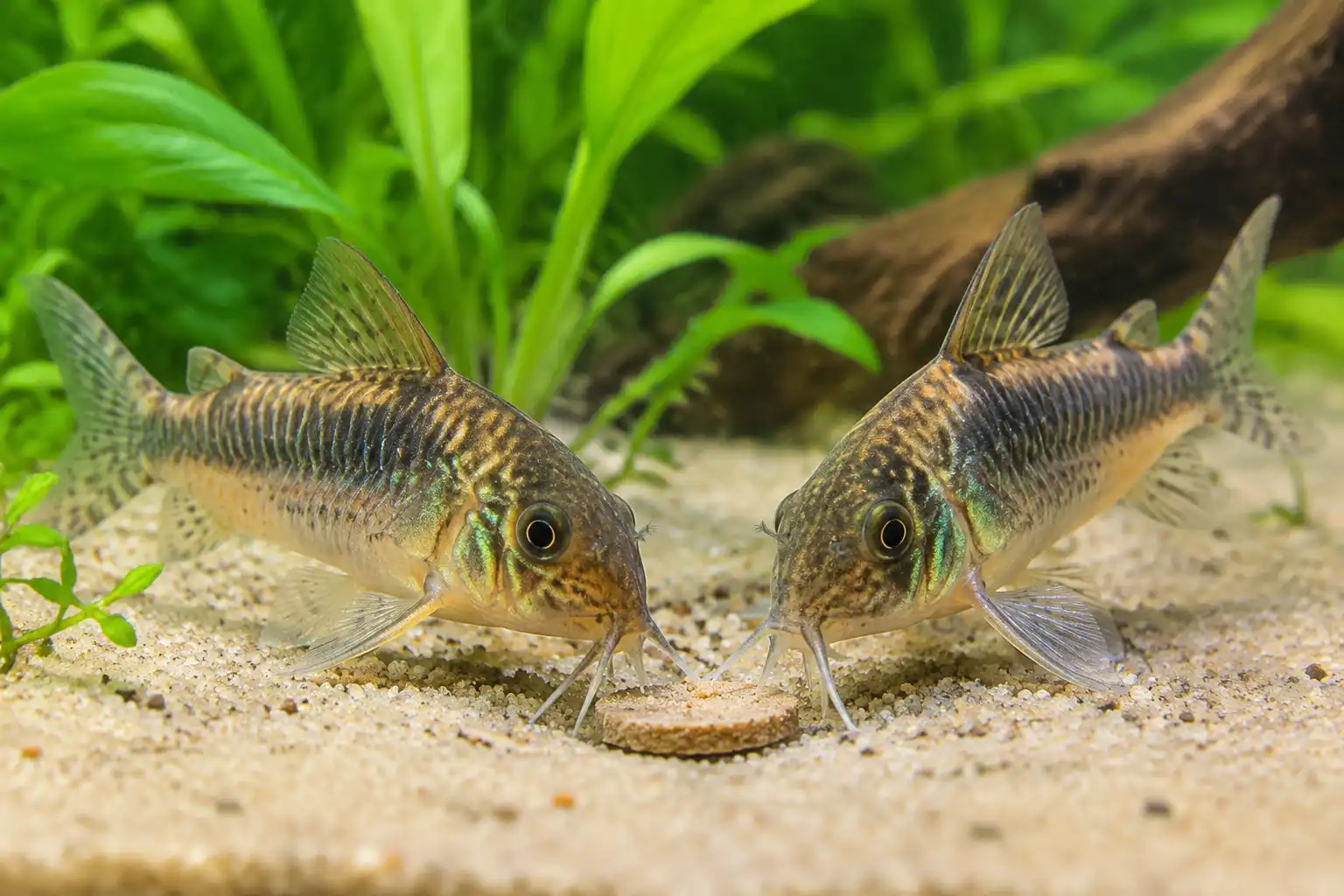
Cory catfish eat worms, insect larvae, and detritus (bits of organic matter) from the bottom. That comes from UF/IFAS Extension publication FA054, revised in July 2023, which covers the ornamental fish Florida farms raise.
Corydoras are small South American catfish, mostly under 4 inches long, from a family of about 224 species. Because they forage on the bottom, their food has to sink to reach them. In a tank shared with fast midwater fish, floating flakes may be gone before any reaches the corys.
UF/IFAS also notes that corys breathe air. They dash to the surface, gulp a bubble, and absorb oxygen from it in the gut. So an occasional quick trip to the surface is normal for the species.
Published extension research on feeding corys in home aquariums is thin. Most feeding advice comes from aquarium food makers, so treat product claims as the maker’s own. Finally, never release a cory or any other aquarium fish into a pond or stream.
Can You Eat Catfish?
Yes, catfish is one of the lower-mercury fish. The FDA puts catfish on the “Best Choices” list in its advice about eating fish, revised in October 2021. That advice targets people who are pregnant or breastfeeding and children. For pregnant or breastfeeding adults, it suggests 2 to 3 servings of Best Choices fish a week. A serving is 4 ounces.
Catfish processing also has its own inspector. USDA FSIS has inspected fish of the order Siluriformes, including catfish, since 2016. At home, cook catfish to an internal temperature of 145°F, the USDA FSIS safe minimum for fish.
Wild catfish need one more check. The FDA advice says to check local fish advisories before eating fish caught by family and friends. If there is no advisory, it says to eat only one serving that week and no other fish.
Are Channel Catfish Good to Eat?
Yes, and diet is a big reason. SRAC Publication 431 credits farm-raised channel catfish with a mild flavor. Farmed fish eat grain and oilseed feed, so flavor problems usually come from the water, not the feed.
SRAC Publication 192 explains that blue-green algae in pond blooms make two common off-flavors. MIB tastes musty, and geosmin tastes earthy or muddy. Processors screen channel catfish for flavor before harvest, so most buyers never meet an off-flavor fish. Small, lean channel catfish in warm, odor-free water purge MIB in 2 to 4 days. Large, fatty fish in cold water can take weeks or months.
How farms handle musty and muddy flavors in pond fish decides when a crop can sell. Wild channel catfish can pick up the same flavors, since SRAC 192 notes that other algae and bacteria make MIB outside ponds. Meanwhile, the Missouri Department of Conservation calls blue catfish a highly valued food fish for its firm, well-flavored flesh.
Why Catfish Stop Eating
A sudden drop in feeding is an early warning. Check dissolved oxygen first, then call your extension aquaculture specialist or a fish health diagnostic lab before treating anything. Report heavy, unexplained losses to your state veterinarian or state aquatic animal health official.
SRAC Publication 181 calls feeding behavior an important clue to the health of the fish and the pond. These are the common reasons channel catfish eat less:
- Cold water. Below 70°F, channel catfish feed unevenly, and at 50°F they nearly stop, per SRAC 181. This is normal.
- Low dissolved oxygen. Mississippi State research lists low oxygen as a stress that hurts feed use.
- Hot water. The same research notes that high temperatures reduce feed intake.
- Disease. Diseased fish eat poorly, per the same research. Low oxygen, parasites, and bacterial disease can look alike from the bank, so a lab has to sort them out.
- Overfeeding. Mississippi State University Extension warns that wasted feed harms water quality and raises costs.
Timing matters as well. SRAC 181 notes that peak oxygen demand in catfish ponds comes 6 to 12 hours after feeding. So a late feeding pushes that demand into the night. That’s why oxygen levels before dawn tell you more than an afternoon reading. It’s also why producers start feeding in the morning, once oxygen begins to rise.
If a lab confirms a bacterial disease, medicated feed is a veterinarian’s decision. It is not a feeding change to make on your own.
FAQs on Catfish Diet
Do catfish eat other fish?
Yes, most adult catfish do. Missouri Department of Conservation field guides say blue catfish over 8 to 13 inches eat mostly fish, and adult flatheads prefer fish and crayfish over dead or decaying food.
Are catfish bottom feeders?
Mostly, yes. SRAC Publication 180 notes channel catfish usually feed near the bottom in natural waters but also take food from the surface, which is why farms can use floating feed.
Do catfish eat algae or plants?
Yes, adult channel catfish eat some plant material along with animal foods. SRAC Publication 180 lists green algae, aquatic plants, and seeds in their diet, next to insects, crawfish, snails, and small fish.
Can I feed pond catfish bread or kitchen scraps?
They’ll eat it, but scraps don’t make a balanced diet. Mississippi State University Extension counts 40 nutrients channel catfish need, so a complete catfish feed sized to the fish is the better choice for a farm pond.
How often should I feed catfish in a pond?
Once a day in warm weather is typical. Mississippi State University Extension says most producers feed channel catfish once daily, 7 days a week, in warm months, though fingerlings grow better when fed twice a day.
Is swai a catfish?
Not under US labeling rules. Swai belongs to the same order as catfish, but the USDA FSIS rule reserves the “catfish” label for the family Ictaluridae, which includes channel, blue, and flathead catfish.
Key Points for Your Pond
Match the feed to the fish, not the calendar. Channel catfish fry live on natural pond food first, and fingerlings need 35 percent protein pellets. After that, food-size channel catfish do well on 28 to 32 percent floating feed, per Mississippi State University Extension.
Let water temperature set the amount. Then cap daily feed by surface acre to protect oxygen. When fish go off feed in warm weather, check dissolved oxygen before anything else.