Oyster Life Cycle: Spawning to Market Size, Stage by Stage
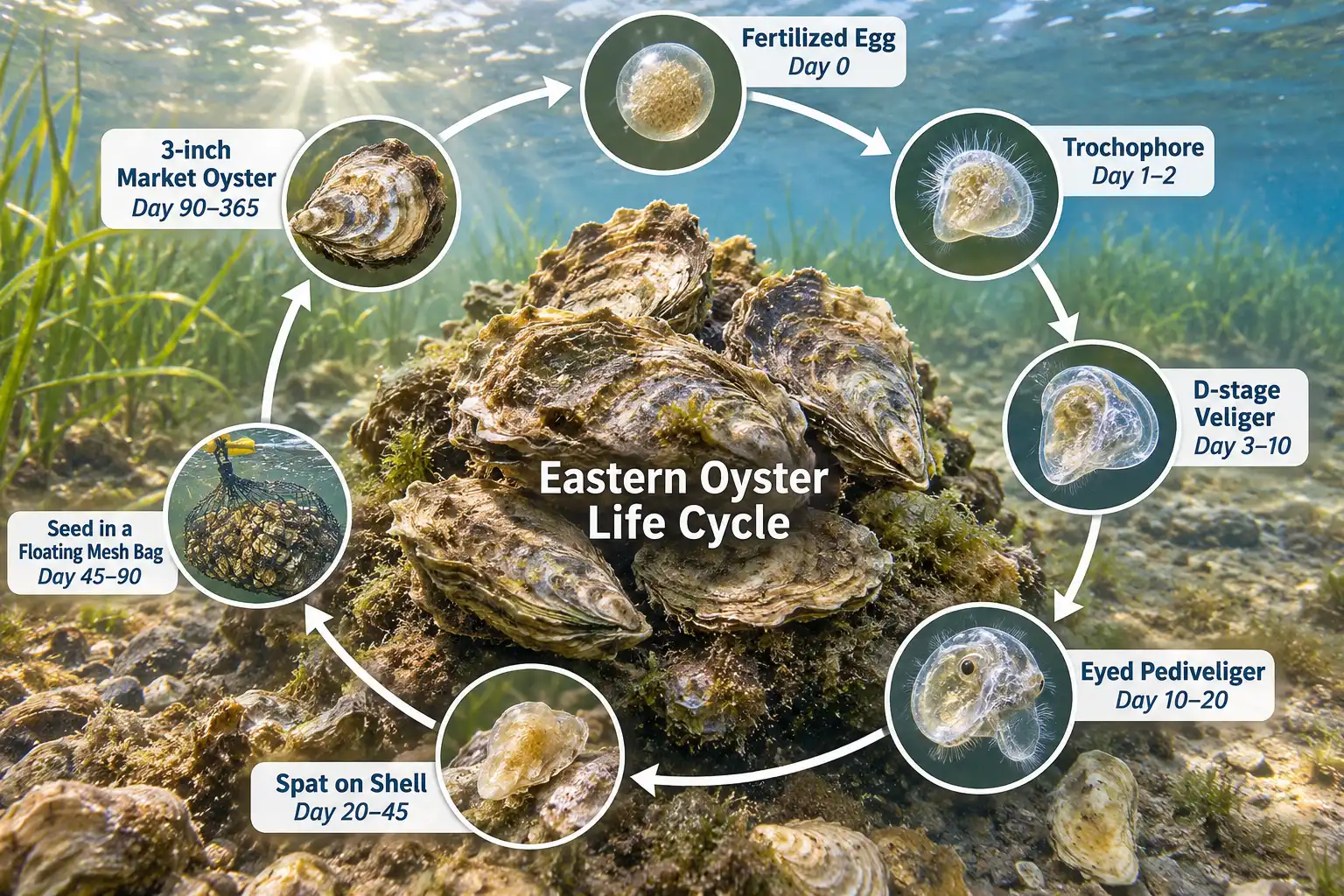
The oyster life cycle runs from a microscopic egg to an adult cemented in one spot for life. For a grower, each stage sets a job. It decides when to buy seed, when to protect spat, and when to harvest.
In the oyster life cycle, a fertilized egg becomes a swimming larva within two days. After two to three weeks, the larva cements itself to hard shell as spat. Eastern oyster spat reach 3-inch market size in 12 to 36 months.
What Is the Life Cycle of an Oyster?
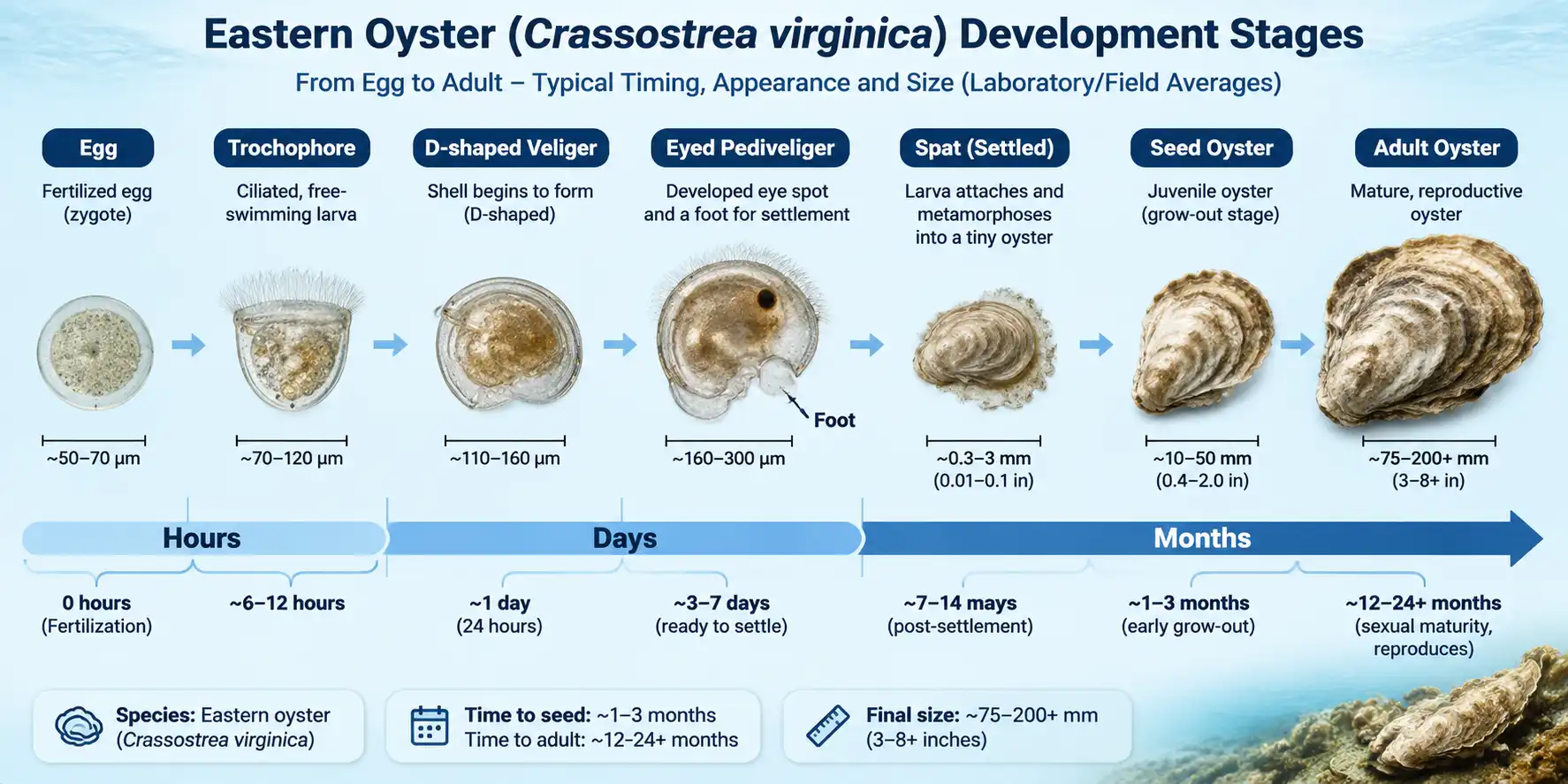
The life cycle of an oyster has two parts. First comes a few weeks adrift as a swimming larva. Then comes a lifetime fixed to one hard surface. SRAC Publication 432, Cultivating the Eastern Oyster (2001 revision), traces the eastern oyster (Crassostrea virginica) through the seven stages below. SRAC Publication 4302 adds hatchery timing and larval sizes.
| Stage | Time after spawning | Size | What happens |
|---|---|---|---|
| Fertilized egg | Hour 0 | Microscopic | Egg and sperm meet in open water |
| Trochophore | 12 to 20 hours | Microscopic | Swims with tiny hairs; no shell yet |
| Veliger (D-stage) | 20 to 48 hours | About 65 microns (0.003 inch) on day 2 | Grows a first shell and feeds on algae |
| Pediveliger (eyed larva) | 12 to 20 days | 290 microns (0.011 inch) or more | Grows a foot and eye spot, then searches for a surface |
| Spat | About 2 days after setting begins | About 300 microns (0.012 inch) | Cements to hard shell for life; mostly male |
| Seed (juvenile) | Weeks to months | Larger than spat | Filter feeds and grows in bags, cages, or on bottom |
| Adult | 12 to 36 months to market | 3 inches (75 mm) at market | Spawns each warm season |
These eastern oyster times assume warm summer water. In cooler water, every stage runs longer.
Spawning: When Oysters Release Eggs and Sperm
Oysters spawn as water warms in spring and summer. SRAC Publication 432 puts the trigger for northern eastern oysters at 60 to 68°F. Southern eastern oysters spawn above 68°F, and spawning can continue through the warm months.
Hatcheries work from a different number. SRAC Publication 4302, Oyster Hatchery Techniques (2008), notes that southern hatcheries typically spawn eastern oysters once water passes 77°F. So the first figure describes wild reefs, while the second describes a planned hatchery spawn.
Spawning also spreads. Sperm from one eastern oyster can trigger its neighbors, per SRAC 4302. Eggs and sperm meet in open water, so fertilization happens outside the shell.
The egg counts are huge. In SRAC 4302’s hatchery example, ten average eastern oyster females release about 200 million eggs, or roughly 20 million each. For Pacific oysters (Crassostrea gigas), FAO puts the count at 50 to 200 million eggs per spawn. That figure covers females 3 to 6 inches long.
Spawning has a cost for the farmer, too. UF/IFAS Extension notes that diploid oysters turn thin and watery after spawning, because the effort burns their stored energy.
Read next: Atlantic Salmon vs Pacific Salmon
Larval Stages: From Trochophore to Eyed Larva
Eastern oyster larvae drift in the water for about two to three weeks. During that time, they pass through three stages.
Trochophore. Within 12 to 20 hours of fertilization, most eastern oyster eggs become trochophores, per SRAC 4302. They swim with tiny hairs called cilia and have no shell yet.
Veliger. Next, the trochophore grows a thin shell and becomes a veliger. SRAC 4302 gives 20 to 48 hours for this step, and SRAC 432 gives 24 to 48. Growers call it the D-stage or straight-hinge larva, because the shell looks like a capital D. It swims and catches algae with a hairy organ called the velum. Later, the hinge rounds into a hump called the umbo.
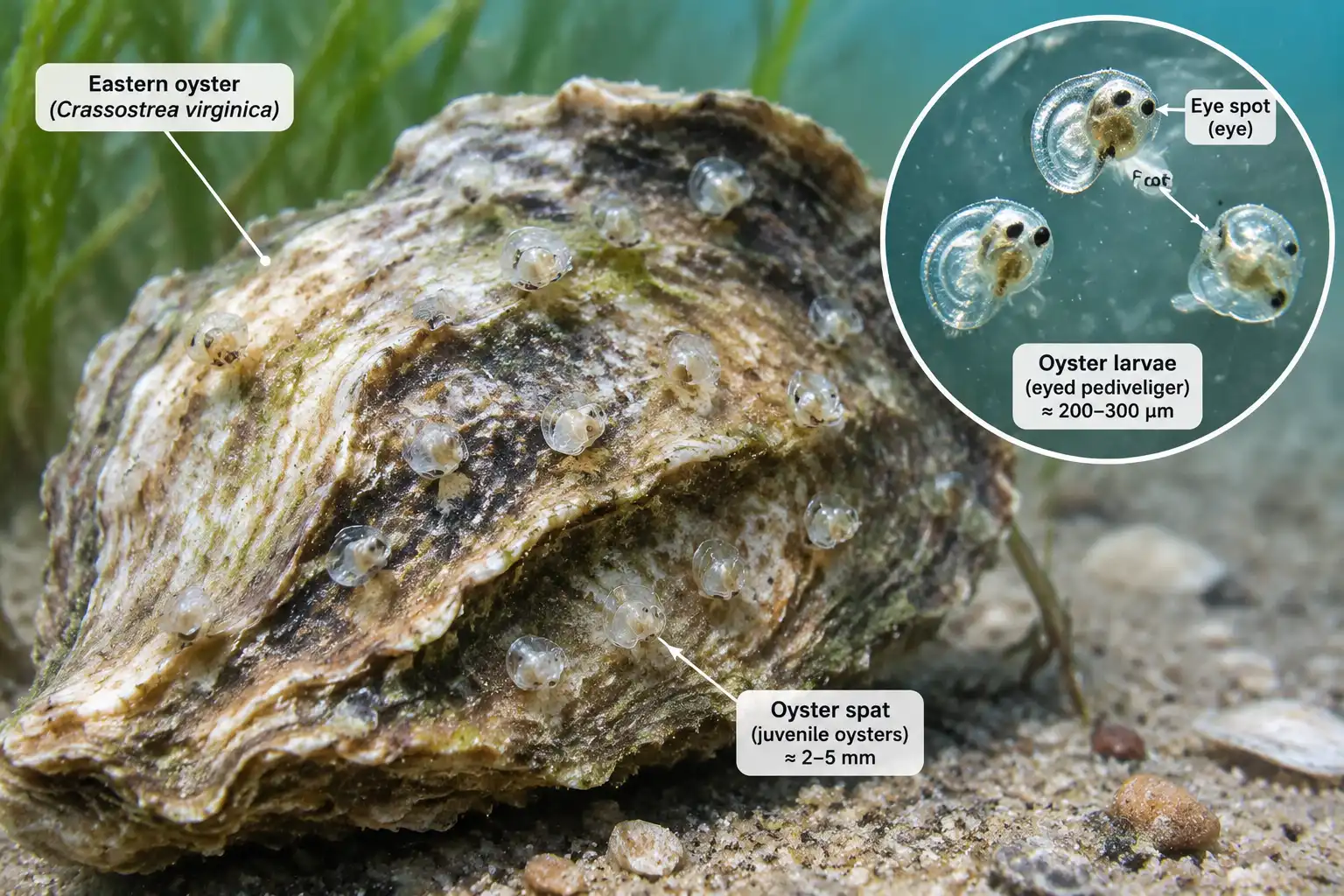
Pediveliger. After 12 to 20 days, SRAC 432 notes, the larva grows a foot and dark eye spots. Now it can both swim and crawl.
Growth is fast. SRAC 4302 records eastern oyster larvae at about 65 microns on day 2 and 290 microns by day 14. That is more than four times longer in under two weeks.
Pacific oysters follow the same path. FAO’s Pacific oyster fact sheet gives 14 to 18 days as veligers in hatcheries at 77 to 82°F. In the wild, the stage lasts two to three weeks. Pacific oyster larvae settle at 300 to 340 microns (about 0.012 to 0.013 inch).
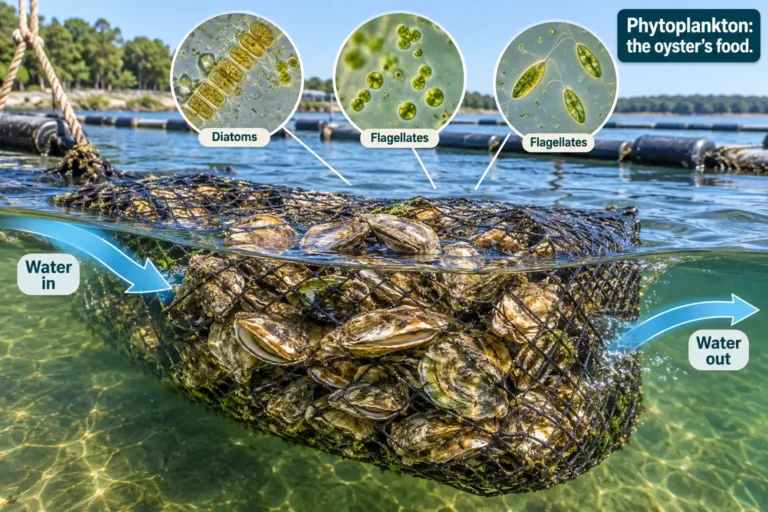
From the veliger stage on, larvae eat microscopic algae, the same food adult oysters filter from the water.
Settlement: How a Larva Becomes Spat
Settlement is the one step in the cycle that can’t be undone. The eyed larva sinks, crawls on its foot, and tests surfaces. Once it finds clean, hard shell, it cements itself in place, per SRAC 432. From then on, it never moves again.
Metamorphosis follows. SRAC 4302 notes that it usually takes about 48 hours. During that time, the larva drops its swimming organ, and the new spat starts filtering algae through its gills.
Even in a hatchery, many larvae fail here. SRAC 4302 expects about 10 million eastern oyster spat from 25 million eyed larvae. Three conditions decide how well eastern oyster larvae set:
- A hard surface. Settling larvae need cultch, such as clean oyster or clam shell, to survive.
- Salinity. SRAC 4302 says water below 10 ppt doesn’t suit spawning, larval development, or early growth.
- Other oysters. Adult oysters stimulate settling, per SRAC 4302.
On a farm, setting happens in one of two ways. In open water, growers plant shell where wild larvae are likely to settle. SRAC 432 notes that these oysters reach harvest in one to three years. In tanks, growers use remote setting instead. A hatchery ships eyed larvae, and the grower sets them on cultch at the farm. FAO calls remote setting the method of choice for Pacific oysters on the Pacific coast of North America.
Spat and Seed: Protecting Young Oysters
A spat is a newly settled oyster. SRAC 432 uses “seed oyster” for juveniles that are larger than spat but still too small to harvest. Both words describe the stage farmers buy, move, and protect.
Eastern oyster spat are mostly male, and they grow quickly. In southern waters, SRAC 432 notes, they can reach sexual maturity within 4 months.
Predators are the next hurdle. SRAC 432 names crabs, oyster drills, and flatworms, and losses rise when seed is damaged during planting. SRAC 4302 adds that small single oysters left without bags or other cover suffer high mortality. That’s why most growers hold young oysters in mesh bags and cages until they are big enough to resist predators.
Nursery sizes show the scale. For Pacific oysters, FAO notes that hatchery upwellers grow spat to about 0.12 to 0.2 inch (3 to 5 mm). Nurseries then take seed from about 0.04 inch up to 0.5 to 0.6 inch (1 mm to 12 to 15 mm). Pacific oyster seed for grow-out is typically 0.4 to 0.6 inch (10 to 15 mm).
Adult Oysters: Sex Change, Growth, and Market Size
Most oysters start life as males and may become females later. Biologists call this protandry. SRAC 432 notes that some eastern oyster males change to females, usually after their first or second spawning. Some females can also change back to males. Similarly, FAO says Pacific oysters most often mature first as males.
Growth depends on the water. SRAC 432 puts eastern oysters at 3 inches (75 mm), the usual harvest size, in 12 to 36 months. Temperature, salinity, and food supply set the pace. So warm, food-rich water shortens the wait, and cold water stretches it. For Pacific oysters, FAO gives 18 to 30 months to market size. That market weight runs 70 to 100 grams (about 2.5 to 3.5 ounces) live weight.
Adults also need steady conditions. SRAC 432 lists eastern oyster needs as 10 to 30 ppt salinity, with 15 to 18 ppt best. It also calls for dissolved oxygen above 3 ppm, and above 5 ppm most of the time. In contrast, FAO puts the Pacific oyster’s best salinity higher, at 20 to 25 ppt.
Each warm season, adults spawn again and the cycle restarts. For a grower, though, market size ends the cycle, and harvest follows the shellfish rules below.
Eastern, Pacific, and Olympia Oysters: How Their Life Cycles Differ
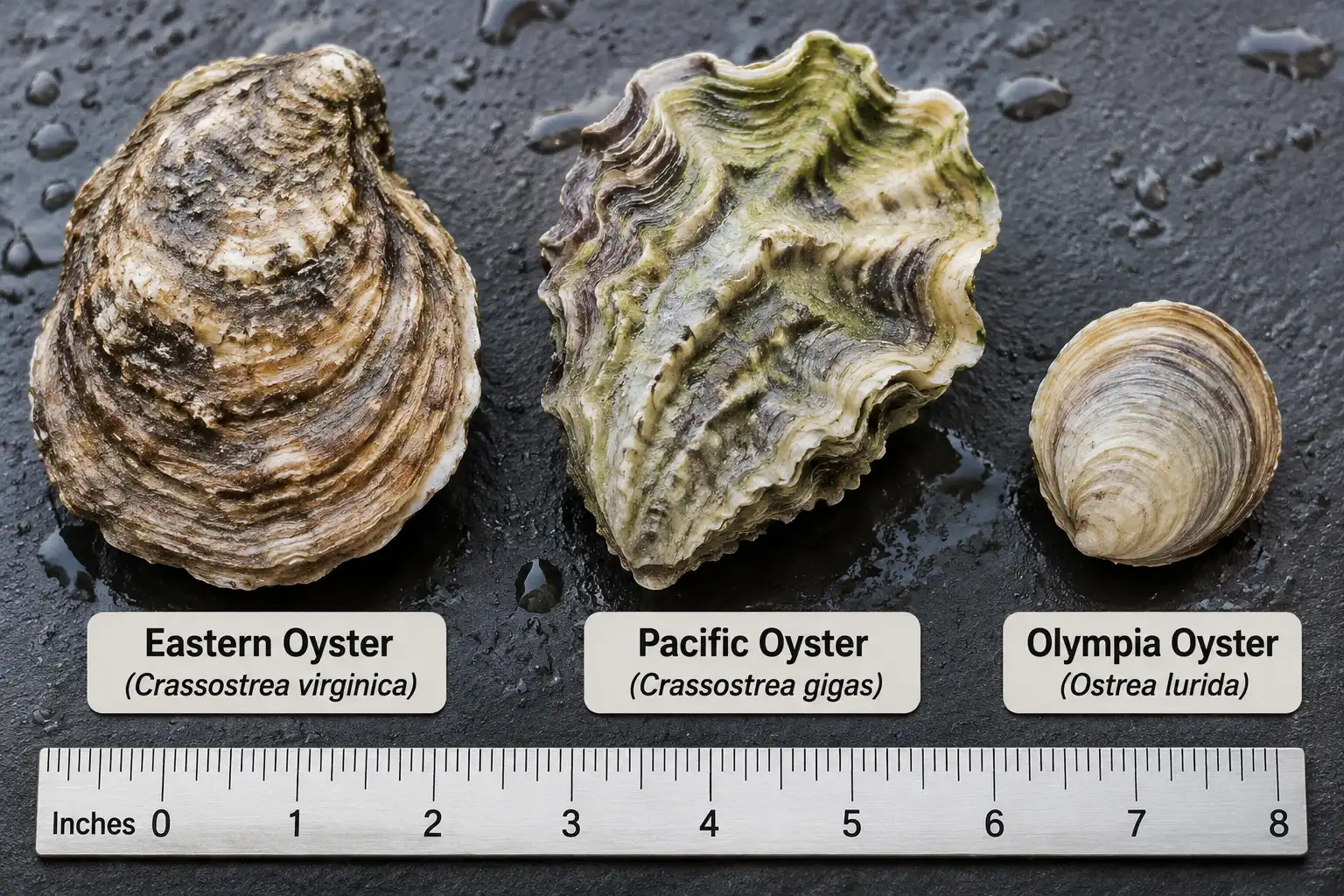
All three oysters pass through the same basic stages. However, they differ in where eggs meet sperm, how many young they make, and the salinity they prefer. The Olympia oyster (Ostrea lurida) differs most. Olympia females brood their embryos inside the shell, per the Oregon Department of Fish and Wildlife. Later, they release them as larvae. Males, meanwhile, release sperm in small balls that break apart in the water.
| Trait | Eastern oyster | Pacific oyster | Olympia oyster |
|---|---|---|---|
| Where eggs are fertilized | Open water | Open water | Inside the female’s shell |
| Young per spawn | About 20 million eggs per female (hatchery example) | 50 to 200 million eggs | 250,000 to 300,000 brooded embryos |
| Days as swimming larvae | 12 to 20 | 14 to 18 in hatcheries; 2 to 3 weeks wild | About 11 to 16 |
| Salinity | 10 to 30 ppt; 15 to 18 best | 20 to 25 ppt best | About 12 to 25 ppt |
| Sex | Male first; some switch, some switch back | Male first | Male first, female in later seasons |
| Size | 3 inches at market in 12 to 36 months | 2.5 to 3.5 ounces at market in 18 to 30 months | 2.4 to 3.1 inches as adults |
Eastern oyster figures come from SRAC 432 and 4302, Pacific oyster figures from FAO, and Olympia oyster figures from ODFW. The Olympia oyster is native to the West Coast, from Sitka, Alaska, to Baja California. Pacific oysters, by contrast, came from Asia. Published growth data for farmed Olympia oysters is thin, so we give adult size rather than a time to market.
The Farmed Oyster Life Cycle: Hatchery, Nursery, and Grow-Out
Many oyster farms don’t wait for wild larvae. Instead, they buy seed or eyed larvae from a hatchery that runs the early life cycle in tanks. Our overview of how oyster farms are set up covers the grow-out side in more detail.
Hatchery. Staff condition eastern oyster broodstock, generally over 3 inches per SRAC 4302. Then they spawn them and raise the larvae on cultured algae until the larvae are eyed.
Nursery. New spat go into upwellers first. As they grow, they move into mesh bags with larger openings.
Grow-out. Seed then goes to the lease in bags, cages, or on bottom until it reaches market size.
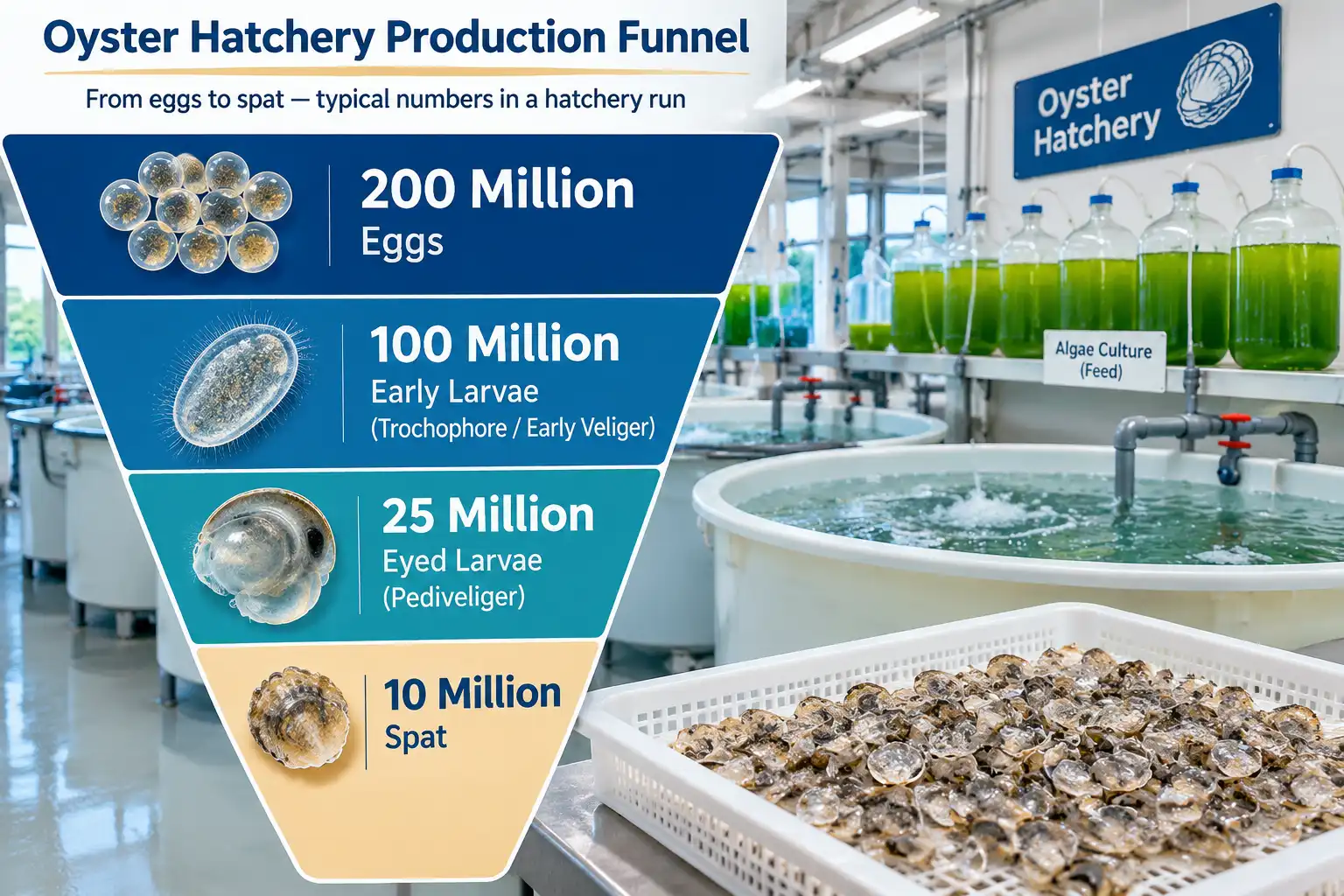
Even a well-run hatchery loses most of its young. SRAC 4302 walks through this eastern oyster example:
- Ten average females release about 200 million eggs.
- Good conditions yield 100 million or more early larvae.
- About 25 million reach the eyed stage, ready to set.
- About 10 million become spat.
That works out to roughly 1 spat for every 20 eggs, under good conditions. After that, more losses follow on the way to market, as the seed math below shows.
Triploid Oysters: A Life Cycle Without Spawning
Triploid oysters skip the reproductive part of the cycle. UF/IFAS Extension publication FA208 (2018, reviewed 2024) explains that normal oysters carry two sets of chromosomes, while triploids carry three. Triploids are considered sterile because their gonads develop poorly. As a result, energy that would go to eggs or sperm goes to growth.
That changes the farm calendar. According to FA208, triploid eastern oysters grew 12 to 41 percent faster than diploids in several studies. They also keep their meat quality through summer, so growers can sell them year-round.
Most commercial hatcheries now produce triploids by crossing tetraploid oysters, which carry four chromosome sets, with normal diploids. In theory, that cross yields 100 percent triploid seed.
Still, triploids are not a sure thing. FA208 cites a Gulf of Mexico study in which triploids appeared more vulnerable to summer mortality at some sites. Results also vary with site conditions, and nutrient-poor water may show little growth gain. So treat triploid gains as likely, not certain, and compare them at your own site.
Seed Math: How Many Larvae, Shells, and Bags You Need
The life cycle’s losses show up in every seed order. SRAC 4302 gives eastern oyster benchmarks you can run for your own lease. Your harvest goal is your own number, so swap it in for the 10,000 used here.
Spat on shell. SRAC 4302 sets about 100 eyed larvae per shell and aims for 10 to 30 early spat. After natural losses, it expects two to four adults per shell.
- Market oysters wanted: 10,000 (your number)
- Shells needed: 10,000 ÷ 4 = 2,500 shells at best, up to 10,000 ÷ 2 = 5,000 shells
- Eyed larvae needed: 2,500 to 5,000 shells × 100 = 250,000 to 500,000 larvae
Single oysters in bags. As seed grows, it moves into bags with larger mesh, and each bag holds fewer oysters. Here is SRAC 4302’s density guide carried through for 10,000 eastern oyster seed:
| Bag mesh | Oysters per bag (SRAC 4302) | Bags for 10,000 seed |
|---|---|---|
| 0.08 inch (2 mm) | 10,000 | 1 |
| 0.25 inch (6.4 mm) | 1,500 | 7 |
| 0.50 inch (12.7 mm) | 500 | 20 |
| 0.75 inch (19 mm) | 250 | 40 |
These counts ignore mortality, so you’ll need fewer bags as oysters die off. Also, gear makers rate their own bags, and those ratings may not match SRAC’s figures.
What Goes Wrong at Each Stage
Heavy or unexplained oyster losses call for a lab, not a guess. Low oxygen, low salinity, predators, and disease can look alike from the boat. So check dissolved oxygen and salinity first. Then call your Sea Grant or extension shellfish specialist, or a shellfish disease lab. Report large, unexplained die-offs to your state shellfish authority or state veterinarian. Until they advise, don’t move or sell oysters from that site.
Common trouble spots, stage by stage:
- Larvae: a salinity drop. Heavy rain can push water below 10 ppt, which SRAC 4302 says doesn’t suit eastern oyster larval development.
- Setting: no clean surface. Larvae need hard cultch to survive. SRAC 432 calls for well-washed shell in setting tanks.
- Spat and seed: predators. Crabs, oyster drills, and flatworms take young eastern oysters, per SRAC 432.
- Summer adults: spawning and heat. Diploids thin out after spawning. Triploids may face summer mortality at some sites, per FA208.
- Any stage: low oxygen. SRAC 432 wants eastern oyster water above 3 ppm dissolved oxygen. Most of the time, it should stay above 5 ppm.
- Disease. Dermo and MSX are two well-known eastern oyster diseases. FA208 reports triploids as equally susceptible to Dermo but resistant to MSX in the studies it reviewed. Only a lab can confirm either one.
Rules That Follow the Oyster Life Cycle
Each stage of the life cycle carries paperwork. So check these points with the agency that decides before you buy seed or plant a lease.
Moving larvae or seed across state lines often needs a health certificate or an import permit from the receiving state. Species and stock rules also apply. Pacific oysters aren’t native to the East or Gulf coasts. States decide which oyster species, stocks, and ploidy may be planted. Your state aquaculture coordinator can confirm what’s allowed. Leases and licenses usually come first, and our guide to aquaculture permits and licenses shows where to start.
Harvest has its own rules. Your state shellfish control authority classifies growing areas under the National Shellfish Sanitation Program. As of November 2026, the FDA’s 2023 Revision of the NSSP Guide is the current edition. Never harvest from closed or unclassified waters, and check closure notices on the day you plan to harvest. Our guide to growing area classification and closures explains how the system works.
Finally, never release farmed oysters, seed, or larvae into public waters. It is often illegal, and it can spread disease or non-native stock.
FAQs on Life Cycle of Oysters
How long does it take an oyster to reach market size?
Eastern oysters reach 3-inch market size in 12 to 36 months, per SRAC Publication 432. Pacific oysters take 18 to 30 months, according to FAO, with water temperature, salinity, and food setting the pace.
Are oysters male or female?
Oysters can be both over a lifetime. Eastern and Pacific oysters usually mature first as males, and SRAC 432 notes that some eastern oysters switch to female after their first or second spawning, while some switch back.
How many eggs does an oyster release?
Eastern and Pacific oysters release millions of eggs per spawn. SRAC 4302’s hatchery example works out to about 20 million eggs per eastern oyster female, and FAO puts a Pacific oyster female at 50 to 200 million.
What is the difference between spat and seed oysters?
Spat are oysters that have just cemented themselves to a surface and finished metamorphosis. Seed oysters, per SRAC Publication 432, are juveniles larger than spat but still too small to harvest.
Can triploid oysters reproduce?
Triploid oysters are considered sterile because their gonads develop poorly, per UF/IFAS Extension. They put that energy into growth instead, so they skip the spawning stage and keep their meat quality through summer.
Can oyster larvae survive in low-salinity water?
Eastern oyster larvae struggle below 10 ppt. SRAC Publication 4302 says water under 10 ppt does not suit spawning, larval development, or early growth, which is why heavy rain can cut a season’s set.
Why do oyster farmers plant old shell?
Oyster larvae need a hard, clean surface to settle and survive. Old oyster or clam shell, called cultch, gives eastern oyster larvae that surface, and SRAC 432 describes planting cultch as the simplest form of oyster culture.
The Practical Takeaway
Plan your farm around the stage you buy. Spawning and larval stages decide seed supply, and settlement decides how many oysters you start with. After that, 12 to 36 months of eastern oyster grow-out shapes your cash flow. Before you order, confirm that salinity at your site stays above 10 ppt in wet months. Then line up predator-proof gear, and check your state’s seed transfer and lease rules.