Atlantic Salmon vs Pacific Salmon: Biology, Farming, and Nutrition
Atlantic salmon vs Pacific salmon comes down to genus, life cycle, and how the fish was raised. Those differences shape fat content, flavor, labeling, and which salmon a US farm can legally grow.
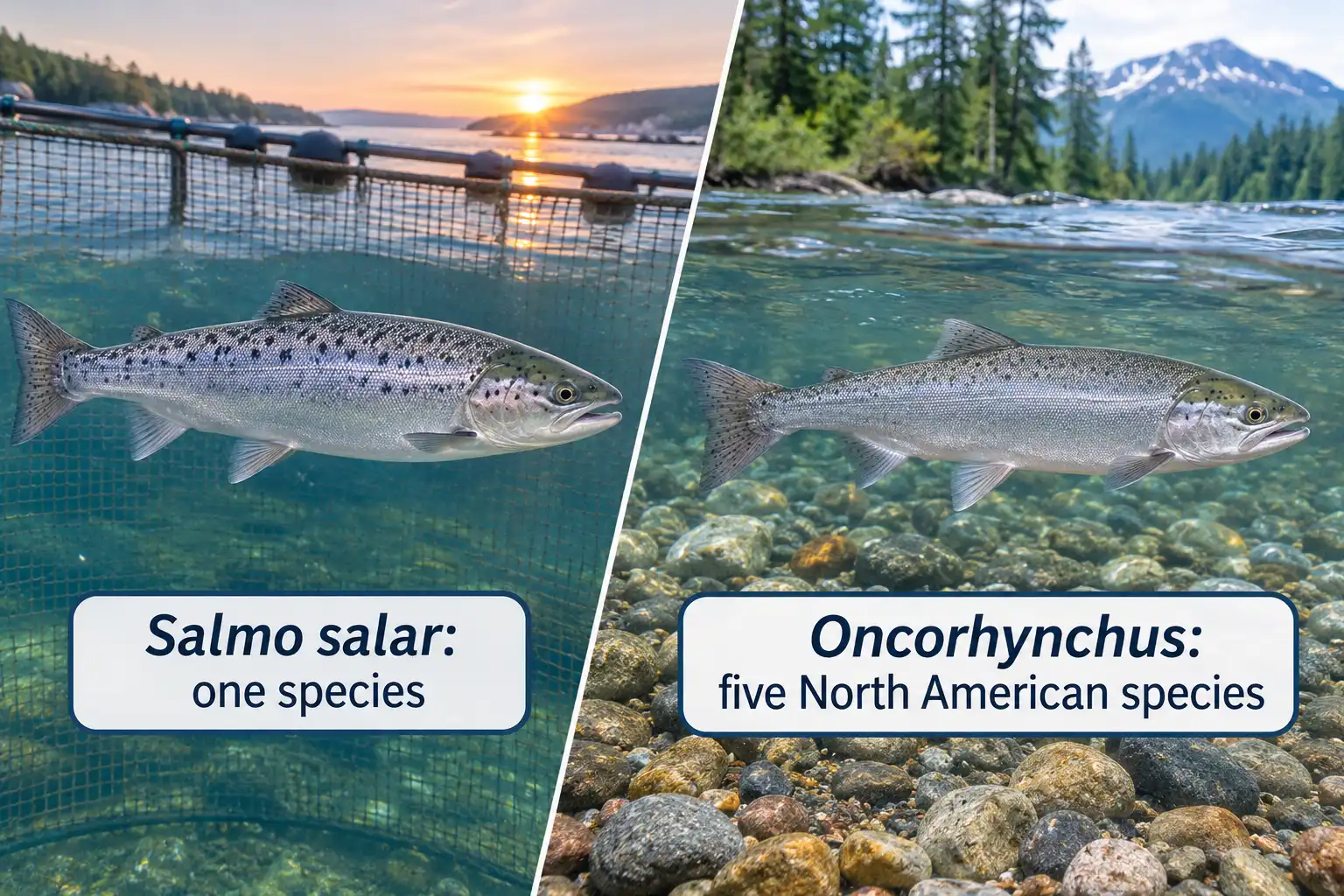
Atlantic salmon is one species, Salmo salar, and every Atlantic salmon in US markets is farm-raised. Pacific salmon are several Oncorhynchus species, mostly wild-caught and leaner, and most of them die after spawning once.
What Is the Difference Between Atlantic and Pacific Salmon?
Atlantic and Pacific salmon belong to different genera. Atlantic salmon is a single species, Salmo salar. Pacific salmon belong to the genus Oncorhynchus, which also holds rainbow trout and its sea-run form, steelhead.
The USGS counts seven Pacific salmon species. Five live in North American waters: Chinook (king), coho (silver), sockeye (red), chum, and pink. Masu and amago salmon occur only in Asia. By contrast, there is just one Atlantic salmon.
Their home waters differ too. NOAA Fisheries notes that Atlantic salmon are the only salmon native to the Atlantic Ocean, and the only native US populations left are in Maine. Pacific species, meanwhile, are native to the North Pacific and the rivers that feed it.
Read next: Are Channel Catfish Good to Eat
Atlantic vs Pacific Salmon at a Glance
The short version: one genus is farmed worldwide and almost never fished in the US, while the other is fished commercially and rarely farmed here.
| Trait | Atlantic salmon | Pacific salmon |
|---|---|---|
| Genus | Salmo | Oncorhynchus |
| Number of species | 1 (Salmo salar) | 7, with 5 in North America |
| Native range | North Atlantic and its rivers | North Pacific and its rivers |
| After spawning | Adults can survive and spawn again | Chinook, coho, sockeye, chum, and pink die |
| Source in US stores | Farm-raised only | Wild-caught, plus farmed coho, mainly from Chile |
| US commercial fishing | Prohibited | Allowed under state and federal management |
| US farms in 2023 | 10 farms | 1 farm |
| Fat per 100 g, raw | 13.4 g (farmed Atlantic) | 3.8 to 10.4 g (wild chum to Chinook) |
Species counts and spawning come from USGS, fishing status from NOAA Fisheries, and Chilean coho farming from FAO. Farm counts come from the USDA NASS 2023 Census of Aquaculture, and fat values from USDA FoodData Central.
Do Atlantic and Pacific Salmon Die After Spawning?
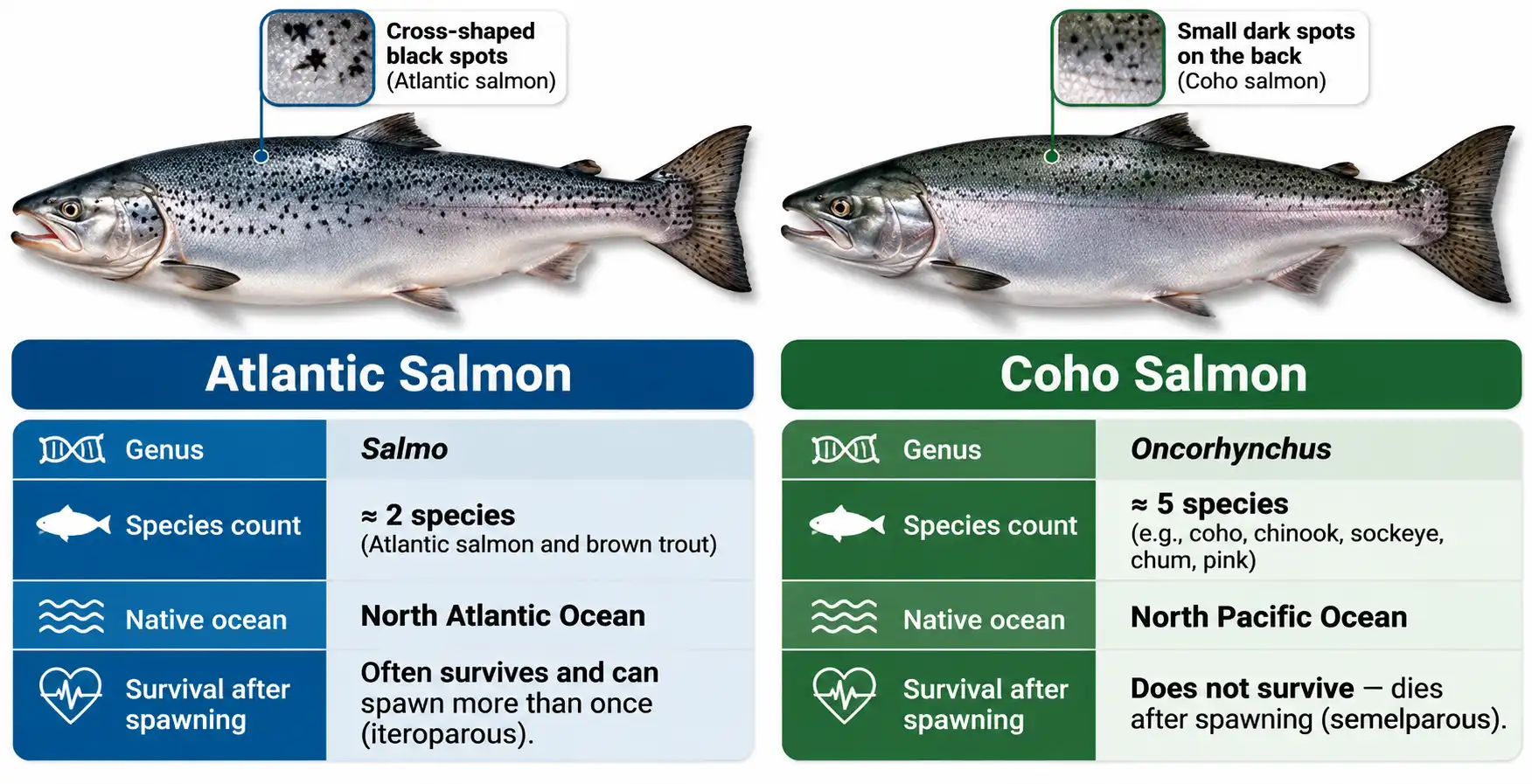
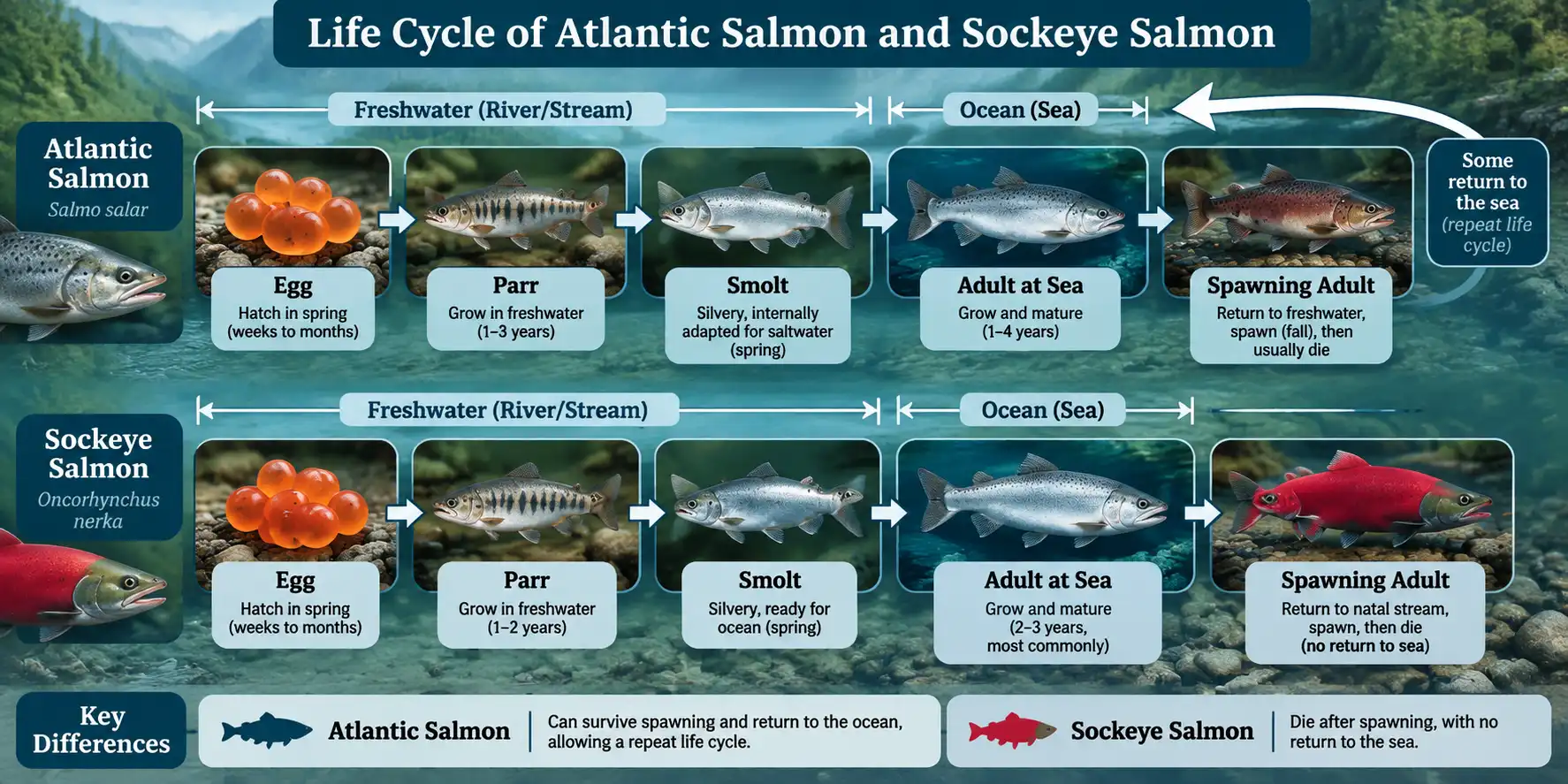
Most Pacific salmon do, but Atlantic salmon often survive. USGS reports that Chinook, coho, chum, sockeye, and pink salmon die after spawning once. Atlantic salmon, however, can repeat the spawning cycle for several years.
USGS also explains why. Pacific salmon mostly stop eating once they return to fresh water. They spend their energy on the upstream run, egg production, and nest digging. As a result, nothing is left for a trip back to sea.
Steelhead is the exception on the Pacific side. Because steelhead can spawn more than once, USGS notes it is sometimes grouped with Pacific trout instead.
The life cycle shapes hatchery work, too. FAO’s coho salmon fact sheet notes that coho mature after one year at sea. So a coho farm keeps two separate broodstocks, odd-year and even-year spawners, to produce fish every year.
Why Is Most Farmed Salmon Atlantic Salmon?
Atlantic salmon has the longest record in salmon farming. FAO’s nutrition and feed profile for the species calls it the most successfully farmed salmonid. FAO’s Atlantic salmon fact sheet adds that sea cage culture of the species began in Norway in the 1960s.
Pacific salmon farming, by contrast, is smaller and more concentrated. FAO reports that coho became a major farmed species in Chile. Meanwhile, North American coho farming has nearly ceased. The coho fact sheet traces that decline to local opposition, a shortage of suitable sea sites, and falling market prices.
That pattern reaches the seafood counter. NOAA Fisheries states that only farm-raised Atlantic salmon are found in US seafood markets. Pacific salmon, on the other hand, reach US buyers mostly from wild fisheries, with farmed coho as the main exception.
How Atlantic and Pacific Salmon Are Farmed
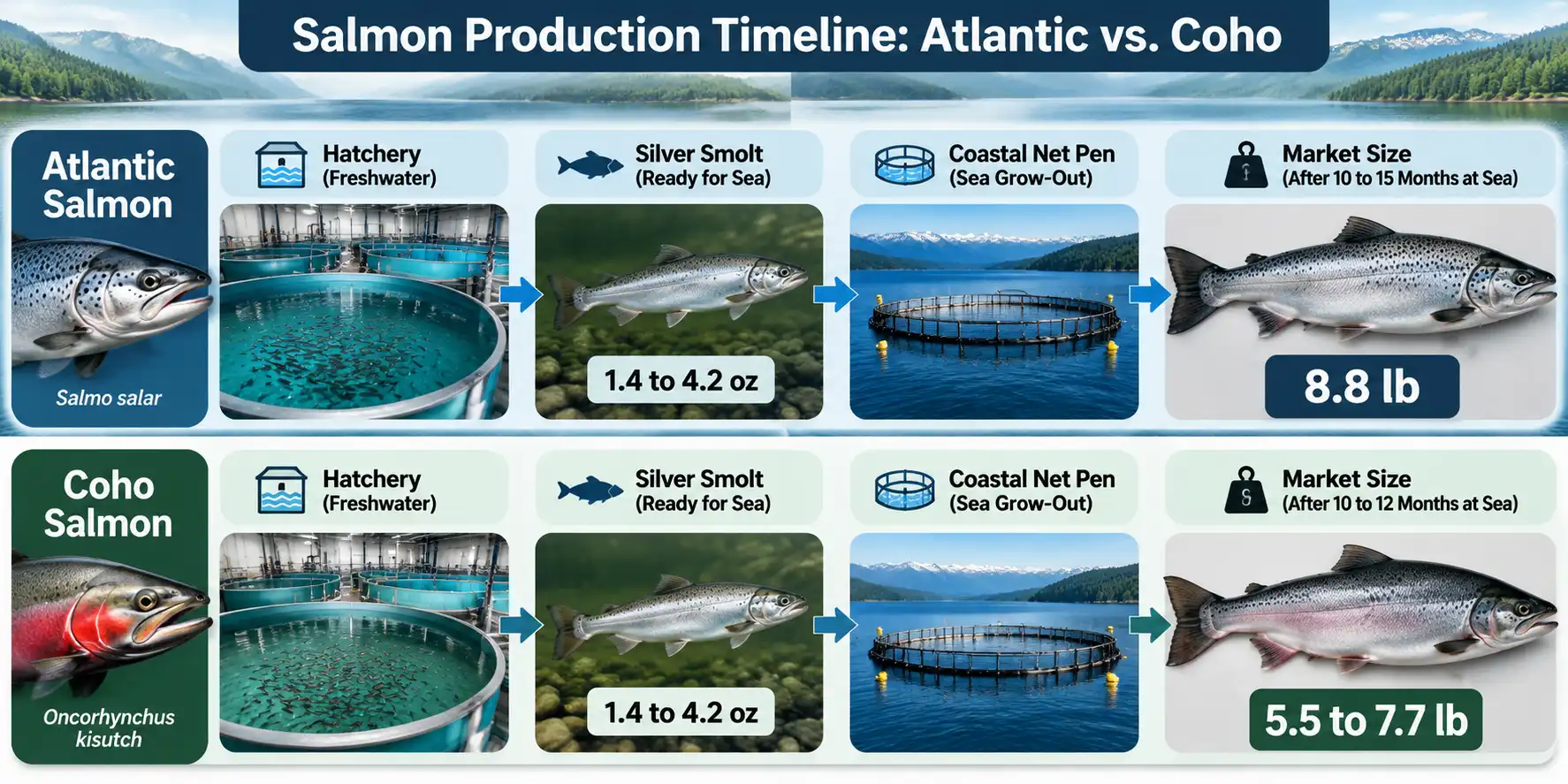
Both start in freshwater hatcheries and finish in salt water, but their timelines differ. NOAA Fisheries describes the US Atlantic salmon model: fish are spawned and raised in on-land hatcheries, then moved to ocean net pens in coastal waters.
| Stage | Atlantic salmon | Coho salmon |
|---|---|---|
| Freshwater phase | Smolts of 50 to 80 g (1.8 to 2.8 oz) in about one year | Smolts raised in tanks, raceways, or lake cages |
| Ready for sea | Smolts of 40 to 120 g (1.4 to 4.2 oz) | Parr marks gone and seawater tests passed |
| Time in sea cages | 10 to 15 months | 10 to 12 months |
| Harvest weight | About 4 kg (8.8 lb) | 2.5 to 3.5 kg (5.5 to 7.7 lb) |
Atlantic figures come from FAO’s feed profile and fact sheet for the species. Coho figures come from FAO’s coho fact sheet.
Water for Atlantic Salmon
FAO notes that Atlantic salmon grow best at sea sites where temperature extremes stay within about 43 to 61°F (6 to 16°C). Salinity should sit close to full seawater, 33 to 34 ppt. So a site search starts with a full year of temperature records, including the warmest weeks of late summer. Our guide to water temperature for farmed fish covers how to log it.
Stocking Coho in a Sea Pen
For coho, FAO advises keeping density at harvest no higher than 8 to 12 kg per cubic meter. That works out to about 0.5 to 0.75 pounds per cubic foot.
Carry that to a pen. A net pen holding 10,000 cubic feet of water (about 74,800 gallons) tops out near 5,000 to 7,500 pounds of coho at harvest. At 5.5 to 7.7 pounds per fish, that is roughly 650 to 1,360 fish. Swap in your own pen volume to get your number.
Land-based recirculating systems are another route for both groups. However, independent US data on their survival and costs for salmon is still limited, so treat company production claims as the company’s own figures.
Can You Farm Atlantic or Pacific Salmon in the US?
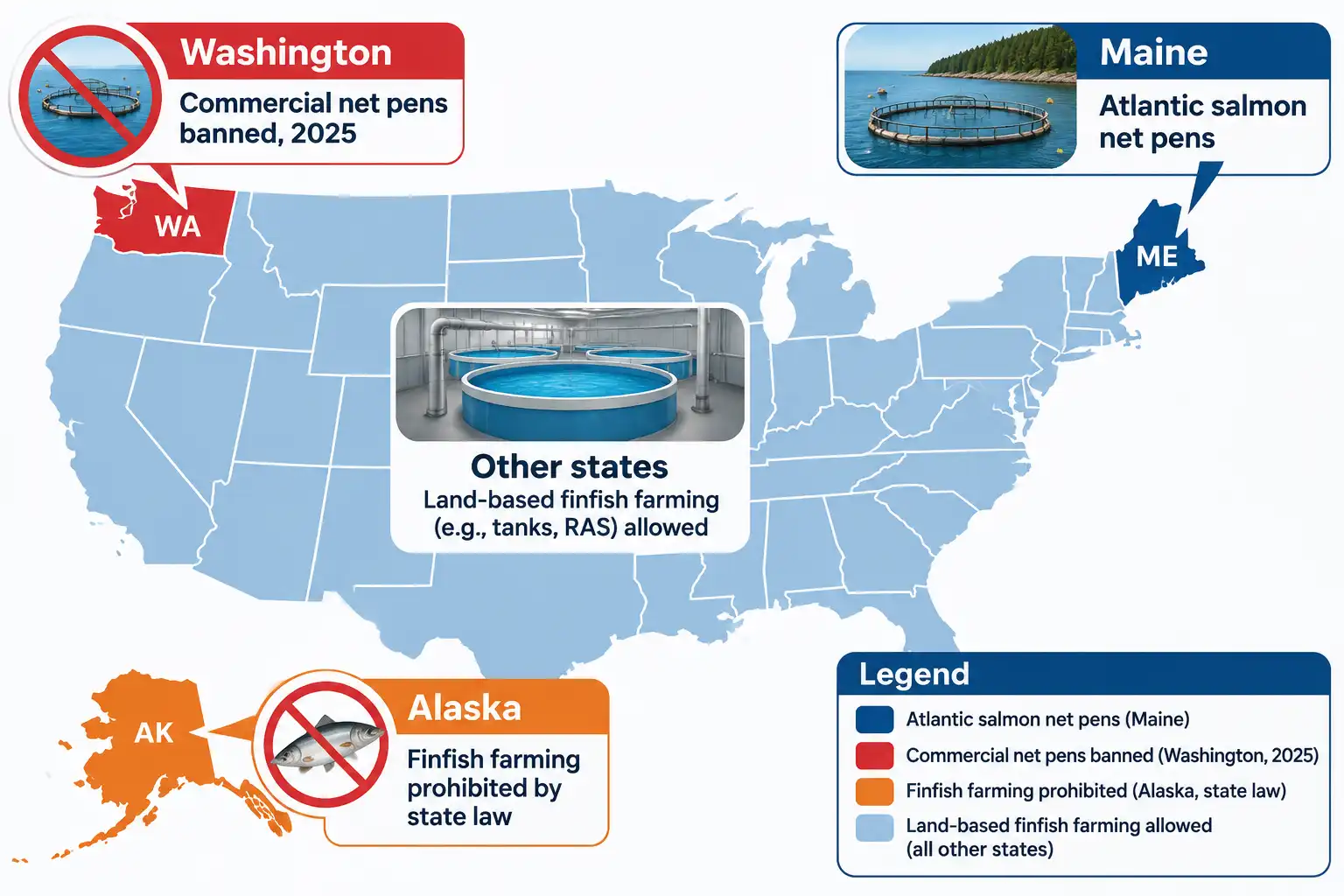
You can farm Atlantic salmon in a few places, but Pacific salmon farming is rare. The USDA NASS 2023 Census of Aquaculture counted 10 farms selling Atlantic salmon in 2023, 8 of them selling food-size fish. In contrast, it counted just 1 farm selling Pacific salmon.
Atlantic Salmon: Maine and Land-Based Farms
Maine is now the center of US net pen salmon farming. NOAA FishWatch still lists farms “mostly in Maine or Washington,” but that page predates Washington’s ban.
Washington closed its farms in stages. The Department of Natural Resources ended the last net pen leases in November 2022, and the last facilities came out in spring 2023. Then, in January 2025, the Board of Natural Resources adopted a rule banning commercial finfish net pen aquaculture on state-owned aquatic lands. The rule followed a net pen collapse at Cypress Island that released farmed Atlantic salmon into Puget Sound. Hatcheries that restore native stocks fall outside the ban.
Wild Atlantic salmon are off limits everywhere in the US. NOAA Fisheries notes that commercial and recreational fishing for the species is prohibited, and the Gulf of Maine population is protected under the Endangered Species Act. Also, NOAA lists federal, state, and local permits for salmon farms, so your state aquaculture coordinator is the first call.
Pacific Salmon: Mostly Closed to Farming
Alaska, the main source of US Pacific salmon, bans commercial finfish farming under state law (AS 16.40.210). However, the statute still allows state fishery rehabilitation and enhancement work, which is the legal basis for Alaska’s salmon hatcheries. Those hatchery fish are released to the sea and caught as wild-harvest salmon, not farmed.
So in Alaska and Washington state waters, commercial salmon net pens are not an option. Land-based tanks remain possible elsewhere, subject to each state’s species, license, and discharge rules. Escapes drive much of this regulation, so read up on the risks from escaped farm fish before you plan a site. Never release farmed salmon into public waters.
Atlantic vs Pacific Salmon Nutrition
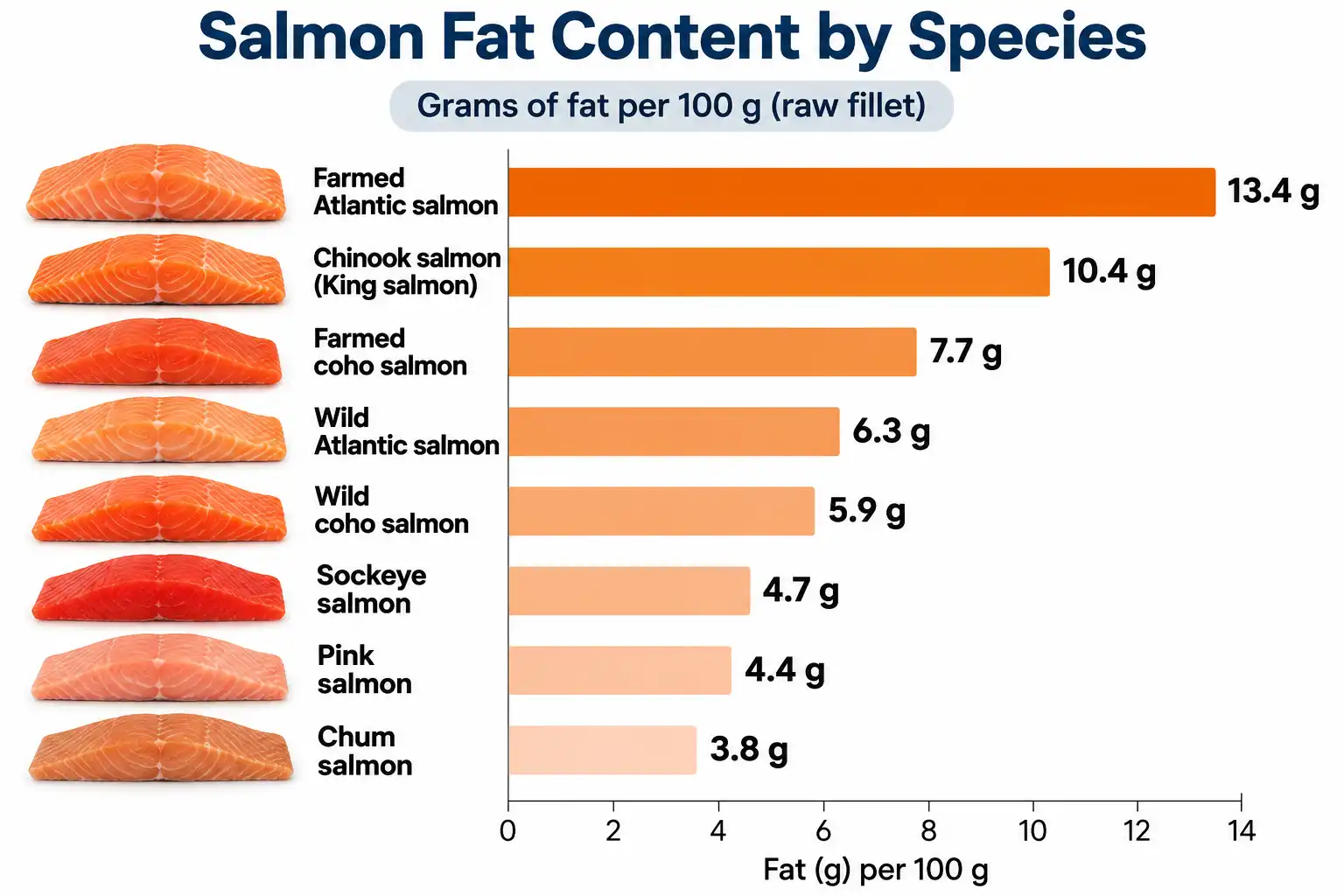
Farmed Atlantic salmon carries the most fat and calories of the eight salmon below. Wild Pacific species such as sockeye, pink, and chum are the leanest. Protein, meanwhile, stays close to 20 to 22 grams across all of them.
The figures below come from USDA FoodData Central reference entries for raw fish, per 100 grams (3.5 ounces).
| Salmon, raw | Calories | Protein (g) | Fat (g) |
|---|---|---|---|
| Atlantic, farmed | 208 | 20.4 | 13.4 |
| Chinook (king) | 179 | 19.9 | 10.4 |
| Coho, farmed | 160 | 21.3 | 7.7 |
| Atlantic, wild | 142 | 19.8 | 6.3 |
| Coho, wild | 146 | 21.6 | 5.9 |
| Sockeye | 131 | 22.3 | 4.7 |
| Pink | 127 | 20.5 | 4.4 |
| Chum | 120 | 20.1 | 3.8 |
The farmed and wild rows show how much raising method matters. For example, farmed Atlantic salmon holds about twice the fat of wild Atlantic salmon. Likewise, farmed coho carries more fat than wild coho.
Now carry it to a dinner plate. A 6-ounce raw fillet of farmed Atlantic salmon holds about 354 calories and 23 grams of fat. The same fillet of sockeye holds about 223 calories and 8 grams of fat. That is nearly three times the fat for the Atlantic fillet.
Keep in mind that these are reference samples. Fat in any salmon shifts with diet, season, and the cut, so a label’s nutrition panel beats a table for a specific product.
Color, Taste, and Labels
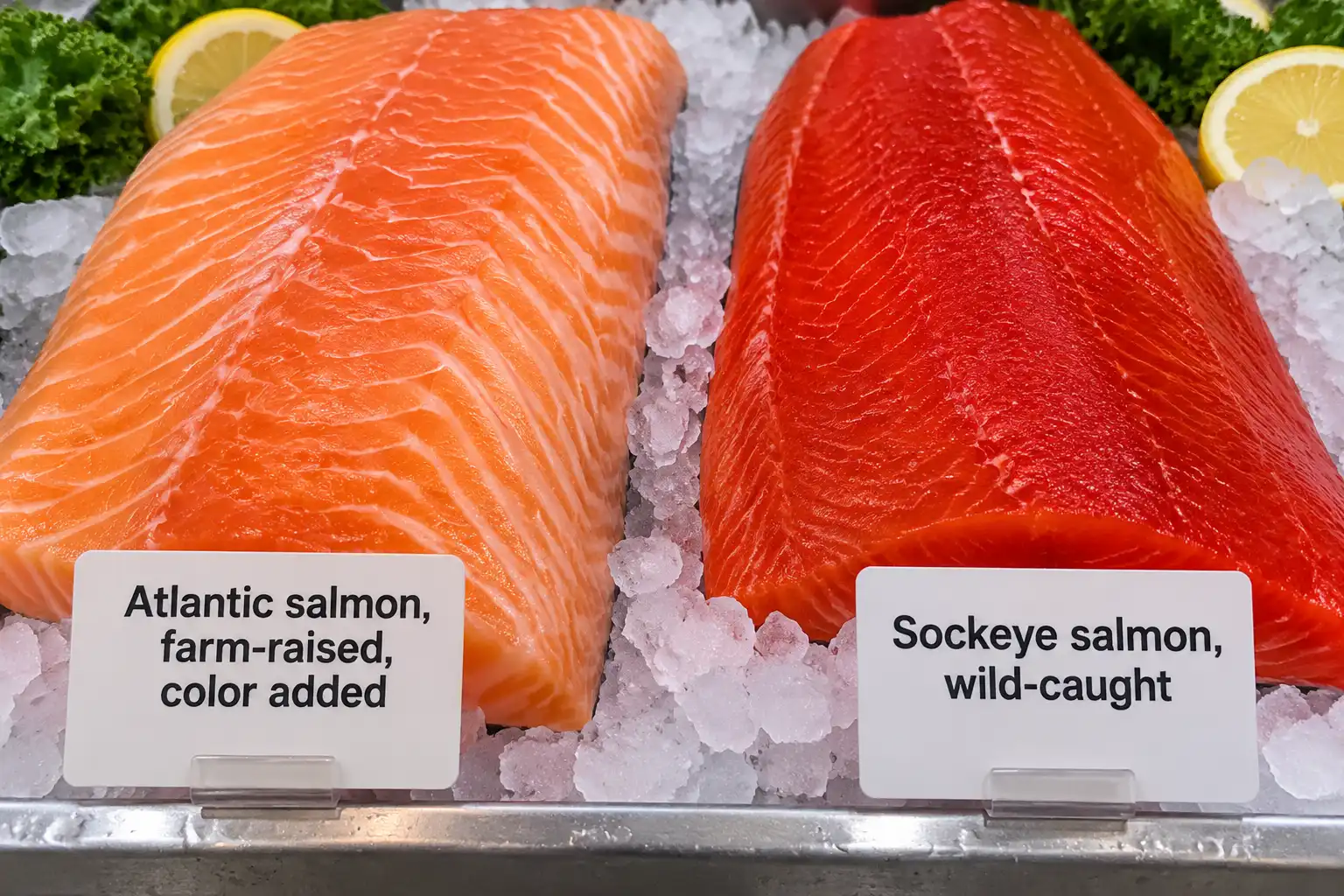
Farmed Atlantic salmon gets its color from its feed. NOAA FishWatch notes that farmed salmon diets include natural or synthetic astaxanthin, a pigment similar to the one wild salmon get from their prey. NOAA describes the result as reddish-orange or pink flesh with a buttery, rich taste and a firm, fatty texture.
The FDA lists astaxanthin and canthaxanthin as color additives for salmonid feed (21 CFR 73.35 and 73.75). As a result, salmon raised on them must declare the added color on the label.
Country of origin rules add a second clue. USDA’s Country of Origin Labeling rules require retail fish to show the country of origin and whether it is wild or farm-raised. So read the label this way:
- “Atlantic salmon” or a country name such as Norwegian or Chilean salmon means farmed fish.
- A Pacific species name with “wild”, such as wild sockeye or wild coho, means a wild fishery.
- “Farm-raised coho” means a farmed Pacific salmon, most often imported.
- “Color added” means the fish ate pigmented feed.
Fish Health: Infectious Salmon Anemia
Infectious salmon anemia (ISA) is a viral disease of Atlantic salmon, and the US tracks it closely in Maine. USDA APHIS reports that ISA was found in Maine in 2001. Since 2002, a joint federal and state program has run surveillance and control on farmed Atlantic salmon there.
Under the program standards, ISA virus detections are reportable to APHIS and to Maine officials. Also, enrolled producers can receive federal indemnity when fish are destroyed because of ISA, subject to available funding.
ISA can’t be confirmed from the pen side. Low oxygen, gill damage, parasites, and infections look alike from above the water, so a fish health lab confirms the cause. If farmed salmon start dying without a clear reason, check dissolved oxygen first. Then call a fish health lab or your extension aquaculture specialist before anything is treated. Report heavy, unexplained losses to the state veterinarian, and don’t move or sell fish until you hear back.
Good biosecurity on fish farms lowers the odds of a disease entering in the first place.
Which Salmon Should a US Farm Raise?
For most US operations, the realistic choice is Atlantic salmon, and only where water, law, and disease rules line up. Pacific salmon farming has very few legal open-water sites left, and the 2023 census found only one farm selling it.
Use these decision rules:
- Cold, full-strength seawater site in Maine: Atlantic salmon in net pens, under a state lease and the APHIS and Maine ISA program.
- Inland site with permits for a land-based system: Atlantic salmon in tanks is possible, but independent cost and survival data is thin.
- West Coast state waters: net pens are closed in Washington and Alaska, so check state rules before planning any Pacific species.
- Interest in coho: plan for two broodstock lines, since FAO notes coho mature after one year at sea.
Our overview of salmon farming in the US gathers our related species guides. For the broader trade-offs, see how farmed and wild fish compare.
FAQs About Atlantic Salmon vs Pacific Salmon
Is Atlantic salmon wild or farmed?
Atlantic salmon sold in the US is farmed. NOAA Fisheries notes that commercial and recreational fishing for Atlantic salmon is prohibited nationwide, and the wild Gulf of Maine population is protected under the Endangered Species Act.
Which is healthier, Atlantic or Pacific salmon?
Both are high-protein fish, with about 20 to 22 grams of protein per 100 grams raw. The main difference is fat: USDA FoodData Central lists 13.4 grams for farmed Atlantic salmon and 4.7 grams for sockeye.
Is sockeye salmon Atlantic or Pacific?
Sockeye is a Pacific salmon, Oncorhynchus nerka, also sold as red salmon. It is one of the five Pacific salmon species that USGS lists for North American waters, and like the others, it dies after spawning.
Is steelhead a salmon or a trout?
Steelhead is the sea-run form of rainbow trout, in the same genus as Pacific salmon. USGS notes it is often listed as an eighth Pacific salmon, but unlike salmon, it can survive spawning and spawn again.
Why is farmed salmon pink?
Farmed salmon is pink because its feed contains astaxanthin or canthaxanthin, pigments similar to those wild salmon get from prey. FDA rules treat these as color additives, so the label must declare the added color.
Can I raise salmon in a backyard pond?
Generally, no. FAO puts the best Atlantic salmon sea sites at about 43 to 61°F in full-strength seawater, and many states require licenses, so ask your state aquaculture coordinator before buying any salmon eggs or fish.
The Practical Takeaway
Atlantic and Pacific salmon differ in genus, life cycle, and source. Every Atlantic salmon in US stores is farmed, and it carries more fat per serving. Most Pacific salmon is wild-caught and leaner.
For a farm, the choice usually narrows to Atlantic salmon in Maine waters or in permitted land-based tanks. Start with a call to your state aquaculture coordinator, then a year of water temperature records for your site.