
How Recirculating Aquaculture Systems Work, Step by Step
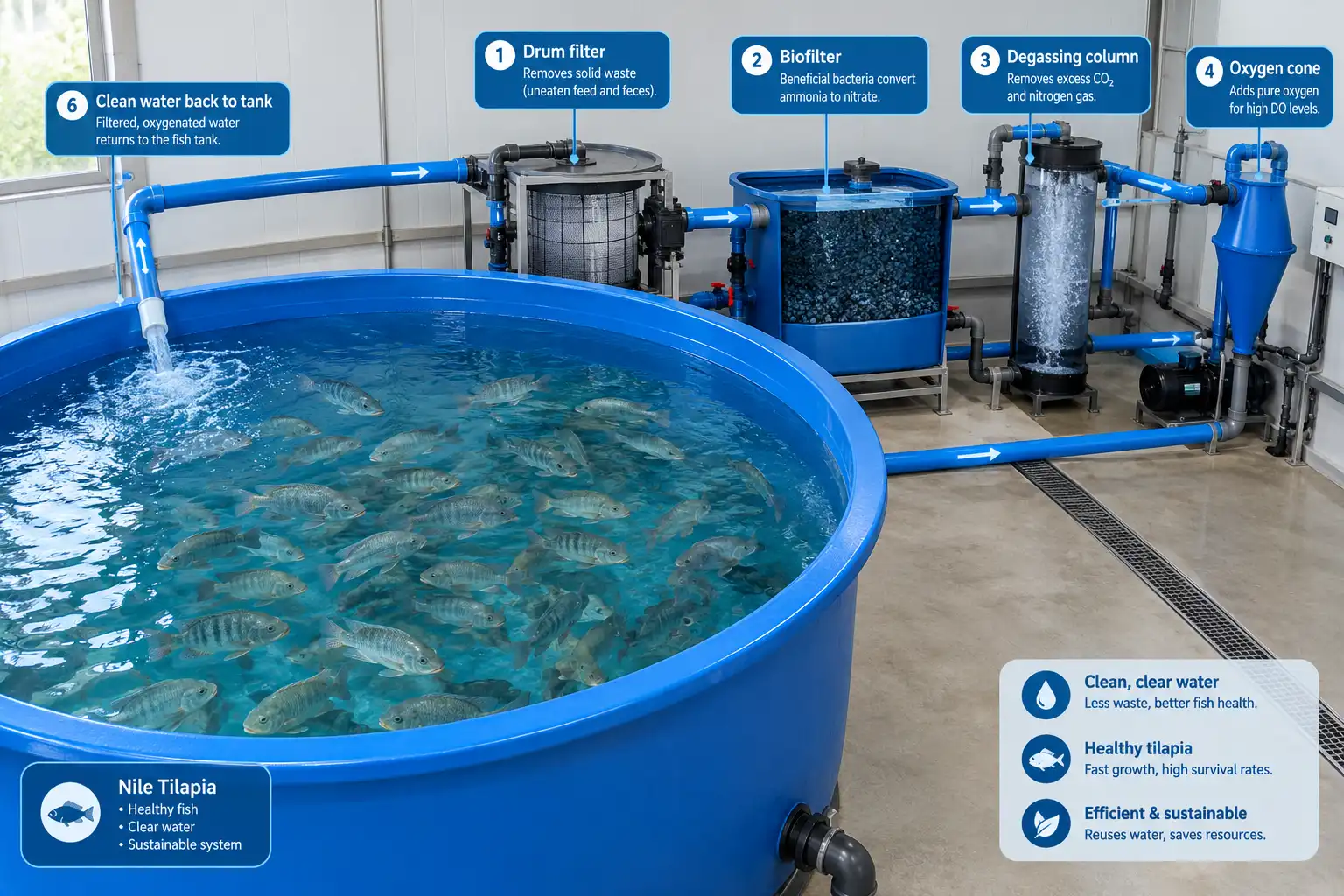
Recirculating aquaculture systems raise fish in tanks and clean the same water over and over. This guide follows that water through each treatment step. It also lists SRAC’s water targets and runs the design numbers for one tilapia tank.
A recirculating aquaculture system pumps tank water through a solids filter, a biofilter that converts ammonia, and units that add oxygen and strip carbon dioxide. SRAC Publication 452 says most systems replace 5 to 10 percent of system water daily.
What a Recirculating Aquaculture System Does
A recirculating aquaculture system, or RAS, treats and reuses the water its fish live in. As a result, it needs far less water and land than a pond.
The gap is large. SRAC Publication 451 estimates that pond fish farming at 5,000 pounds per acre uses about 100 gallons of water per pound produced. By contrast, most recirculating systems replace only 5 to 10 percent of their volume each day, per SRAC Publication 452. That new water mainly flushes out nitrate and dissolved organic matter.
Control is the other draw. Because the tanks sit indoors, you can hold water at the right temperature all year. So a farm can be built near its buyers instead of near a big water supply.
The catch is intensity. SRAC 452 notes that food fish in these systems usually run at 0.5 pound per gallon or more, because lighter loads don’t cover costs. It compares that to a 20-gallon home aquarium holding 10 pounds of stock. At that load, a stalled pump or a failing biofilter can put the whole crop at risk within minutes.
The Water Loop in Five Core Steps
SRAC Publication 453 (October 2013 revision) names five processes every RAS needs. It treats them as links in a chain. The weakest one sets how many fish the whole system can hold.
Water usually moves through them in this order:
- Circulation. A pump or airlift moves water from the fish tank into the treatment loop.
- Solids removal. A screen, settler, or bead filter catches feces and uneaten feed.
- Biofiltration. Bacteria convert toxic ammonia to nitrite, then to nitrate.
- Carbon dioxide stripping. A packed column or blown air vents the gas that fish breathe out.
- Aeration or oxygenation. Air or pure oxygen brings dissolved oxygen back up before the water returns.
On top of these, many systems add UV or ozone disinfection, heating or cooling, and foam fractionation.
Every part must handle the same feed load. SRAC 453 puts typical recirculation flow at 5 to 10 gallons per minute for each pound of feed fed per day. Also, the pump or blower driving that loop is usually the biggest energy user. For that reason, compare tank and filter setups as one matched set rather than part by part.
How Each Part of the System Works
Fish Tanks and Stocking Density
Circular tanks dominate RAS, per SRAC 453. Water spinning toward a center drain carries solids out quickly. Rectangular tanks use floor space about 20 percent better and harvest more easily. However, solids tend to settle in them.
How heavily you stock depends on the job. SRAC 453 gives these typical design loads:
| Use | Typical design density |
|---|---|
| Broodstock and display fish | Under 1/8 pound per gallon |
| Fingerlings, baitfish, and ornamental fish | Under 1/4 pound per gallon |
| Food fish growout | About 1/2 pound per gallon |
Densities near 1 pound per gallon are possible. Still, SRAC 453 warns that water quality then turns unstable, and disease and growth problems follow.
For tilapia, the oxygen method sets the ceiling. SRAC Publication 282 (June 2009 revision) says tilapia tanks run on aeration alone top out near 0.25 pound per gallon. With supplemental pure oxygen, tilapia density often passes 0.5 pound per gallon.
Solids Removal
Solids leave first because they rot fast. SRAC 453 estimates that about half the feed fish and crustaceans eat comes out as solid waste. SRAC 452 puts the share higher, at more than 60 percent of the feed placed in a system. The larger figure also counts uneaten feed, so the two answer slightly different questions.
Left in the water, solids burn oxygen and release more ammonia. They also feed the microbes linked to off-flavor. SRAC 453 describes the main options:
- Settling basins: simple, but they take a lot of floor space and miss fine particles.
- Rotating drum screens: a 20 to 60 micron mesh, a small footprint, and the main choice on larger freshwater farms.
- Floating bead filters: catch particles down to about 30 microns and can double as a biofilter.
- Foam fractionators: strip fine solids and work far better in salt water than in fresh.
Every method produces sludge. SRAC 452 names land application and composting as sound disposal routes. Even so, your state decides what is allowed.
The Biofilter
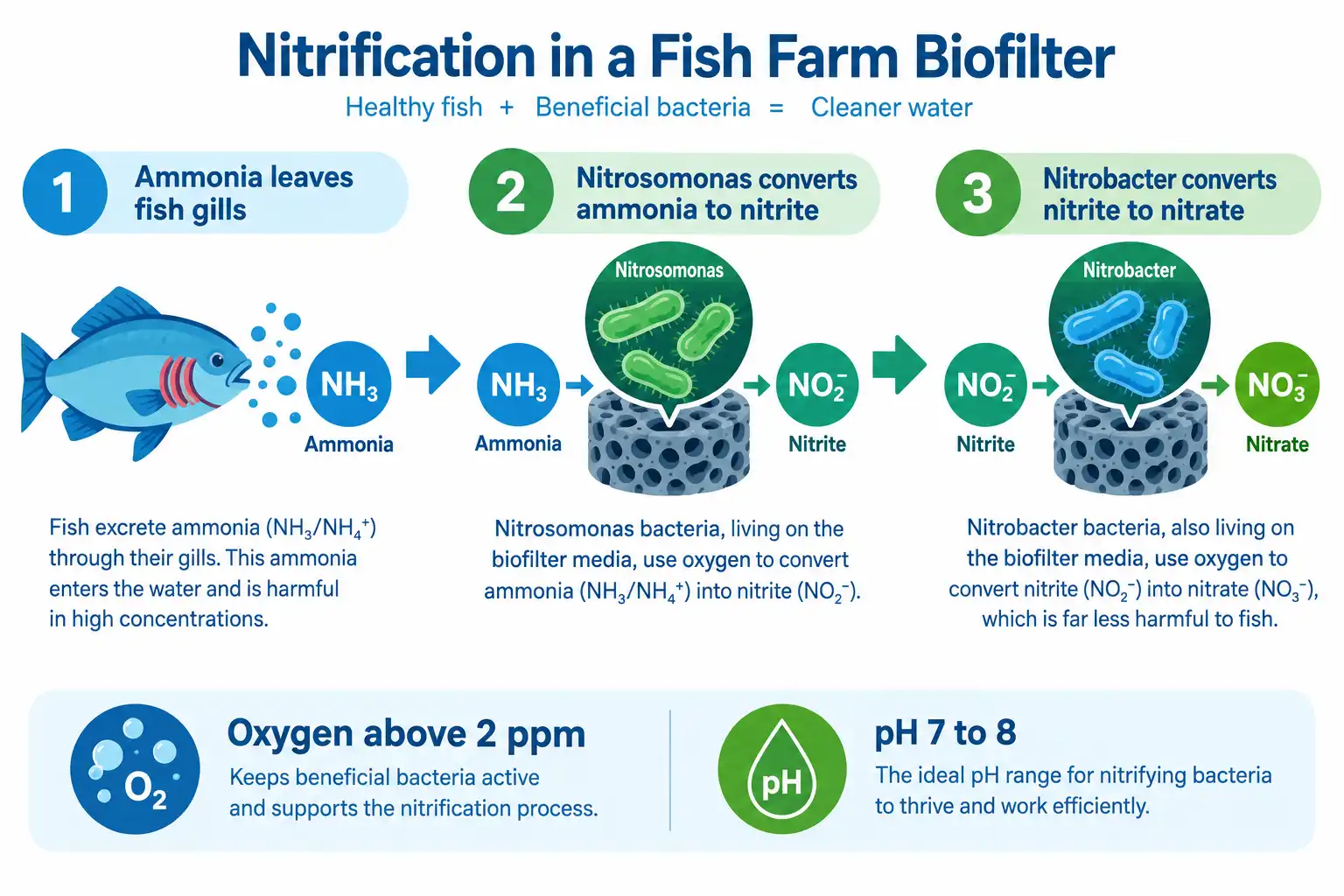
Fish excrete ammonia through their gills as they digest protein. In a RAS, nitrifying bacteria on the biofilter media remove it in two steps. First, Nitrosomonas bacteria convert ammonia to nitrite. Then Nitrobacter bacteria convert nitrite to nitrate, which is far less toxic.
The ammonia load follows the feed. SRAC 451 says about 3 percent of feed becomes ammonia-nitrogen. SRAC 452 puts it at 2.2 pounds per 100 pounds of feed. In other words, every extra bag of feed needs more biofilter.
SRAC 453 rates biofilters by how much daily feed each cubic foot of media supports:
- Fluidized sand beds: 1 to 2 pounds of feed a day
- Floating bead biofilters: 1 to 2 pounds of feed a day
- Moving bed reactors: 0.5 to 1 pound of feed a day, but cheaper and simpler to run
The bacteria need steady conditions. SRAC 452 says they lose efficiency below 2 ppm of dissolved oxygen and work best at pH 7 to 8. That is why daily ammonia and nitrite readings are the clearest sign of biofilter health.
Oxygen Supply
SRAC 451 says oxygen supply is usually the first limit on how many fish a system can carry. Fish use it, and so do the bacteria in the biofilter and sludge. Together they consume about 0.3 to 0.75 pound of oxygen per pound of feed in a recirculating system. The low end applies where solids leave fast. The high end applies where solids sit in submerged filters.
Targets shift with temperature. SRAC 453 notes that most warmwater recirculating systems run at 5 to 6 ppm of dissolved oxygen. Cooler systems, by contrast, can run above 8 ppm.
Two delivery methods dominate:
- Blown air: simple, and it strips carbon dioxide at the same time. SRAC 453 says it is widely used for commercial tilapia.
- Pure oxygen: delivered through cones, pressurized columns, or low-head units. It supports higher densities but needs a separate carbon dioxide stripper.
Pure oxygen adds a fire hazard. SRAC 453 warns that it can be explosive when mixed with common substances, and local rules may govern where tanks sit. Meanwhile, the basics of oxygen saturation and demand apply in tanks just as they do in ponds.
Carbon Dioxide Stripping
Fish and bacteria breathe out carbon dioxide, and it builds up quickly in a closed loop. SRAC 451 advises keeping free carbon dioxide under 20 mg/L for most farmed species. SRAC 282, however, allows up to 40 mg/L for tilapia, a hardier fish.
High carbon dioxide lowers pH, and low pH stalls the biofilter. SRAC 453 reports that poorly designed systems can reach 50 to 100 ppm. When that happens, ammonia or nitrite climbs next.
Packed columns do most of the stripping, with a blower pushing outside air up through falling water. SRAC 453 also flags a common winter mistake. Operators move blowers indoors to save heat and close the vents. The building air then fills with carbon dioxide, which dissolves straight back into the water.
Disinfection and Heating
SRAC 453 treats disinfection as optional for most farms. It earns its cost when stock is valuable, such as broodstock, or when disease pressure is high. Otherwise, disease-free source water such as groundwater has largely replaced it.
- UV light: easy to run, but it needs clear water, and bulbs need replacing every several months.
- Ozone: powerful, but an overdose can kill fish, so it suits larger farms with trained staff.
- Heat: boiler-fed coils in the sump or tank, a heated air space, or greenhouses in milder Southern climates.
Water Quality Targets for a RAS
SRAC 452 lists general targets for warmwater fish in recirculating systems. SRAC 282, by contrast, gives wider ranges for tilapia alone.
| Measure | Warmwater fish in RAS (SRAC 452) | Tilapia in RAS (SRAC 282) |
|---|---|---|
| Temperature | Optimum for the species; avoid sudden changes over 5°F | 81 to 84°F for best growth |
| Dissolved oxygen | 5 mg/L or more; over 2 mg/L leaving the biofilter | 5.0 to 7.5 mg/L |
| Carbon dioxide | Under 20 mg/L | Under 40 mg/L |
| pH | 7.0 to 8.0 | 6.8 or higher for the biofilter |
| Total alkalinity (as CaCO3) | 50 to 100 mg/L or more | 100 to 250 mg/L |
| Hardness | 50 to 100 mg/L or more (total, as CaCO3) | 50 to 100 mg/L (calcium) |
| Un-ionized ammonia-nitrogen | Under 0.05 mg/L | Under 1.0 mg/L |
| Nitrite-nitrogen | Under 0.5 mg/L | Under 5 mg/L when chloride is low |
| Chloride | Not listed | 100 to 300 mg/L |
The two columns answer different questions. The SRAC 452 limits protect sensitive warmwater species. For example, SRAC 452 notes that nitrite as low as 0.5 ppm stresses catfish. Tilapia, on the other hand, tolerate high un-ionized ammonia and seldom show toxic effects in well-buffered systems.
Also, pH changes how toxic the same ammonia reading is. At pH 7.0, most total ammonia stays in the less toxic ionized form, per SRAC 451. At pH 8.75, up to 30 percent is un-ionized.
Coldwater systems sit at the other end. New Mexico State University Extension Guide L-108 (revised 2020) puts the best growth for rainbow trout at 50 to 55°F.
Worked Example: One 5,000-Gallon Tilapia Tank
Take a 5,000-gallon tank of 1.5-pound market tilapia at 0.5 pound per gallon. That is 2,500 pounds of tilapia. SRAC 282 puts their daily feed at 1.0 to 1.5 percent of body weight, or 25 to 37.5 pounds. At this density, SRAC 282 also expects supplemental pure oxygen.
| Item | Ratio and source | For 25 to 37.5 lb of feed a day |
|---|---|---|
| Ammonia-nitrogen produced | 2.2 to 3 percent of feed (SRAC 452, SRAC 451) | 0.55 to 1.1 lb a day |
| Oxygen consumed | 0.3 to 0.75 lb per lb of feed (SRAC 451) | 7.5 to 28 lb a day |
| Recirculation flow | 5 to 10 gpm per lb of daily feed (SRAC 453) | 125 to 375 gpm |
| Moving bed media | 0.5 to 1 lb of daily feed per cubic foot (SRAC 453) | 25 to 75 cubic feet |
| New water | 5 to 10 percent of system volume daily (SRAC 452) | 250 to 500 gallons per 5,000 gallons of system water |
Without recirculation, SRAC 451 calculates that the same 2,500-pound load fed 37.5 pounds a day needs about 93 gpm of fresh water. That is more than 130,000 gallons a day.
SRAC 453 also suggests a uniform safety factor, such as 1.5. So size this tank for about 56 pounds of feed a day.
Treat these as planning figures, not a design. Then have a qualified RAS designer review the final plan, as SRAC 453 advises.

Starting a New Biofilter
A new biofilter has no bacteria yet, so it can’t handle a full feed load. SRAC 452 says activation takes at least a month. During that time, keep stocking and feeding well below normal.
The pattern follows a set order, per SRAC 452:
- First two weeks: ammonia climbs while Nitrosomonas bacteria colonize the media.
- Around week two: ammonia falls as those bacteria convert it, and nitrite rises.
- Next: Nitrobacter bacteria build up, and nitrite drops.
- Ready: both stay low at normal feed rates, so stocking can increase.
SRAC Publication 4502 (February 2012) describes starting the biofilter before fish arrive, using a source of nitrifying bacteria and added ammonia. The alternative, a “cold start,” stocks fish into an unstarted filter. In that case, SRAC 4502 warns, you must cut or stop feeding and exchange water to keep ammonia and nitrite tolerable. Warm water speeds the process, and the example in SRAC 4502 ran at about 83°F.
Overfeeding during startup is a classic loss. SRAC 452 notes that fish stop eating and crowd the aerators when ammonia spikes. Later on, a biofilter knocked out by a chemical treatment needs 3 to 4 weeks to re-activate.

Power Failures and Backup Systems
In a RAS, minutes count. SRAC 452 gives an example for warmwater fish at 84°F. With half-pound warmwater fish at 1/4 pound per gallon, oxygen falls from saturation to a stressful 3 ppm in 16 minutes. With 1-pound warmwater fish at 1 pound per gallon, it takes under 6 minutes. SRAC 451 adds that an aeration failure can wipe out a heavily stocked crop in half an hour or less.
So the backup has to work without you. SRAC 452 and SRAC 453 describe a standard set:
- A backup generator with an automatic transfer switch
- A pure oxygen tank on a solenoid valve that opens when power fails
- An auto-dialing alarm for power loss and water level changes
- Spare pumps or blowers that switch on quickly
SRAC 453 says power or blower capacity should be back within 20 minutes. Use that response time to judge any generator and alarm setup.
Two safety rules apply. The CDC warns never to run a generator indoors, in a garage, or in a carport, because its exhaust carries carbon monoxide. Also, pumps, blowers, and heaters near water belong on ground-fault protected circuits installed by a licensed electrician.

Fish Health and Biosecurity in a RAS
When fish go off feed, crowd the aerators, or start dying, check dissolved oxygen first. Then test carbon dioxide, ammonia, and nitrite. Water problems, parasites, and bacterial disease can look alike from the tank side. So call your extension aquaculture specialist or a fish health diagnostic lab to confirm the cause before anything is treated. Report heavy, unexplained losses to your state veterinarian or state aquatic animal health official.
SRAC 452 lists diseases that have caused trouble in recirculating systems. They include the parasites Ich and Trichodina, plus columnaris, Aeromonas, Streptococcus, and Mycobacterium infections. It links Trichodina and Streptococcus to tilapia systems and Mycobacterium to hybrid striped bass.
Treatment is harder in a closed loop. SRAC 452 notes that formalin, copper sulfate, potassium permanganate, and some antibiotics inhibit biofilter bacteria. Therefore, treatment choices belong with an aquatic animal veterinarian or your extension specialist, using FDA-approved products as the label directs.
Prevention works better. SRAC 452 advises these steps:
- Quarantine new fish, and have a few checked by a fish health specialist.
- Never pour hauling water into the system.
- Give each tank its own nets, and disinfect gear between tanks.
These steps match wider farm biosecurity practices for any tank system.
Where a RAS Fits and What It Costs
SRAC 453 says a RAS makes sense where temperature, salinity, disease, water supply, land, or exotic species rules make cheaper systems impractical. It also supports pond and net pen farms through broodstock and fingerling production. Still, commercial food fish use has stayed mostly with high-value products. EPA notes that tilapia and hybrid striped bass are the main species grown this way.
Capital is the hurdle. SRAC 451 says variable costs such as feed, fingerlings, electricity, and labor differ little from other methods. However, building a RAS costs far more, and its power draw runs all year. SRAC 282 cites Southern economic analyses on tilapia. Those showed a farm needed about 200,000 to 250,000 pounds of live tilapia a year for proper cash flow. Building that capacity could exceed $750,000. These are 2009 figures, so treat them as a benchmark, not a quote.
SRAC 452 advises planning to build, run, and market with no return for at least 2 years. It also notes that many commercial systems failed through poor design, weak management, or flawed economics.
Species rules come first. Some states require a permit to culture tilapia. SRAC 282 notes that some issue it more readily for indoor systems because escape is less likely. Check with your state aquaculture coordinator before you buy fish.
Discharge Permits and Sludge
A RAS discharges far less water than a pond or raceway. But what it does release is concentrated. EPA’s effluent guidelines (40 CFR Part 451) cover direct dischargers that produce at least 100,000 pounds a year of fish, mollusks, or crustaceans. That includes flow-through and recirculating systems.
These requirements are written into NPDES permits, which most states issue. Smaller farms still have obligations, too. EPA notes that farms under 100,000 pounds a year still need NPDES permits if they discharge wastewater. So contact your state permitting office early, and ask how it treats backwash water and sludge. The broader rules on farm wastewater and effluent apply here as well.
Troubleshooting Common RAS Problems
| What you see | Likely system cause | First checks |
|---|---|---|
| Total ammonia rising day to day | Biofilter overloaded, or feed above its capacity | Feed rate, plus oxygen, pH, and alkalinity at the biofilter (SRAC 452) |
| pH sliding downward | Nitrification and carbon dioxide using up alkalinity | Alkalinity, carbon dioxide, and degassing equipment (SRAC 452) |
| Tank water level rising | Fouled drain pipe or clogged fish screen (SRAC 452) | Pipes and screens, especially if flow has dropped |
| Cloudy water | Fine solids building up | Solids filter and backwash schedule (SRAC 453) |
| Foul or fecal smell | Solids building up, with off-flavor risk | Solids removal, feed rate, and water exchange (SRAC 452) |
| Low pH and high nitrite in winter | Blowers indoors, building air rich in carbon dioxide (SRAC 453) | Ventilation and blower placement |
These are system checks, not diagnoses. If fish are sick or dying, follow the fish health steps above.
FAQs About Recirculating Aquaculture Systems
How much water does a recirculating aquaculture system use?
Most recirculating systems replace 5 to 10 percent of their volume each day, according to SRAC Publication 452. By comparison, SRAC 451 estimates pond fish farming at 5,000 pounds per acre uses about 100 gallons per pound produced.
Which fish are raised in recirculating systems in the US?
EPA says any species can be grown in a recirculating system, but tilapia and hybrid striped bass lead. SRAC 453 adds broodstock, fingerlings, and other high-value products as common uses, so check your state’s species rules first.
Can a recirculating system run in a garage or basement?
It can if the space handles humidity, ventilation, and electrical safety, and SRAC 453 notes heated RAS buildings need insulation and a vapor barrier. Never run a backup generator indoors, and have a licensed electrician install ground-fault protection.
Why does pH keep dropping in my recirculating system?
Nitrifying bacteria produce acid and use up alkalinity, and carbon dioxide forms carbonic acid, per SRAC 452. Farms add alkaline buffers such as sodium bicarbonate, with the amount set by daily pH and alkalinity tests.
Why do fish from a RAS sometimes taste off?
SRAC 452 calls off-flavor a common and persistent problem in recirculating systems. Fish are often moved into clean water to purge before sale, which can take a few days to many weeks depending on severity.
Is a RAS the same thing as aquaponics?
Not quite, because aquaponics links a fish system to plants that take up nutrients from the water. A standard RAS removes those nutrients with filters and water exchange instead, which SRAC Publications 451 through 454 describe.
Before You Build a Recirculating System
Start with your market and your state’s species rules. Then size every part to one peak feed rate, and build in automatic backup power and oxygen before the first fish arrive. Start the biofilter ahead of stocking, and test water daily. Finally, take SRAC 451’s advice and visit a working commercial system before you commit capital.