
What Do Tilapia Eat? Wild Diet, Farm Feeds, and Nutrition
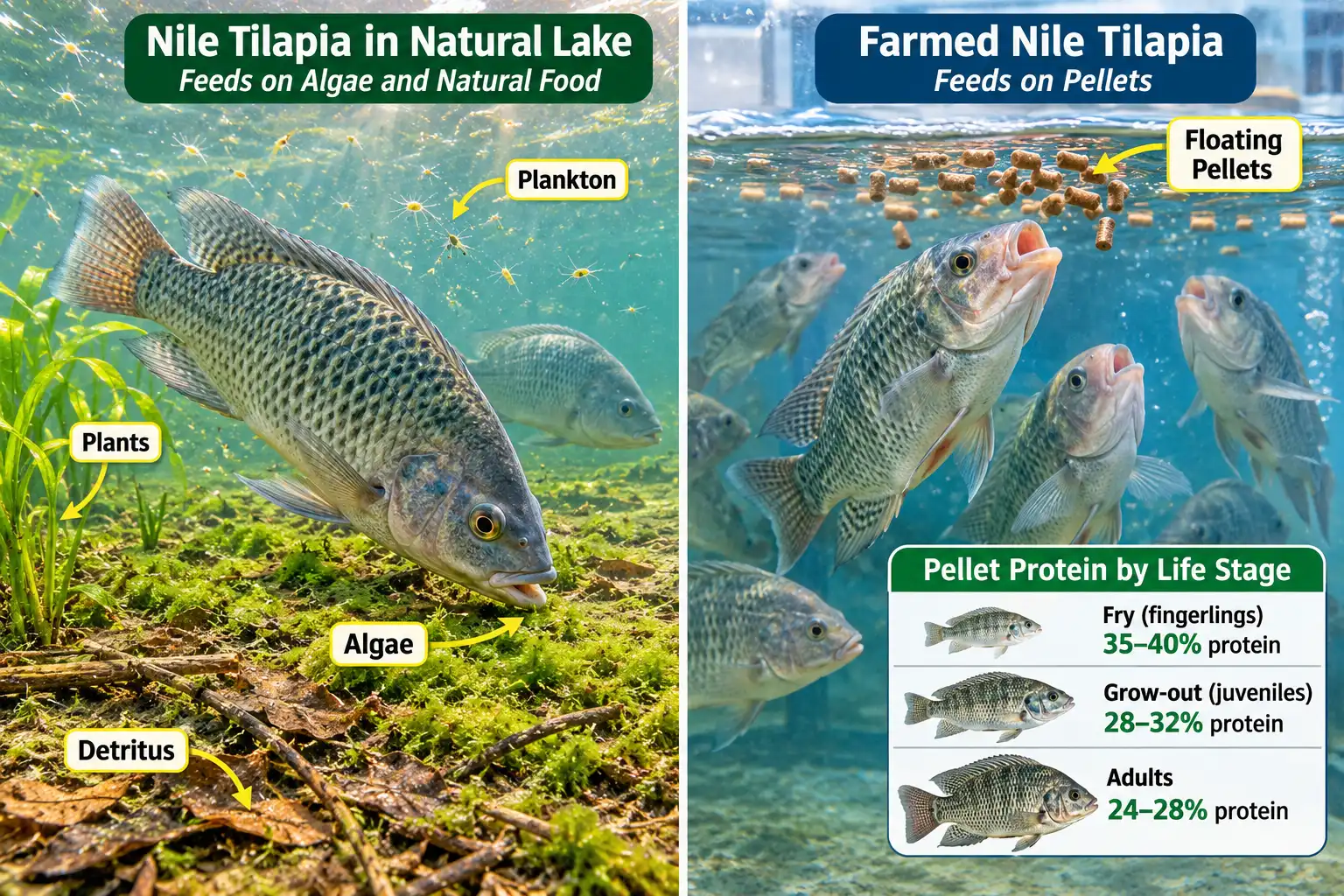
Tilapia feed low on the food chain, and that’s a big reason farms around the world raise them. So what do tilapia eat? The answer changes with where the fish live and how big they are. That diet also shapes the fillet on your plate.
Wild tilapia mostly eat algae, plankton, small invertebrates, and detritus (decaying organic matter). Farmed tilapia eat complete pellets. Per SRAC and NCRAC, fry need about 50 percent protein, and growout feed runs 26 to 40 percent.
What Do Wild Tilapia Eat?
Wild tilapia eat mostly algae and other small food at the base of the food chain. NCRAC Fact Sheet 114 describes most wild tilapia as omnivores that graze blue-green algae and bacteria.
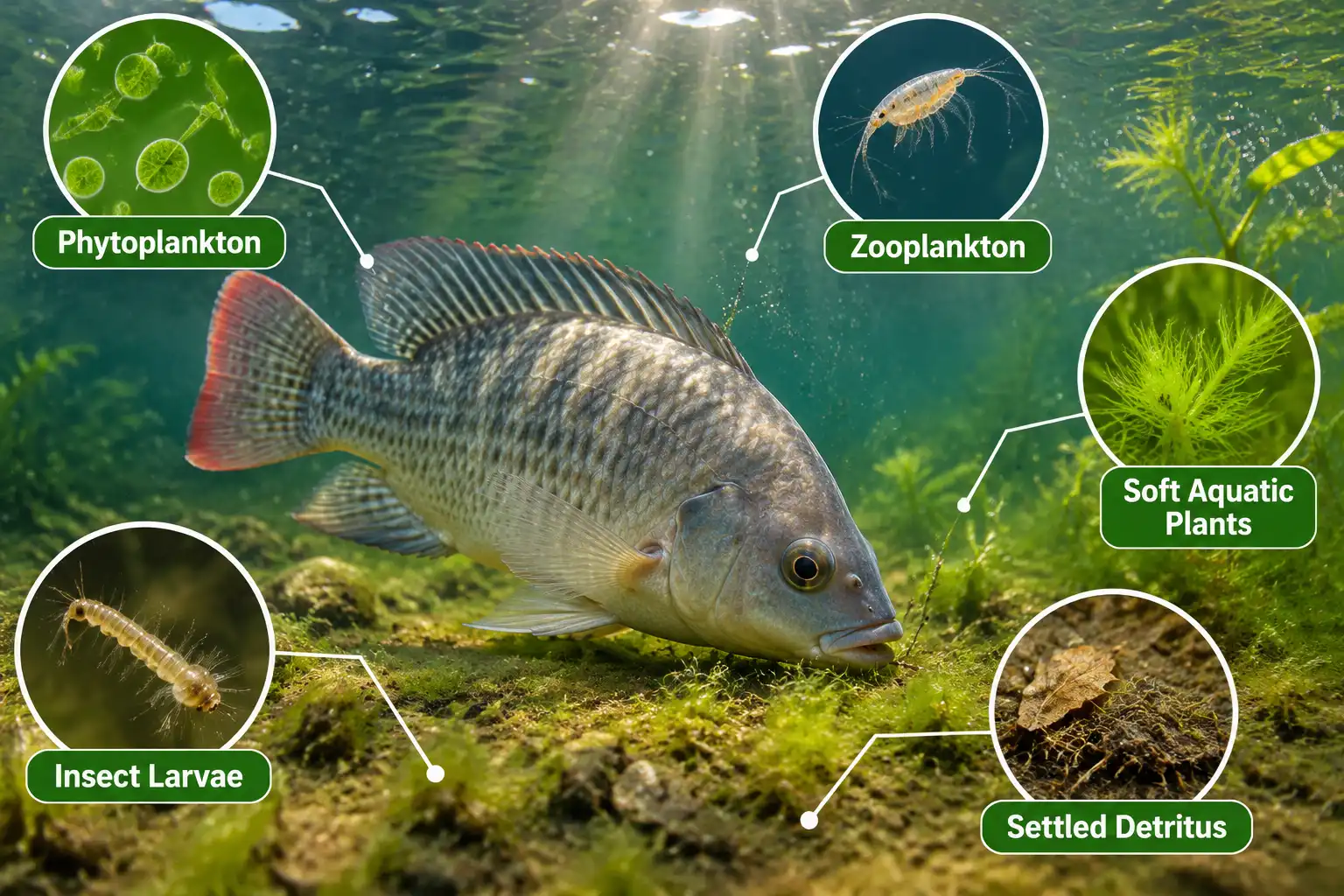
SRAC Publication 283, Tilapia: Life History and Biology, lists a wider menu:
- Phytoplankton, the free-floating algae that tint pond water green
- Zooplankton and other tiny animals in open water
- Some aquatic plants
- Insect larvae and other invertebrates on the bottom and in open water
- Larval fish, eaten mainly by juvenile tilapia
- Detritus, the decaying organic matter that settles on the bottom
Still, tilapia are not hunters. SRAC 283 notes that juveniles eat larval fish, but tilapia are not generally fish eaters.
Grazing also costs energy. As a result, NCRAC notes that wild tilapia have to eat more food than farm-raised tilapia to grow.
Nile, Blue, and Mozambique Tilapia Eat Differently
Species matter here. SRAC 283 reports that Mozambique tilapia harvest planktonic algae less efficiently than Nile or blue tilapia.
Nile tilapia also dominate farming. SRAC 283, published in 1999, put Nile tilapia at more than 90 percent of commercially farmed tilapia outside Africa.
How Tilapia Catch and Digest Algae
Tilapia trap plankton in mucus rather than straining it through their gills. SRAC 283 explains that tilapia gills secrete a mucus that catches plankton, which the fish then swallow. True filter feeders, such as gizzard shad and silver carp, strain water far more efficiently.
Digestion is where tilapia stand out. According to SRAC 283, tilapia digest 30 to 60 percent of the protein in algae. They also digest blue-green algae better than green algae. Their intestine usually runs at least six times the fish’s total length, so plant material has time to break down.
On the bottom, tilapia browse invertebrates and detritus. However, SRAC 283 notes that tilapia stir up sediment far less than common carp do. So the “bottom feeder” label tells only part of the story.
What Do Tilapia Fish Eat on a Farm?
Farmed tilapia eat pellets, plus whatever natural food their system grows. The split between the two depends on the system.
In ponds, natural food carries real weight. SRAC 283 reports that natural foods supply 30 to 50 percent of tilapia growth, even with heavy feeding. For channel catfish, the same source puts that share at only 5 to 10 percent. In fact, SRAC 283 says well-fertilized ponds can carry about 2,700 pounds of tilapia per acre or more on natural food alone.
Tanks work differently. SRAC Publication 282, Tank Culture of Tilapia (revised 2009), explains that tank-raised tilapia find little natural food. So they need a complete diet with all the protein, vitamins, and minerals they need to grow. The same holds for tilapia in aquaponics systems, since their tanks also hold little natural food.
Biofloc tanks sit in between. SRAC 282 notes that biofloc tilapia eat some of the bacteria, so lower-protein feed can still grow them well.
| System | Natural food | Feed tilapia need | Growout feed protein |
|---|---|---|---|
| Fertilized pond, no feed | All of the diet | None | Not applicable |
| Fed pond | 30 to 50% of growth | Supplemental pellets | 26 to 30% |
| Biofloc tank | Part of the diet | Complete pellets | Lower than clear-water tanks |
| Tank, RAS, or aquaponics | Little to none | Complete pellets | 28 to 40% |
Figures in the table come from SRAC 282, SRAC 283, and NCRAC 114. For stocking, systems, and harvest, see the full guide to raising tilapia.
Nutrition for Tilapia: Protein by Life Stage
Young tilapia need the most protein, and the need drops as they grow. NCRAC 114 sets tilapia fry at about 50 percent protein and fingerlings at 32 to 36 percent. Tilapia over 1.4 ounces (40 grams) need 28 to 32 percent.
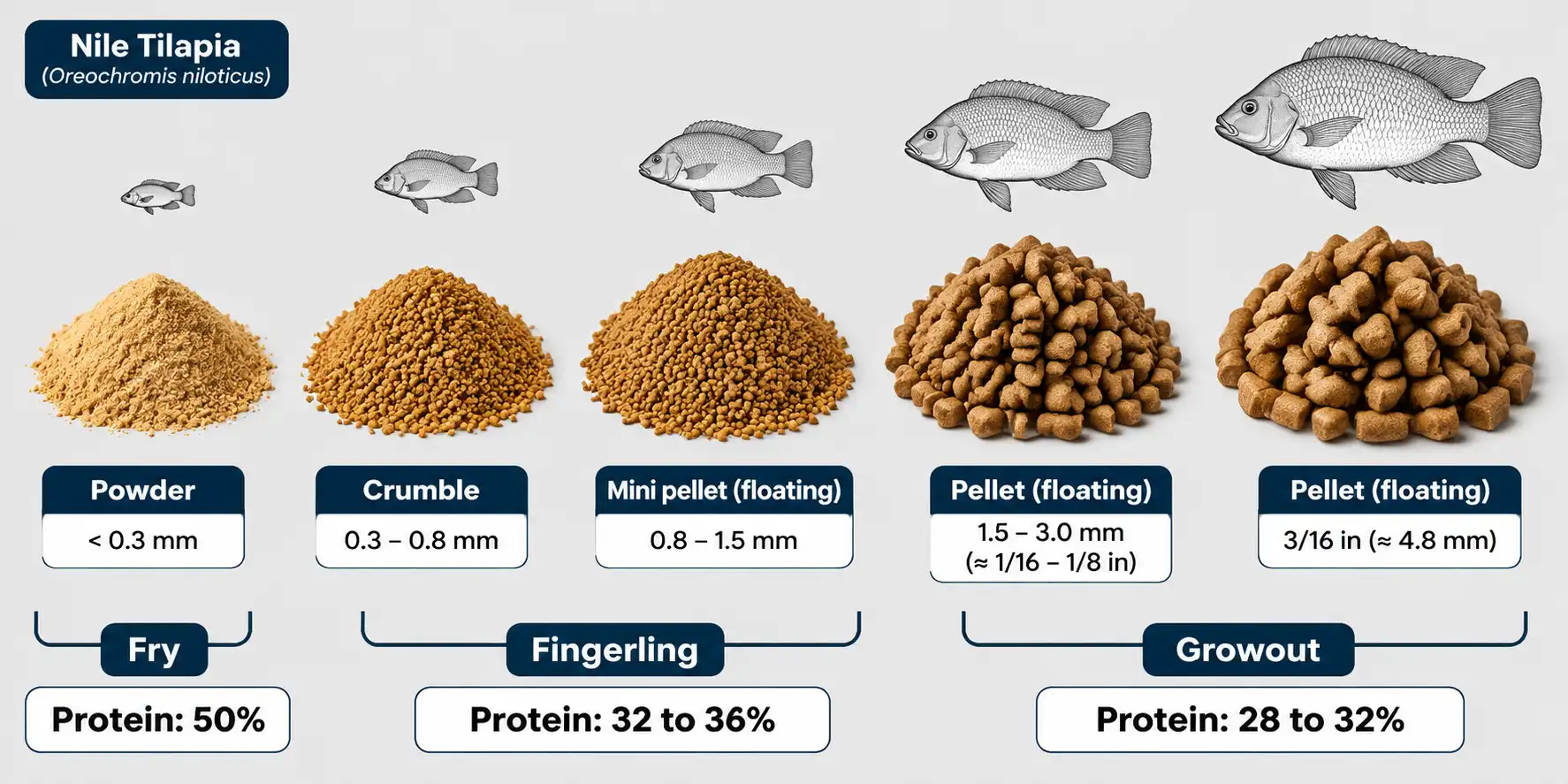
| Tilapia life stage or system | Crude protein | Source |
|---|---|---|
| Fry | About 50% | NCRAC 114 |
| Fingerlings | 32 to 36% | NCRAC 114 |
| Over 1.4 oz (40 g), recirculating tanks | 28 to 32% | NCRAC 114 |
| Tank finishing feed | 32 to 40% | SRAC 282 |
| Fed pond growout | 26 to 30% | SRAC 283 |
Growout protein is where sources differ, so we give both figures. NCRAC puts tilapia over 1.4 ounces at 28 to 32 percent. Meanwhile, SRAC 282 says tank finishing feeds usually run 32 to 40 percent. Pond feeds run lower, at 26 to 30 percent per SRAC 283, because natural food fills part of the diet.
Fat matters too. NCRAC 114 puts dietary fat for tilapia at 4 to 8 percent, with the higher end for small fish. Floating pellets also help, since NCRAC notes their processing makes more energy available to tilapia.
Plant protein suits tilapia well. SRAC 283 reports that tilapia digest plant protein, especially fibrous material, better than channel catfish do. No tilapia feed nearby? SRAC 283 considers a US catfish feed with 28 to 32 percent crude protein appropriate.
How Much to Feed Tilapia
Small tilapia eat a far bigger share of their body weight each day than large ones. SRAC 282 gives this schedule for tilapia in tanks:
| Average tilapia weight | Feed size | Daily feed, % of body weight |
|---|---|---|
| Hatch to 0.02 oz (0.5 g) | #00, #0, #1 crumble | 20 to 15 |
| 0.02 to 0.18 oz (0.5 to 5 g) | #2 crumble | 15 to 10 |
| 0.18 to 0.6 oz (5 to 18 g) | #3 crumble | 10 to 5 |
| 0.6 to 2.6 oz (18 to 75 g) | #4 crumble, about 0.04 inch | 5 to 3 |
| 2.6 to 5.3 oz (75 to 150 g) | 1/8-inch pellet | 3 to 1.5 |
| 5.3 oz (150 g) to market | 3/16-inch pellet | 3 to 1.5 |
Near market size, about 1.5 pounds, SRAC 282 caps tilapia at 1.0 to 1.5 percent of body weight a day. NCRAC 114 gives a similar curve measured at 82°F, though it starts tilapia fry as high as 30 percent.
Pellet size matters as much as the amount. SRAC 282 advises offering the largest pellet the smallest tilapia in the tank can eat. Pellets that are too big cut intake, slow growth, and widen size differences. Our guide to how rations shift as fish grow covers other species as well.
Feed Math for a Tilapia Tank
Feeding rates are easier to use once you turn them into pounds. Here’s the arithmetic for 400 Nile tilapia in a tank. The fish count, weights, and survival are example numbers, so swap in your own.
Daily ration at 8 ounces per fish
- Total weight: 400 tilapia x 0.5 lb = 200 lb
- Rate for that size: 1.5 to 3 percent a day (SRAC 282)
- Daily feed: 200 lb x 0.015 to 0.03 = 3 to 6 lb
Daily ration near market size
- Total weight: 400 tilapia x 1.5 lb = 600 lb
- Rate for that size: 1.0 to 1.5 percent a day (SRAC 282)
- Daily feed: 600 lb x 0.01 to 0.015 = 6 to 9 lb
Feed for the whole crop
- Gain per fish: 1.5 lb at harvest minus 1 oz at stocking = about 1.44 lb
- Total gain: 400 tilapia x 1.44 lb = 576 lb, if every fish survives
- Feed conversion ratio for tilapia: 1.4 to 1.8 (SRAC 282)
- Feed needed: 576 lb x 1.4 to 1.8 = about 810 to 1,040 lb, or 16 to 21 fifty-pound bags
Losses shrink the gain, so use your own survival rate. Also, watch growth alongside FCR. SRAC 282 warns that a very low FCR can simply mean you’re underfeeding the tilapia.
How Often to Feed Tilapia
Small tilapia need frequent meals, while larger tilapia do well on a spread-out schedule. NCRAC 114 recommends feeding fry 8 to 10 times a day and fingerlings at least four times a day. For larger tilapia, NCRAC puts the best spacing at 4 to 5 hours between meals. Feed offered every 2 to 3 hours tended to pass through the stomach and go to waste.
SRAC 282 takes a similar view. Because tilapia are grazers, you can spread their daily ration over 10 to 12 hours or longer. SRAC 282 also cites reports of better feed conversion when tilapia get rest periods instead of nonstop feeding.
Hand feeding lets you watch the fish eat and adjust the ration, per SRAC 282. On the other hand, automatic feeders make a long schedule easier to keep. NCRAC cautions that feeders for fry still need frequent checks to prevent overfeeding.
Floating pellets make this easier. You can see what the tilapia eat and what they leave behind.
Water Temperature and Tilapia Appetite
Water temperature sets how much tilapia will eat. The two SRAC fact sheets give slightly different numbers, so we show both.
| Condition | SRAC 283 | SRAC 282 |
|---|---|---|
| Best growth | About 85 to 88°F | 81 to 84°F |
| Acceptable growth | Not given | 77 to 90°F |
| Feeding falls off | Generally stops below 63°F | Reduced at 50 to 60°F |
| Lethal, Nile tilapia | 50 to 52°F after a few days | About 50°F |
| Lethal, blue tilapia | Tolerates about 48°F | About 45°F |
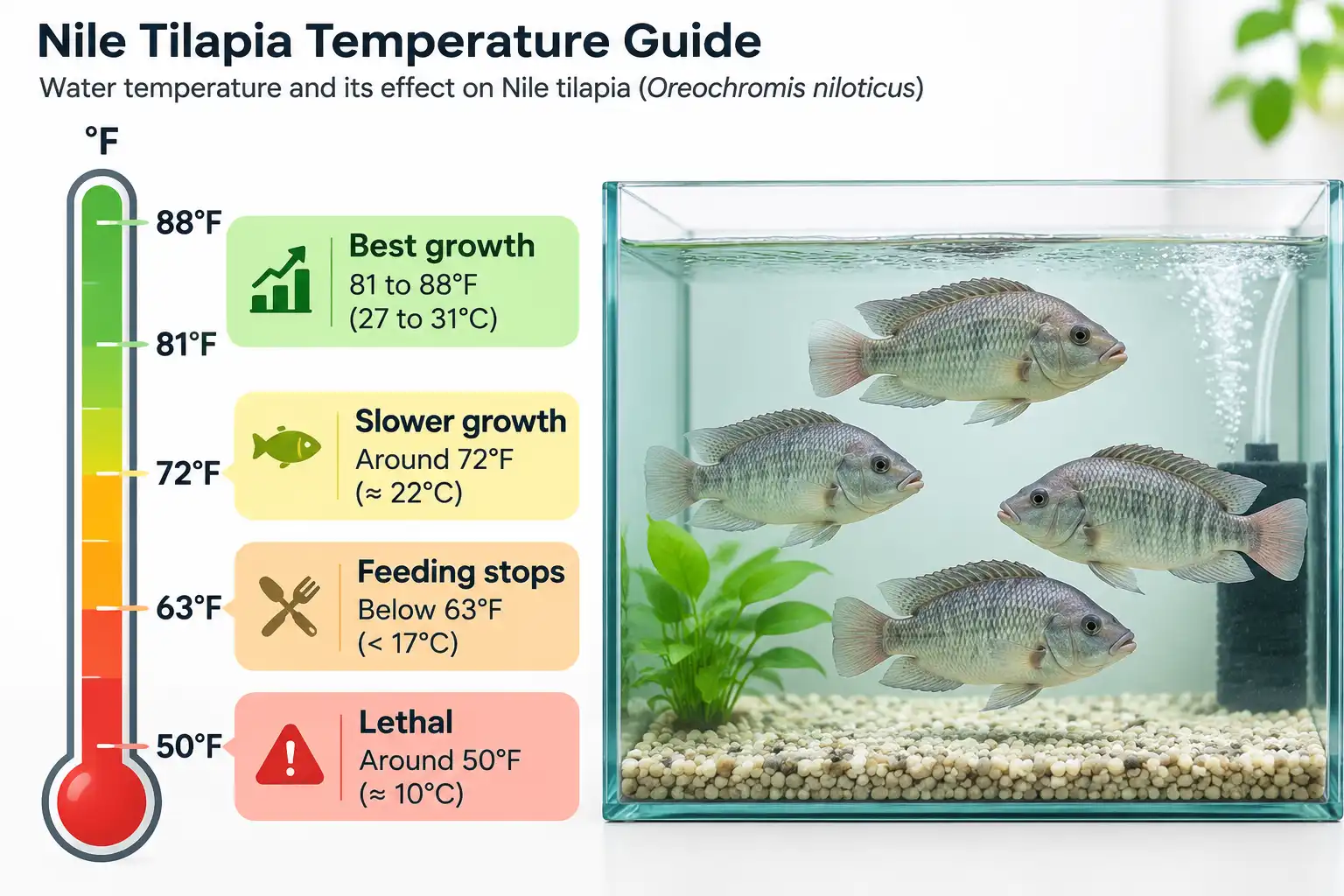
Growth slows sharply away from the top range. SRAC 283 notes that tilapia grow about three times faster at the optimum than at 72°F.
In practice, feed less as water cools. NCRAC 114 notes that its feeding table assumes 82°F and that tilapia should get less feed in cooler water. Also, handle tilapia as little as possible in cool water. SRAC 283 calls disease losses after handling a serious problem below 65°F.
Heat brings its own trouble. SRAC 282 notes that dissolved oxygen gets harder to hold near the upper temperature limits.
Can Tilapia Live on Duckweed, Greens, or Kitchen Scraps?
Tilapia will eat duckweed and soft greens, but research on growing them to market size on plants alone is thin. SRAC 283 confirms that tilapia eat some aquatic plants and digest plant protein well. Beyond that, we found no extension trial that raises food-size tilapia on duckweed or kitchen scraps alone. Most backyard claims come from hobby sources, not measured trials.
Protein is the main gap. NCRAC 114 sets tilapia fry at about 50 percent protein and fingerlings at 32 to 36 percent. Fresh greens are mostly water, so they fall far short.
Leftovers cause a second problem. NCRAC 114 warns that uneaten feed degrades water quality and fish health. Scraps that sink and rot do the same.
So treat plants as a side dish:
- Feed a complete tilapia or catfish pellet first.
- Offer duckweed or greens in small amounts the fish clear quickly.
- Skim off anything left after the meal.
- Never feed moldy pellets or spoiled food.
NCRAC advises keeping feed in a dry, cool place to prevent mold.
When Tilapia Stop Eating
Fish health first check: dissolved oxygen. When tilapia go off feed, test oxygen before anything else. NCRAC 114 says to keep oxygen in tilapia recirculating systems above 5.0 mg/L (5.0 ppm). Feed less between 3.0 and 5.0 mg/L, and stop feeding below 3.0 mg/L.
Oxygen and temperature fine, but tilapia still refuse feed or start dying? Call your extension aquaculture specialist or a fish health diagnostic lab. Report heavy, unexplained losses to your state veterinarian or state aquatic animal health official. Until you have an answer, don’t move or sell fish from that system.
Ponds run on different numbers. SRAC 283 notes that tilapia survive dawn oxygen below 0.3 mg/L. Even so, Nile tilapia grew better when dawn oxygen stayed above 0.7 to 0.8 mg/L. SRAC 283 advises keeping tilapia ponds above 1 mg/L. The first figure is about survival, while the second and third are about growth. Our guide to oxygen levels before dawn covers testing and timing.
Tilapia Feeding Problems and Fixes
These are the common feeding problems in tilapia tanks and ponds. Disease can look like any of them, so have a fish health lab confirm the cause before you treat anything.
| What you see | Common cause | What to check or change |
|---|---|---|
| Tilapia ignore feed at dawn | Low dissolved oxygen | Test oxygen; hold feed below 3.0 mg/L (NCRAC 114) |
| Little feeding in cool weather | Water below about 63°F | Check temperature; cut the ration (SRAC 283) |
| Pellets left on the bottom | Overfeeding | Feed less; remove leftovers |
| Wide spread in fish sizes | Pellets too large | Size feed to the smallest fish (SRAC 282) |
| Ammonia climbs after meals | Heavy feed load | Ammonia peaks 4 to 6 hours after feeding (NCRAC 114); reduce the ration |
| Off-flavor at harvest | Feed and waste in the gut | Withhold feed 3 to 5 days before harvest (SRAC 282) |
How Diet Shapes Tilapia as Food
What tilapia eat changes the fat in their fillets. A 2008 Wake Forest study in the Journal of the American Dietetic Association measured fatty acids in commonly eaten fish. Farmed tilapia carried less than half a gram of omega-3 fat per 3.5 ounces (100 grams). Their ratio of arachidonic acid, an omega-6 fat, to EPA, an omega-3, averaged about 11 to 1. In farmed salmon and trout, that ratio sat well below 1 to 1.
Feed appears to drive much of the gap. A 2009 review in the International Journal of Food Sciences and Nutrition compared tilapia composition studies. It found that wild tilapia generally carry more omega-3 than farmed tilapia. It also noted that diet changes can shift the fatty acids in farmed tilapia.
That matches what each fish eats. Wild tilapia graze algae and bacteria, per NCRAC 114. Farm feeds, by contrast, lean on plants. SRAC 283 notes that one-tenth or less of the protein in commercial tilapia pond feeds comes from animal sources.
Tilapia Nutrition Facts
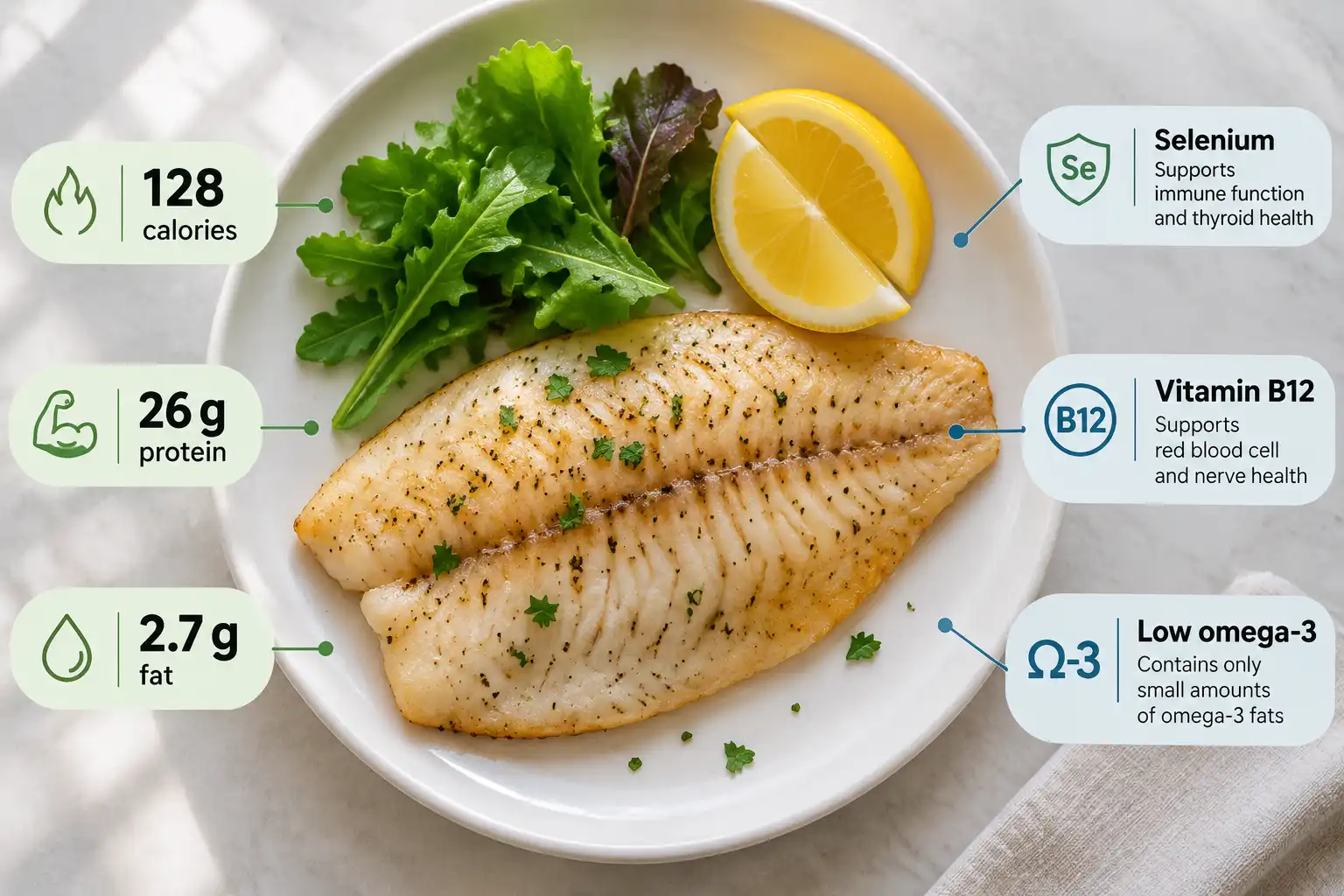
A 3.5-ounce portion of cooked tilapia has 128 calories and about 26 grams of protein, per USDA FoodData Central. The fillet is lean, with under 3 grams of total fat.
| Tilapia, cooked, dry heat | Per 3.5 oz (100 g) | Per 4 oz serving |
|---|---|---|
| Calories | 128 | 145 |
| Protein | 26.2 g | 29.7 g |
| Total fat | 2.7 g | 3.0 g |
| Saturated fat | 0.9 g | 1.1 g |
| Cholesterol | 57 mg | 65 mg |
| Sodium | 56 mg | 64 mg |
| Potassium | 380 mg | 431 mg |
| Phosphorus | 204 mg | 231 mg |
| Selenium | 54.4 mcg | 61.7 mcg |
| Vitamin B12 | 1.86 mcg | 2.1 mcg |
| Vitamin D | 3.7 mcg (150 IU) | 4.2 mcg (170 IU) |
| DHA (omega-3) | 0.13 g | 0.15 g |
| EPA (omega-3) | 0.005 g | 0.006 g |
The 4-ounce column is our arithmetic from USDA’s per-100-gram figures. Against FDA Daily Values, that tilapia portion covers about 99 percent of daily selenium needs. It also covers 78 percent for vitamin B12 and about half for protein.
Omega-3s are the weak spot. DHA and EPA together come to under 0.15 gram per 3.5 ounces of tilapia.
Is Tilapia Healthy?
For most people, yes. Tilapia is a lean, high-protein fish that is low in mercury. The FDA’s advice about eating fish lists tilapia among its Best Choices, the lowest-mercury group.
That advice targets people who are or might become pregnant or breastfeeding, and children ages 1 to 11. For that group, FDA suggests 2 to 3 servings a week from Best Choices. An adult serving is 4 ounces.
Where tilapia falls short is omega-3. Want more omega-3s? The 2008 Journal of the American Dietetic Association study found far more in farmed salmon and trout than in farmed tilapia. Still, tilapia works well as an everyday lean protein.
Cook it all the way. FDA’s safe minimum temperature chart lists 145°F for fin fish. Or cook until the flesh is opaque and separates easily with a fork. If you follow a medical diet, your doctor or a registered dietitian can say how tilapia fits.
Why Is Tilapia Bad for You? Three Claims, Checked
Most “tilapia is bad for you” claims trace back to three ideas. Here’s what the sources say about each.
“Tilapia has too much omega-6”
This comes from the 2008 study above. The measurement is real, but it has limits. The study measured fat in fish samples. It didn’t test health effects in people who ate them. Tilapia is also lean. USDA lists 0.6 gram of total polyunsaturated fat, omega-6 and omega-3 combined, in 3.5 ounces of cooked tilapia. So the ratio looks large, while the amounts stay small.
“Tilapia are raised on manure”
This claim usually cites a 2009 USDA Economic Research Service report, Imports From China and Food Safety Issues. One photo caption in it says Chinese pond fish often feed on poultry and livestock waste. That line describes Chinese pond farming in general, not tilapia alone, and it is now 17 years old. The same report lists the farm-raised products on FDA’s 2007 drug-residue import alert: catfish, basa, dace, eel, and shrimp. Tilapia wasn’t among them.
Fertilized ponds are a separate case. In those ponds, fertilizer grows plankton and the tilapia eat the plankton (SRAC 283). Tank-raised tilapia, by contrast, live on complete pelleted feed (SRAC 282).
“Tilapia are bottom feeders that eat waste”
Partly true. Tilapia do eat detritus, the decaying matter on the bottom. However, detritus is one item on a long menu of plankton, plants, and invertebrates, per SRAC 283.
How to Buy Tilapia With Confidence
Start with the label. USDA’s Agricultural Marketing Service enforces the labeling rules for retail fish. Retailers must show the country of origin and the method of production, farm-raised or wild. That tells you where the tilapia came from and how the farm raised it.
Then look for third-party farm certification labels, which add an outside check on farm practices. Finally, cook tilapia to 145°F, per FDA.
FAQs About Tilapia Feeding and Nutrition
Do tilapia eat other fish?
Rarely, though juvenile tilapia do eat some larval fish in ponds and lakes. SRAC Publication 283 notes that tilapia are not generally fish eaters, favoring plankton, plants, and small invertebrates.
What do baby tilapia eat?
Tilapia fry live off their yolk sac inside the mother’s mouth at first, per SRAC Publication 283. Once they feed on their own, NCRAC Fact Sheet 114 calls for powdered feed with about 50 percent protein.
How often should I feed tilapia?
Feed fry 8 to 10 times a day and fingerlings at least four times, per NCRAC Fact Sheet 114. Beyond that, SRAC Publication 282 says tilapia can take their daily ration spread over 10 to 12 hours.
Will tilapia eat in cold water?
Very little below about 63°F, where SRAC Publication 283 says tilapia generally stop feeding. SRAC Publication 282 adds that water at 50 to 60°F stresses tilapia and leaves them more open to disease.
Can I feed tilapia catfish feed?
Yes, catfish feed works when no tilapia feed is available nearby. SRAC Publication 283 considers a 28 to 32 percent protein catfish feed appropriate, though fry need richer starter feed.
Can tilapia clean algae out of my pond?
Partly, because tilapia graze planktonic algae and some aquatic plants, per SRAC Publication 283. Most die within days at 50 to 52°F, so check state rules and never release tilapia into public waters.
Is farm-raised tilapia safe to eat?
For mercury, yes: the FDA lists tilapia among its lowest-mercury Best Choices. Cook it to 145°F, or until the flesh is opaque and flakes easily, per FDA’s safe minimum temperature chart.
Is tilapia healthier than salmon?
Not across the board, since both rank as low-mercury FDA Best Choices. But a 2008 Journal of the American Dietetic Association study found farmed salmon far richer in omega-3 fats.
Putting This Into Practice
Match the feed to the fish and the system. Tank and aquaponics tilapia need a complete floating pellet sized to the smallest fish. Protein should drop as they grow. Pond tilapia get 30 to 50 percent of growth from natural food (SRAC 283), so pond feeds can run leaner. Check oxygen and temperature before you blame the feed. And before you stock, check whether your state lets you own and raise tilapia.