Trout Life Cycle: 5 Stages from Egg to Adult (6 for Steelhead)
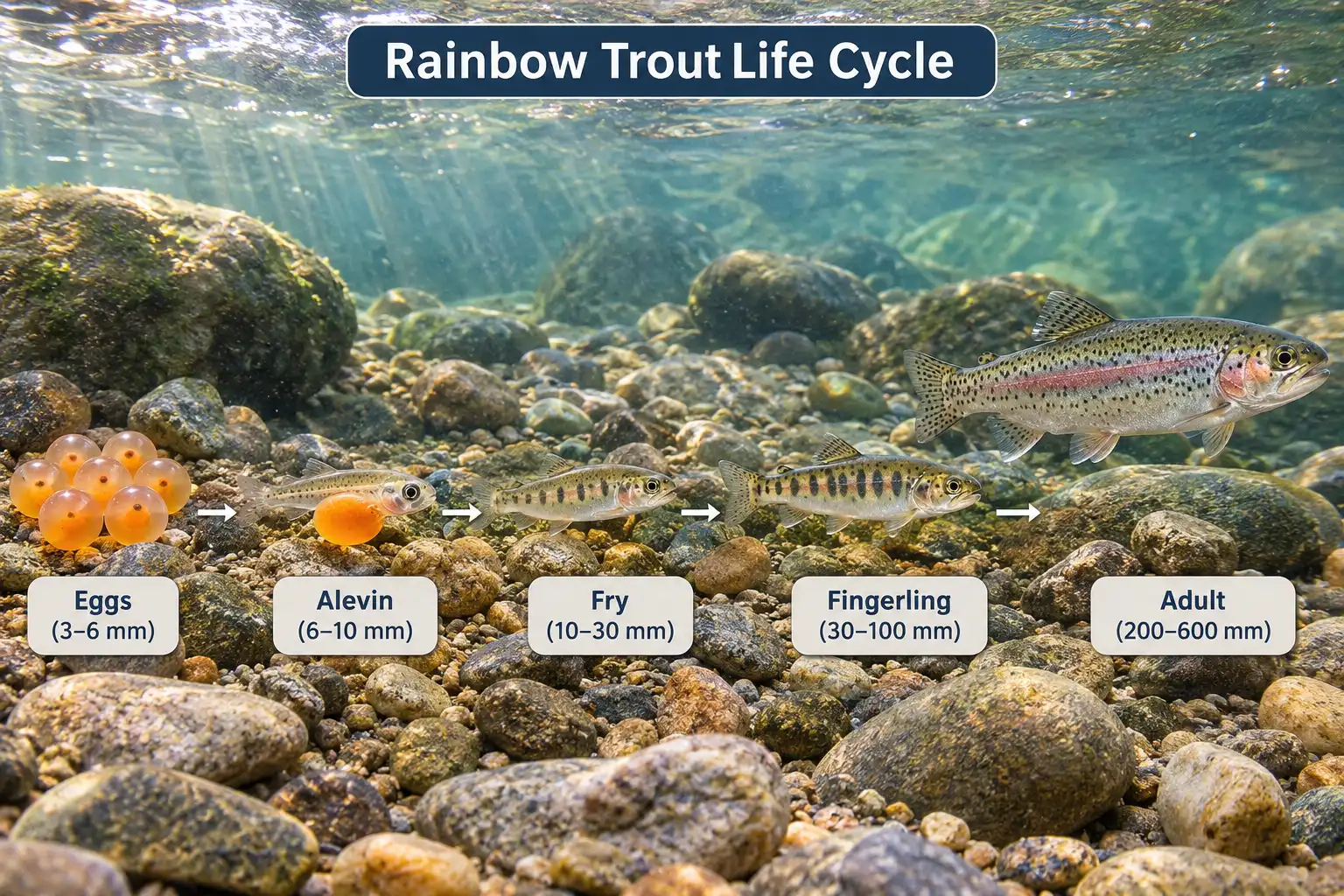
A rainbow trout spends weeks as an egg, about two weeks living off a yolk sac, and most of a year growing to plate size. Here is the trout life cycle stage by stage, with the sizes, timing, and water each stage needs on a US farm.
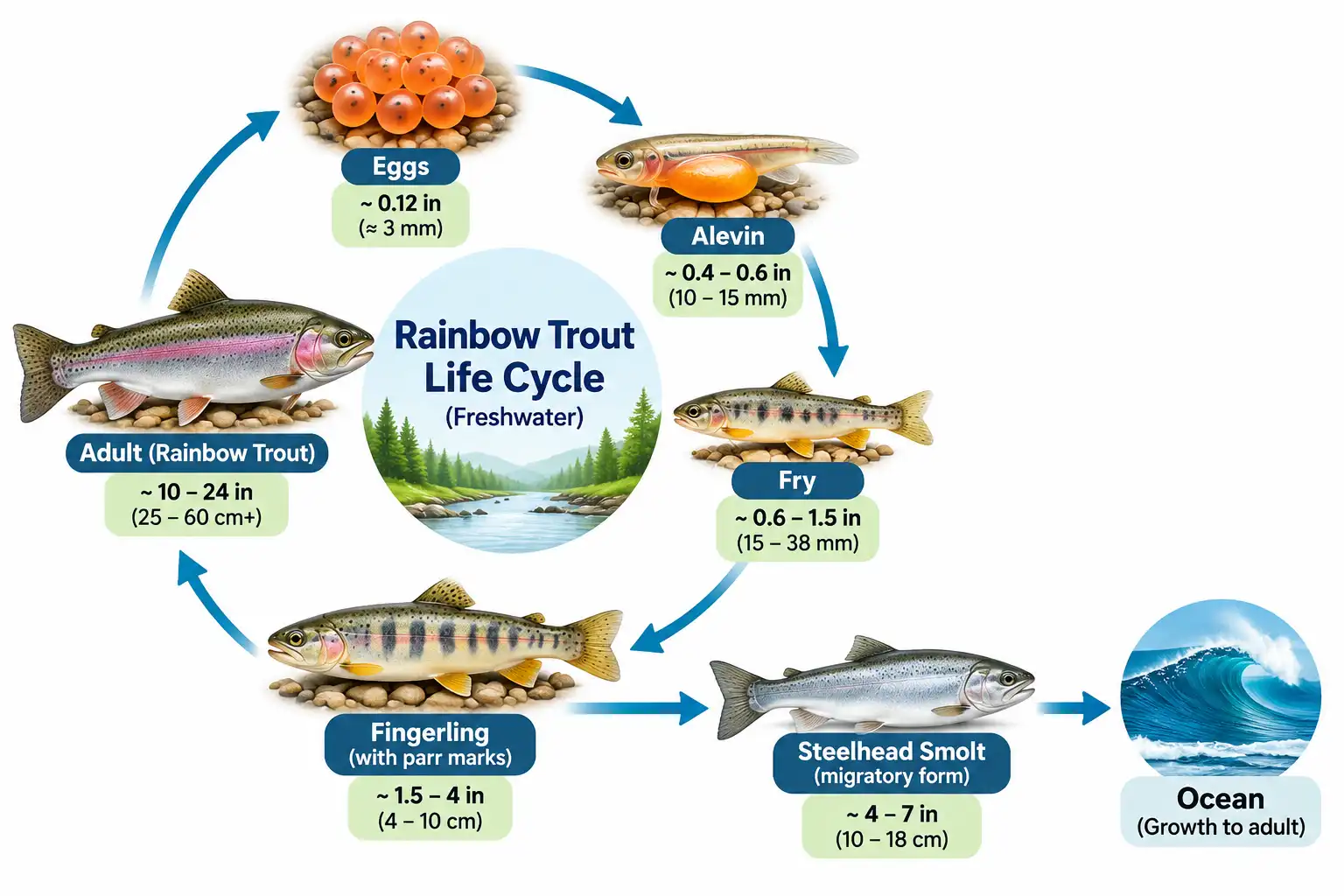
The trout life cycle has five core stages: egg, alevin (sac fry), fry, fingerling or parr, and adult. Steelhead, the sea-run form of rainbow trout, add a sixth stage, the smolt, before migrating to the ocean.
How Many Stages Are in the Life Cycle of a Trout?
A trout passes through five core stages: egg, alevin, fry, fingerling (called parr in the wild), and adult. Steelhead add a sixth, the smolt, because they leave fresh water for the ocean.
Farms split the young years more finely. For example, USDA NASS sorts trout sales into fingerlings, stockers, and food-size fish. So a farm price list rarely uses the word “parr.”
| Stage | What defines it | Rainbow trout size or timing |
|---|---|---|
| Egg | Fertilized egg in gravel or a hatchery tray | 0.12 to 0.28 inch across |
| Alevin (sac fry) | Hatched fish living off its yolk sac | Yolk lasts 2 to 4 weeks |
| Fry | Yolk nearly gone; fish swims up and starts eating | 0.6 to 1 inch at first feeding |
| Fingerling or parr | Juvenile with dark marks along its sides | 1 to 6 inches |
| Adult | Grows to food size, then matures and spawns | 12 inches or longer at food size |
| Smolt (steelhead only) | Silvery juvenile ready for salt water | Varies by river and population |
Egg size, yolk timing, and first-feeding length come from FAO’s rainbow trout fact sheet, with metric figures converted. The fingerling and food-size cutoffs are the size classes in the USDA NASS Trout Production report released in February 2026.
Read next: Life Cycle of Oysters
Stage 1: Spawning and the Egg
The cycle starts when a female digs a nest in clean gravel. Idaho Fish and Game describes a female rainbow trout fanning the gravel with her tail to form this nest, called a redd. Building one can take her up to a week. Males then release milt as she drops her eggs, and she sweeps gravel back over them.
The eggs rest in the gaps between stones. There, flowing water brings them oxygen. Hatcheries copy this by running water through every tray.
Timing varies by strain. FAO’s fact sheet places most rainbow trout spawning between January and May. However, it also notes that selected hatchery strains can spawn year-round, which is how farms get eggs in every season.
Egg counts depend on the female’s size, and the sources differ. FAO gives up to 2,000 eggs per kilogram of female rainbow trout, or about 900 per pound. At that rate, a 2-pound farmed female carries up to about 1,800 eggs. In contrast, Idaho Fish and Game puts a typical 2-pound wild female at 2,000 to 3,000 eggs.
On farms, most eggs never touch a stream bed. SRAC Publication 220 notes that commercial trout eggs usually come from broodstock farms that are separate from food-fish farms. Those farms ship eggs at the eyed stage, when dark eyes show through the shell. By then, incubation is more than halfway done. From there, the steps of incubating trout eggs take over.
How Long Do Rainbow Trout Eggs Take to Hatch?
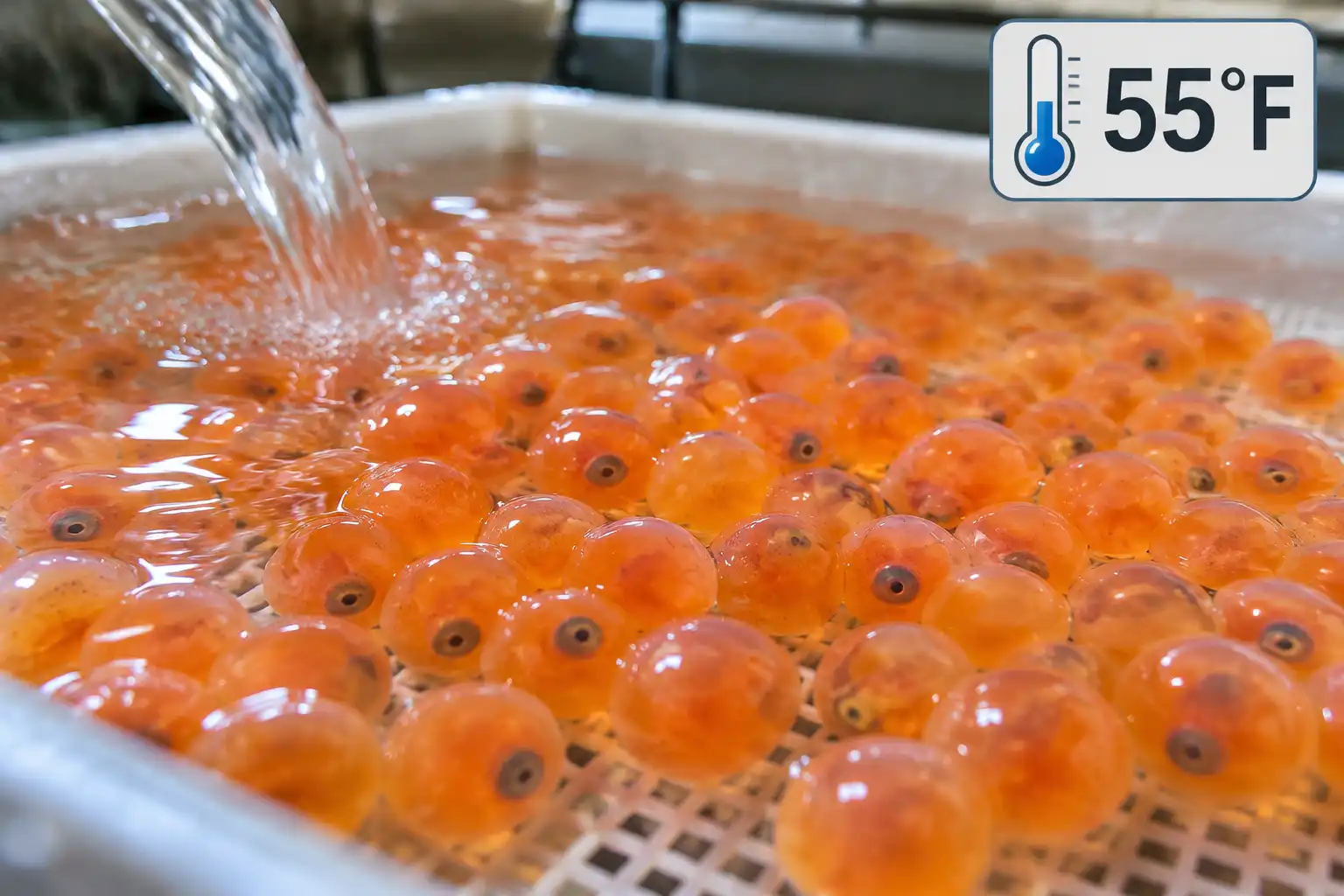
Rainbow trout eggs hatch about 3 weeks after fertilization at 55°F and about 7 weeks at 45°F, per SRAC Publication 220. Colder water slows development, so temperature sets the hatch date.
| Water temperature | Rainbow trout eggs: fertilization to hatch | Source |
|---|---|---|
| 39°F | About 100 days | FAO |
| 45°F | About 7 weeks | SRAC 220 |
| Upper 40s °F | About 7 weeks (wild redds) | Idaho Fish and Game |
| 55°F | About 3 weeks | SRAC 220 |
| 58°F | About 21 days | FAO |
The figures don’t line up perfectly. SRAC’s 45°F estimate and Idaho’s upper-40s estimate both land near 7 weeks. Meanwhile, FAO’s 39°F figure stretches past 3 months. Each comes from different water and strains, so use the table to plan a window, not a date.
Eyed eggs shipped to a farm hatch soon after they arrive. SRAC Publication 220 says rainbow trout eggs at 55°F hatch 4 to 7 days after arriving eyed. After that, a batch finishes hatching over 2 to 4 days.
Stage 2: Alevin, or Sac Fry
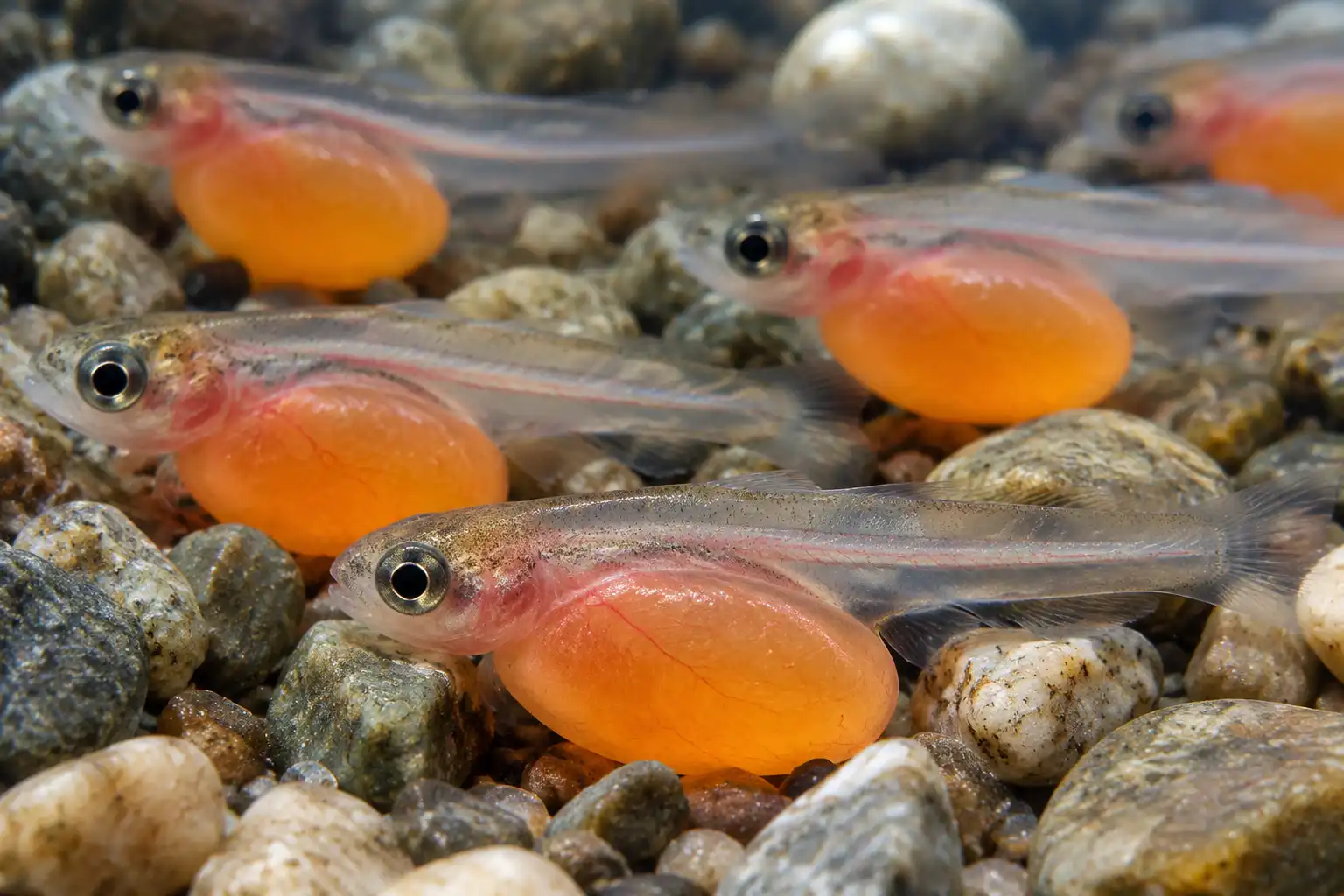
A newly hatched trout is an alevin, also called a sac fry. It carries a yolk sac on its belly and lives on that alone. FAO’s fact sheet says the rainbow trout yolk sac lasts 2 to 4 weeks.
In the wild, alevins stay hidden in the redd gravel. In a hatchery, SRAC Publication 220 says rainbow trout sac fry can stay in vertical trays until swim-up, about 10 to 14 days after hatching.
Water quality matters here, since alevins stay put in the gravel or the tray. SRAC 220 advises keeping dissolved oxygen for trout eggs and fry ideally no lower than 6 mg/L (6 ppm). It also notes that once hatching begins, eggs and sac fry should not be treated with any chemicals.
Stage 3: Fry and Swim-Up
A trout becomes a fry when its yolk is nearly used up and it rises to feed. SRAC Publication 220 puts rainbow trout swim-up about 2 weeks after hatching at 55°F. It advises starting feed once about half the fry have swum up.
First feeding takes close attention. Fry eat a fine starter feed spread on the water surface. SRAC 220 recommends feeding rainbow trout fry every 15 minutes if possible, and at least hourly.
Growth picks up quickly once fry eat. SRAC 220 says rainbow trout fry move to larger tanks at about 1 inch long, when they run about 1,000 fish per pound. Then the feed particle size steps up with them, from starter mash to granules, as covered in what trout eat at each size.
Stage 4: Fingerling, or Parr
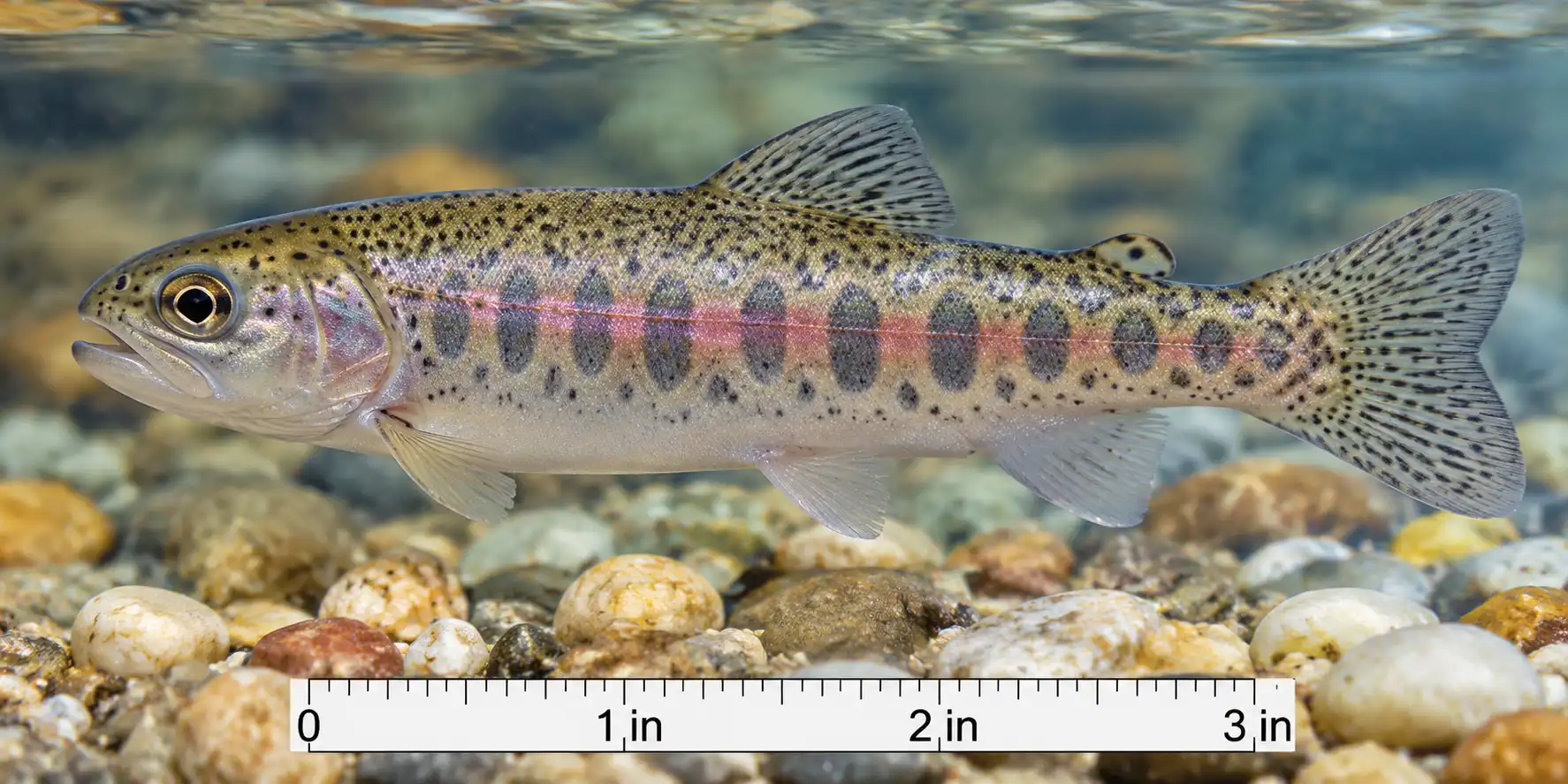
A fingerling is a young trout of about 1 to 6 inches, the fingerling class in USDA NASS sales reports. In the wild, the same fish is called a parr, after the dark oval marks along its sides.
Grow-out farms usually start from fingerlings. SRAC Publication 222 says rainbow trout go into grow-out tanks at about 3 inches. Earthen ponds, by contrast, take trout of 4 ounces or larger. FAO’s fact sheet moves rainbow trout fry outdoors at 3 to 4 inches, or about 113 fish per pound.
Grading starts at this stage. SRAC 222 says trout are usually graded about four times between fingerling stocking and market size, to keep sizes uniform. Also, bar graders work best on fish over 5 inches.
By value, the fingerling market is small. US farms sold about 3.04 million trout of 1 to 6 inches in 2025, worth about $1.02 million, per USDA NASS. The groundwork behind that stage is in the guide to raising fry to fingerling size.
Stage 5: Stocker, Food-Size Fish, and Spawning Adult
Past 6 inches, a farmed trout becomes a stocker, then a food-size fish. USDA NASS defines stockers as trout of 6 to 12 inches, usually under three-fourths of a pound. Food-size trout are 12 inches or longer and usually weigh three-fourths to 1.5 pounds.
Timing depends on water temperature and strain. FAO’s fact sheet says rainbow trout usually reach a marketable 12 to 16 inches within 9 months of grow-out. Some, however, stay over 20 months for larger sizes. The same sheet puts pan-size rainbow trout of about 10 to 14 ounces at 12 to 18 months. SRAC Publication 222 gives the same 12 to 16 inch market range.
Food-size fish carry the US industry. In 2025, farms sold 25.3 million trout of 12 inches or longer, worth $95.2 million, per USDA NASS. That was most of the $102 million in total trout fish sales.
Some adults are kept back as broodstock. FAO notes that rainbow trout can mature at 2 years, but hatcheries seldom spawn females before age 3 or 4. FAO also places rainbow trout spawning and growth at about 48 to 57°F. Then eggs from those females go back to the trays, and the cycle restarts.
Stage 6 for Steelhead: Smolt and the Ocean
Steelhead and rainbow trout are the same species, Oncorhynchus mykiss. NOAA Fisheries calls steelhead the anadromous form: fish that migrate to the ocean, then return to fresh water to spawn. Fish that stay in fresh water all their lives are rainbow trout.
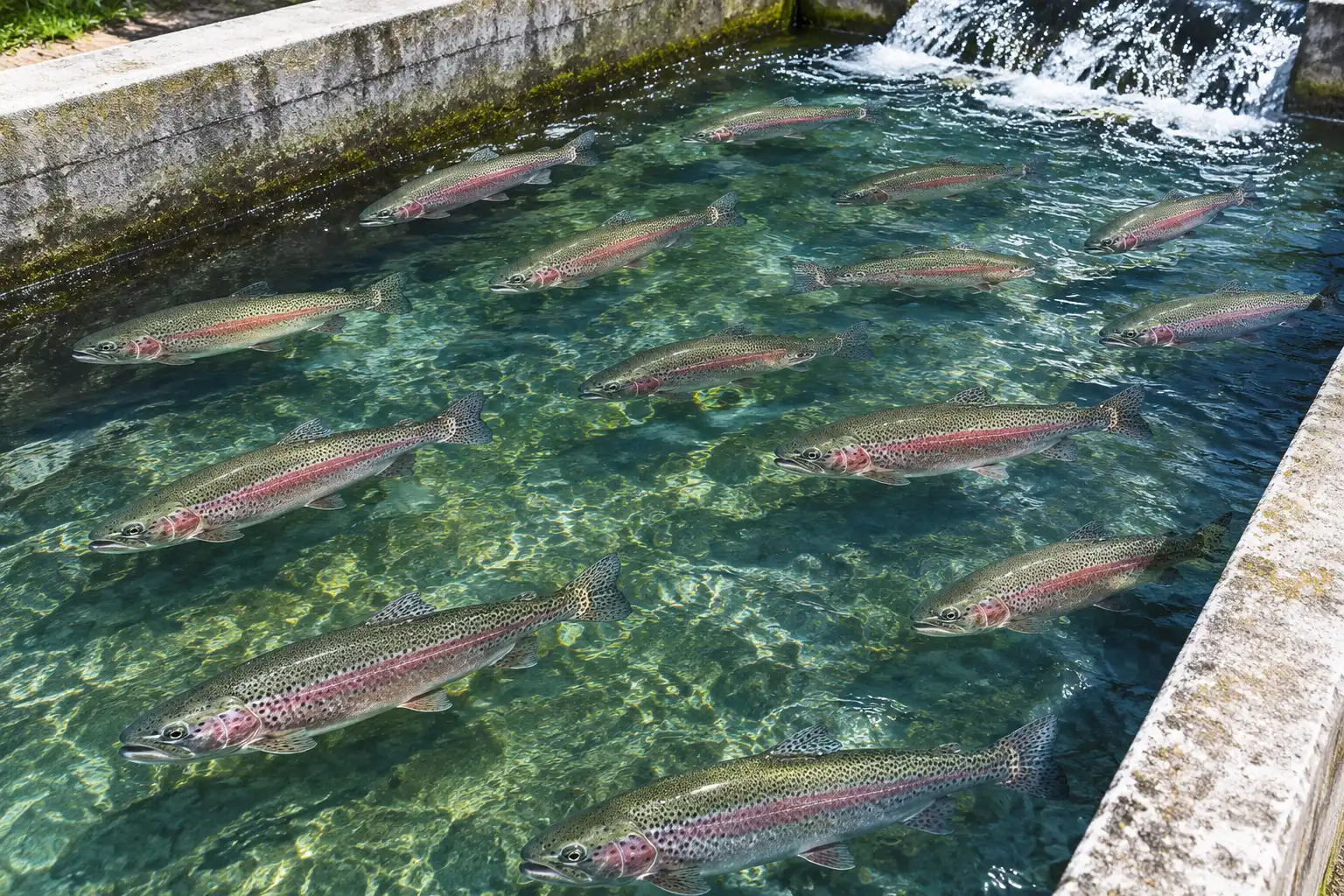
The extra stage is the smolt. Before heading to sea, a young parr turns silvery and loses its parr marks as it readies for salt water. At sea, steelhead grow larger than freshwater fish. NOAA Fisheries lists steelhead at up to about 30 pounds and 40 inches, living up to 11 years, usually 5 to 8.
Unlike most Pacific salmon, steelhead don’t always die after spawning. Instead, NOAA Fisheries notes that many return to the ocean and come back to spawn again in later years.
The steelhead strain also grows faster in culture. FAO’s fact sheet says it reaches 15 to 22 pounds within 3 years, while the freshwater rainbow trout strain reaches about 10 pounds in the same time. Several wild steelhead populations are protected under the Endangered Species Act, which is one more reason farmed trout must never reach public waters.
Rainbow Trout Life Cycle on a Farm: Stage Timeline
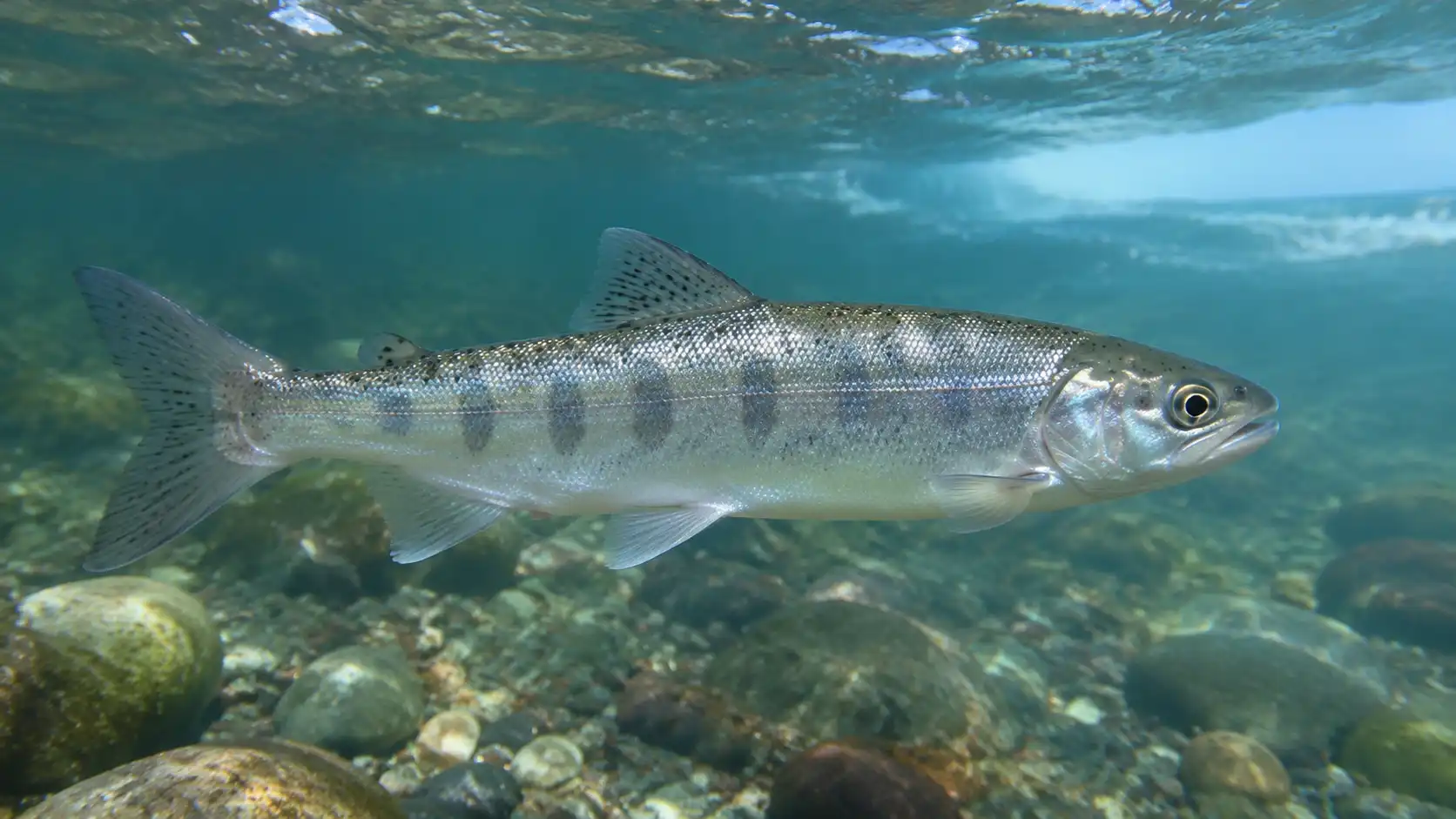
On a farm, a rainbow trout goes from egg to pan size in about 12 to 18 months, per FAO’s fact sheet. Water temperature sets the pace at every step.
| Stage | Rainbow trout size | Typical timing | Source |
|---|---|---|---|
| Egg | 0.12 to 0.28 inch | Hatches 3 to 7 weeks after fertilization at 55 to 45°F | SRAC 220 |
| Alevin | Yolk sac attached | Yolk lasts 2 to 4 weeks | FAO |
| Fry | 0.6 to 1 inch | Swims up about 2 weeks after hatching at 55°F | SRAC 220, FAO |
| Fingerling | 1 to 6 inches | Stocked into grow-out tanks at about 3 inches | USDA NASS, SRAC 222 |
| Stocker | 6 to 12 inches, under 3/4 pound | Sold for stocking or grown on | USDA NASS |
| Food-size | 12 inches or longer, 3/4 to 1.5 pounds | Within 9 months of grow-out; some over 20 months | USDA NASS, FAO |
| Broodstock | Mature females | Spawned at 3 to 4 years | FAO |
For farm planning, the fingerling to food-size stretch takes the most feed, water, and time. So that is where water supply decides what a farm can grow.
What Water Each Stage Needs
Rainbow trout need cold water at every stage, but the target shifts as they grow.
| Stage or condition | Rainbow trout temperature | Source |
|---|---|---|
| Egg incubation (published hatch timing) | 45 to 55°F | SRAC 220 |
| Spawning and growth | About 48 to 57°F | FAO |
| Best grow-out growth | 55 to 65°F | SRAC 223 |
| Growth stops | About 38°F and below | SRAC 223 |
| Severe heat stress begins | 70°F | SRAC 163 |
Two figures here answer two questions. SRAC Publication 223 gives 55 to 65°F as the best growing range for trout. FAO’s survival range for rainbow trout runs wider, about 32 to 81°F, but that is tolerance, not a target.
Oxygen matters just as much. SRAC 220 advises keeping hatchery water for trout eggs and fry at 6 mg/L (6 ppm) or more. Likewise, SRAC 222 says to cut trout loading in a raceway when outflow oxygen drops below 6 mg/L. Because oxygen arrives with the inflow, raceway layout and water flow set how many fish a farm can hold.
Carrying the Numbers to Your Raceway
SRAC Publication 222 gives a flow rule for trout: hold 0.5 to 1 times the fish’s length in inches, in pounds per gallon per minute (gpm). Here it is worked through for 12-inch food-size rainbow trout on a 300 gpm spring. The flow is your own number, so swap in yours.
- Pounds per gpm: 12 inches × 0.5 to 1 = 6 to 12 pounds per gpm.
- Fish weight the flow carries at one time: 300 gpm × 6 to 12 = 1,800 to 3,600 pounds.
- Raceway space: SRAC 222 notes many farmers cap density at 4.5 pounds per cubic foot. So 1,800 to 3,600 pounds needs about 400 to 800 cubic feet.
- Fish count: At 1 pound each, within the NASS food-size range, that is 1,800 to 3,600 trout.
- Fingerlings to stock: SRAC 222 says to allow about 10 percent loss. Divide by 0.9 to get about 2,000 to 4,000 fingerlings.
These figures assume inflow at full oxygen saturation. SRAC 222 says to cut capacity in proportion when it isn’t. At 85 percent saturation, for example, the same spring carries about 1,530 to 3,060 pounds.
The hatchery end works the same way. FAO’s fact sheet gives a typical 95 percent hatch, so 10,000 eggs yield about 9,500 rainbow trout fry. At about 1,000 fry per pound at 1 inch (SRAC 220), that is roughly 9.5 pounds of fry.
Where Trout Are Lost Across the Life Cycle
Disease is the biggest cause of loss on US trout farms. USDA NASS counted 9.93 million trout lost in 2025, and disease caused 82 percent of them. Predators came next, at about 851,000 fish.
If trout go off feed or start dying at any stage, check dissolved oxygen first. Low oxygen, gill problems, parasites, and bacterial disease can look alike from the raceway edge, and an oxygen reading takes minutes. Next, call your extension aquaculture specialist or a fish health diagnostic lab to confirm the cause before anything is treated. Heavy, unexplained losses may also need reporting to your state veterinarian or state aquatic animal health official.
Until the cause is known, keep fish where they are. Don’t move, sell, or release trout from a tank, raceway, or pond with unexplained losses. In addition, steady routines for biosecurity on a trout farm lower the odds of bringing disease in with new eggs or fingerlings.
Rules to Check Before You Buy Eggs or Fingerlings
Rainbow trout are native to the Pacific drainages of North America, per FAO, so states set their own rules on where they can be raised and stocked. First, check your state’s aquaculture license and species rules before you order.
Moving live eggs or fish across state lines often requires a fish health certificate or an import permit from the receiving state. So ask the seller for health inspection records, and confirm which ones your state accepts.
Never release farmed trout into public waters. It is often illegal, and escaped fish can carry disease into wild populations.
Larger farms face discharge rules too. Under EPA’s aquaculture NPDES rules, a coldwater facility such as a trout farm that discharges on 30 or more days a year needs a permit once it produces 20,000 pounds a year or feeds 5,000 pounds in its peak month. Most states issue these permits, so start with your state’s permitting office. EPA also notes that smaller farms may still need a permit in some cases.
FAQs on Life Cycle of a Trout
How long does a rainbow trout take to grow from egg to food size?
Pan-size rainbow trout of about 10 to 14 ounces are harvested after 12 to 18 months, per FAO’s fact sheet. Colder water stretches that time, and fish grown for larger markets can stay over 20 months.
What is the difference between an alevin and a fry?
An alevin still carries its yolk sac and doesn’t feed, while a fry has used up the yolk and started eating. In hatcheries, rainbow trout swim up as fry about 10 to 14 days after hatching, per SRAC Publication 220.
Do rainbow trout die after spawning?
No, rainbow trout can spawn more than once, unlike most Pacific salmon. NOAA Fisheries notes that many steelhead, the sea-run form, return to the ocean after spawning and come back to spawn again in later years.
At what age do rainbow trout start spawning?
Rainbow trout can mature at 2 years, but FAO’s fact sheet notes hatcheries seldom spawn females before age 3 or 4. Most rainbow trout spawn between January and May, while selected hatchery strains spawn year-round.
What size is a trout fingerling?
USDA NASS counts trout of 1 to 6 inches as fingerlings in its sales reports. Farms usually stock rainbow trout fingerlings into grow-out tanks at about 3 inches, per SRAC Publication 222.
How does water temperature change hatching time?
Colder water slows hatching. Rainbow trout eggs hatch about 3 weeks after fertilization at 55°F and about 7 weeks at 45°F, per SRAC Publication 220, while FAO gives about 100 days at 39°F.
Putting This Into Practice
Start with your water, not your fish. Log your spring or well temperature through a full year, and measure its flow in gallons per minute before you order anything. Those two numbers decide which stages you can raise and how many trout your raceways hold.
Then match the stage you buy to your setup. Eyed eggs need hatchery troughs and fry feeding at least hourly, while 3-inch fingerlings go straight into grow-out. For the wider picture of farming rainbow trout, from site to sale, the species guide is the next stop.